





From the HDT Archives (2018): There Must be a Business Case for New Truck Tech
Truck Platoon in Operation on I-70
A pair of tractor-trailers with automated truck platooning technology is now traveling Interstate 70 between Columbus, Ohio, and Indianapolis, Indiana, delivering shipments for Ease Logistics.
April 16, 2025
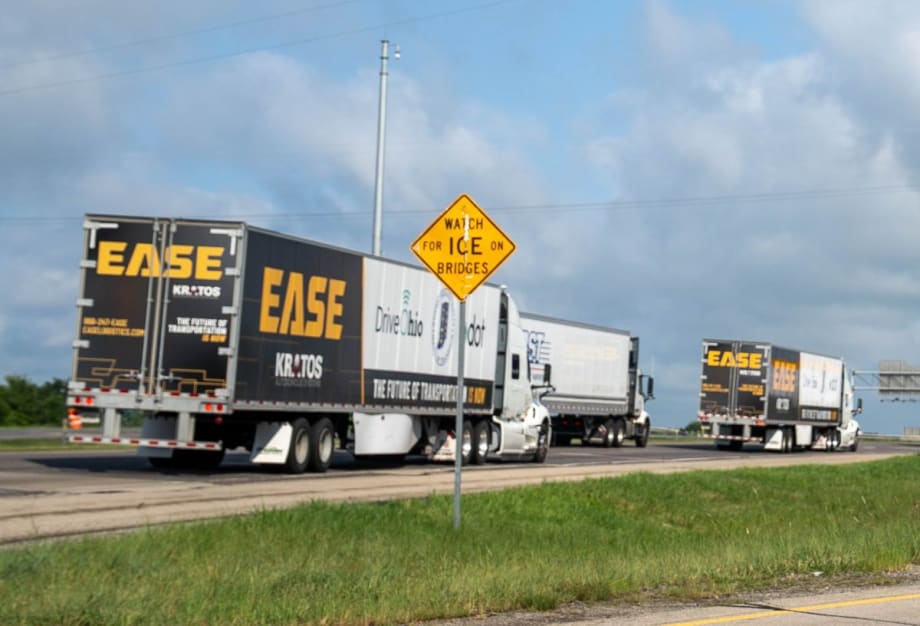
Because the follower truck travels at a closer distance than is typical, the trucks will have a purple light on the cab that is illuminated when they’re in platooning mode to alert law enforcement that they are digitally connected.
Photo: Drive Ohio
4 min to read
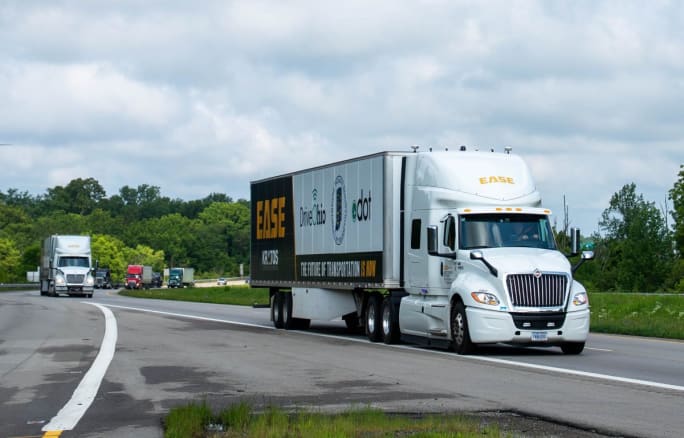
The Ease Logistics trucks are equipped with platooning technology provided by Kratos Defense.
Photo: Drive Ohio
A pair of tractor-trailers with automated truck platooning technology is now traveling Interstate 70 between Columbus, Ohio, and Indianapolis, Indiana, delivering shipments for Ease Logistics.
The project is a collaboration between the Ohio Department of Transportation DriveOhio initiative and the Indiana Department of Transportation to advance the adoption of truck automation technologies in the logistics industry across the Midwest.
While the majority of automated vehicle testing to date has been done in regions with warmer and more predictable weather, it’s crucial to assess technology performance in adverse weather conditions to deliver the safety benefits of this technology to residents in the Midwest, according to the Ohio DOT.
Peter Coratola Jr., CEO and founder at Ease Logistics, explained that it has used a “crawl/walk/run” strategy on this project, requiring drivers to complete 260 hours of intensive training to ensure they were fully prepared.
The project was first announced in 2023.
“Through projects like this, we’re not only advancing innovation — we’re helping establish Ease and our region as national leaders in transportation.”
What Happened to Truck Platooning?
At one time, major truck makers as well as startups were investing in truck-platooning development, touting improved fuel efficiency and safety, reduced stress on the driver in the following truck, and as a stepping-stone to fully autonomous vehicles with having one driver control two trucks.
However, companies such as Volvo Trucks North America and Daimler Trucks eventually dropped their platooning projects.
In 2018, Daimler Trucks North America's Martin Daum said in a speech that platooning might not be the holy grail, and by 2019 had officially said it would focus on autonomous technology rather than platooning.
In 2019, Hendrickson's Jeff Sass, who had previously worked for Navistar, told attendees at Heavy Duty Trucking Exchange, "I just don't see a place for platooning in our industry in the near future."
Later, truck-platooning startups such as Peloton and Locomation disappeared. Peloton ceased operations in 2021 and Locomation sold its AI autonomous trucking solutions business in 2023.
The technology behind the Ohio truck platooning project comes from a company that is adapting it from military use.
How Does the Ease Logistics Truck-Platooning Technology Work?
The Ease Logistics trucks are equipped with platooning technology provided by Kratos Defense. This technology electronically links the two vehicles and allows the driver of the lead vehicle to control the speed and direction of the second truck, enabling it to precisely follow the path of the leader.
During portions of the I-70 trips, the follower truck will automatically steer, accelerate, and brake.

The trucks are also equipped with cameras and sensors for object detection that enable the following vehicle to automatically adjust its speed, or stop, if another vehicle or object moves in between the trucks.
Source: Drive Ohio
Professional drivers will be in the driver’s seat of both trucks throughout the deployment and can turn off the technology system and take over if needed.
The trucks are also equipped with cameras and sensors for object detection that enable the following vehicle to automatically adjust its speed, or stop, if another vehicle or object moves in between the trucks.
Because the follower truck travels at a closer distance than is typical, the trucks will have a purple light on the cab that is illuminated when they’re in platooning mode to alert law enforcement that they are digitally connected.
Military Technology Adapted for Truck Platooning
“At Kratos, we have adapted advanced automated truck platooning technology — originally developed for the U.S. military — to address critical challenges facing commercial logistics, agriculture, energy, and mining sectors, all vital to national security.” said Maynard Factor, VP of Business Development at Kratos Defense.
“This project offers a real-world opportunity to demonstrate how proven automated driving systems can increase safety, strengthen supply chain resilience, and ensure economic vitality.
“Operating along the I-70 corridor between Ohio and Indiana enables us to showcase performance in complex, all-weather conditions essential to Midwest freight operations and accelerates readiness for broad adoption. This marks a significant step forward in bringing scalable, next-generation automation to the industries that keep the nation moving.”
Ohio’s Truck Automation Project
Funded in part by a grant from the U.S. Department of Transportation, this multi-year $8.8 million project aims to deploy varying levels of automation and integrate these technologies into truck fleets’ daily freight-hauling operations.
“Unlike human drivers, automated vehicles do not drive impaired, text while driving, fall asleep at the wheel, or recklessly speed,” said Ohio State Highway Patrol Captain Chris Kinn.
“The goal of this technology is to take the human error out of the safety equation.”
Later this year, ODOT and INDOT will release a Request for Proposals for additional deployments of automated trucks in Ohio and Indiana.
More Safety & Compliance

FMCSA Pauses Biennial-Update Enforcement Amid Motus Transition
Carriers whose updates were due on or after June 1 have more time, while FMCSA works to stabilize its new registration system and warns of phishing sites impersonating its new carrier registration system, Motus.
Read More →
ZF Expands Commercial Vehicle Push in North America
ZF is expanding its North American commercial-vehicle presence with new transmission applications, electrification, trailer technology and autonomous-driving systems.
Read More →
Truck Drivers Need More Than Another Alert
Fleets have more visibility into truck health, safety events, and driver activity than ever. The next challenge is turning all that information into useful guidance for the person who has to decide what to do next.
Read More →
Tesla Wants a Self-Driving Semi. Are Cameras Enough?
Could Tesla’s camera-only autonomous driving technology work on an 80,000-pound Semi? In this commentary, HDT's Deborah Lockridge takes a look at Tesla, Cybercab, and how autonomous trucks see the road.
Read More →
What DOT’s Automated Vehicle Strategy Means for Trucking
The U.S. Department of Transportation issued a new automated-vehicle strategy that outlines plans for driverless-truck regulations, cross-state freight corridors, and federal safety standards.
Read More →
NYC Expands Speed, Pedestrian Safety Tech Across Fleet
New York City is expanding intelligent speed assistance and pedestrian-alert systems across its municipal fleet, moving the technologies from pilot programs into vehicle procurement and retrofit requirements.
Read More →
FMCSA Removes 110 Truck Driver Training Schools from Certified ELDT List
Federal regulators also are targeting more than 160 additional training providers and launching a nationwide audit of third-party CDL skills testers as part of a broader crackdown on trucking fraud.
Read More →
Beyond DOT Compliance: What Makes a Trucking Fleet Truly Safe?
A trucking fleet can follow every rule and still make unsafe decisions. The real test comes when safety conflicts with freight, productivity, or cost.
Read More →
Hours of Service Pilot Programs: FMCSA Readies for 2027 Rollout
Two pilot programs could eventually reshape hours-of-service rules, giving truck drivers options to pause their 14-hour clock or use longer split sleeper rest periods.
Read More →
New Guide Offers Pet Safety Tips for Truck Drivers
Hundreds of thousands of pets travel in truck cabs. A new safety guide from Volvo Trucks and the Center for Pet Safety offers practical advice for truck drivers who bring dogs and cats along for the ride.
Read More →