




Commentary: There Must be a Business Case for New Truck Tech
There has to be a business case for fleets to invest in new tech like platooning and electric trucks - a benefit in terms of safety, efficiency, or other factors that eventually will go to the bottom line. Commentary by editor in chief Deborah Lockridge.

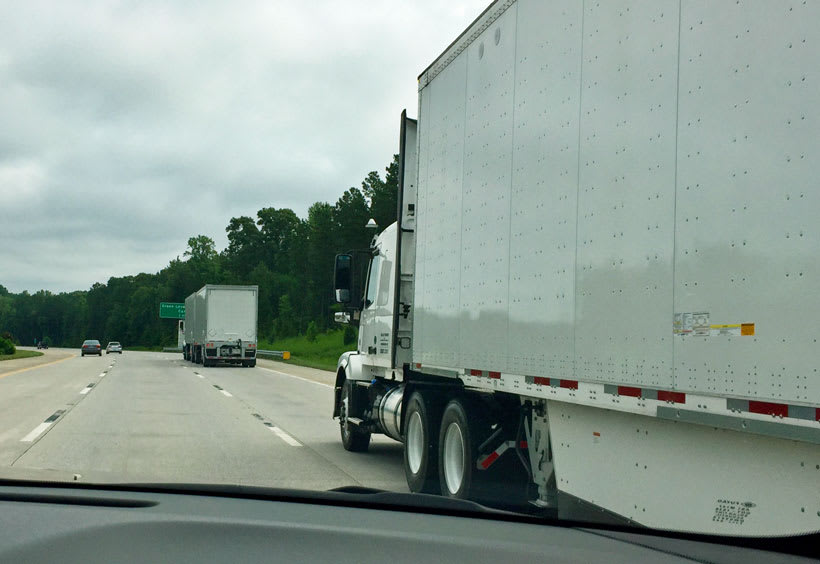
Manufacturers need to make a business case for fleets to invest in new technologies like platooning, seen here in a demonstration by Volvo Trucks North America.
Photo: Deborah Lockridge
Does building a better mousetrap really mean the world will beat a path to your door? That depends on whether your definition of “better” is the same as that of those who buy mousetraps.
This summer, truck makers and suppliers have been showing off their research into near- and far-future endeavors such as electric trucks, platooning, and automated vehicle technologies. I’m going to focus here on two trips I was on, with Daimler Trucks North America and Volvo Trucks North America, but there are plenty of other companies engaged in such efforts, too.
It’s all very exciting to cover. Yet at this point, there are more questions than answers about much of this technology. That’s something that might not be so evident in tech and mainstream media coverage where the reporters (and sometimes the startup companies they’re covering) don’t really have a grasp on the daily realities of trucking.
Take platooning, for instance, where vehicle-to-vehicle communication allows trucks to follow each other extremely closely for fuel savings and safety benefits. During Daimler and Volvo demonstrations in June, officials with both companies stressed that they are working with customers to determine the real-world use cases and challenges.

"Unlike consumers, trucking fleets don’t buy a Tesla just for the flashiness or 'coolness' of it. Or even just for the environmental benefits," says HDT's Deborah Lockridge.
Photo: HDT File
And that means a lot of questions still need to be answered. How much fuel can be saved? What are the safety benefits? What’s the effect on the drivers in a platoon? What happens if a truck needs to leave a platoon to pull into a weigh station or for a restroom break? What happens if you need to move over for a vehicle stopped on the side of the road? What are the logistics of actually having two or three trucks travel together? Will the technology work in adverse weather conditions or snow? What about the legal aspects regarding following distances?
Then there are electric trucks. Daimler and Volvo are both putting heavy-duty pre-production models into customer hands for evaluation, Volvo in Europe and Freightliner working with Penske and NFI on the West Coast. The question isn’t whether these companies can make an electric truck that works; it’s how they can do it in a way that makes sense for customers.
And that, truck makers say, is something that some of the startups don’t seem to understand. Unlike consumers, trucking fleets don’t buy a Tesla just for the flashiness or “coolness” of it. Or even just for the environmental benefits. There has to be a business case for these investments, a benefit in terms of safety, efficiency, or other factors that eventually will go to the bottom line.
And all these points go double when it comes to automated vehicle technologies, which these truck makers are researching as well. Daimler announced it’s creating an Automated Truck Research and Development Center. Volvo is testing autonomous trucks in operations such as refuse, and in contained areas such as mines and crop fields.
They emphasize it’s early, and that they see automated technologies not as a replacement for drivers in most operations, but as something that works in partnership with drivers to make them safer, more efficient, and more productive.
This is a pretty big contrast to startup autonomous truck efforts that have touted totally “driverless” trucks. Two years ago, Anthony Levandowski, at the time co-founder of the autonomous trucking startup Otto, predicted the advent of trucks that don’t need seats, windshields or HVAC, and that could operate nearly 24/7 without worrying about driver hours of service or fatigue.
The good thing is that the media coverage of these flashy startups has helped portray an image of trucking as cutting-edge and high-tech, something that can help as the industry works to attract new talent everywhere from the shop floor to the board room.
However, truck makers like Daimler and Volvo understand that it’s one thing to build a truck that can platoon, or run on electricity, or even drive itself – but if the technology doesn’t work for their customers’ business, it doesn’t matter how much “buzz” it generates.
Related: Volvo Trucks, FedEx Demonstrate Truck Platooning in North Carolina
More Fleet Management

Color Match Smarter: Tools That Restore & Perform
For fleet managers and collision repair professionals keeping heavy-duty trucks on the road, getting the color right the first time isn't just about appearance — it's about efficiency, turnaround time, and bottom-line results. Discover how today's digital color tools are transforming the repair process from guesswork to precision.
Read More →
FMCSA Pauses Biennial-Update Enforcement Amid Motus Transition
Carriers whose updates were due on or after June 1 have more time, while FMCSA works to stabilize its new registration system and warns of phishing sites impersonating its new carrier registration system, Motus.
Read More →
2026 Blueprint for Countering Smarter Supply Chain Theft
Cargo theft is no longer just the cost of doing business. It's a multi-billion-dollar criminal enterprise exploiting vulnerabilities across your fleet, drivers, and supply chain.
Read More →


How Telematics Improves Visibility, Control, and Performance in Refrigerated Fleets
Explore how telematics help refrigerated fleets improve visibility, uptime, efficiency, compliance, and cargo protection across connected cold chain operations.
Read More →
What the U.S.-Canada Trade War Means for Trucking
Escalating U.S.-Canada tariffs could disrupt cross-border freight, reduce truck volumes, raise costs, and create new uncertainty for carriers on both sides of the border.
Read More →
What Are Trucking’s Top Concerns for 2026?
The American Transportation Research Institute wants to know what's worrying trucking fleet managers, drivers, and other stakeholders in its annual Industry Issues survey.
Read More →
American Trucking Associations Looks for a New Leader
ATA President and CEO Chris Spear abruptly left his job at the association on August 21, at a pivotal time for the trucking industry.
Read More →
Public Wi-Fi Cybersecurity Risks: How Truck Drivers and Fleets Can Protect Their Data
Public Wi-Fi can expose truck drivers and fleets to credential theft, malware, and other cyber threats. Here’s how to reduce the risk on the road.
Read More →
For Nicky Cupp, Fleet Innovation Starts With Frustration
HDT Truck Fleet Innovator Nicky Cupp turns everyday pain points at Fraley & Schilling into opportunities for better technology and smarter processes.
Read More →
Adam Buttgenbach’s Approach to Electric Trucks: Start With Where They Fit
HDT Truck Fleet Innovator Adam Buttgenbach helped PepsiCo build one of North America’s largest EV fleets by focusing on where electric trucks make operational sense.
Read More →