




Volvo Trucks, FedEx Demonstrate Truck Platooning in North Carolina
Volvo Trucks North America teamed up with FedEx and the North Carolina Turnpike Authority for an on-highway demonstration of its truck platooning technology on N.C. 540, the Triangle Expressway.

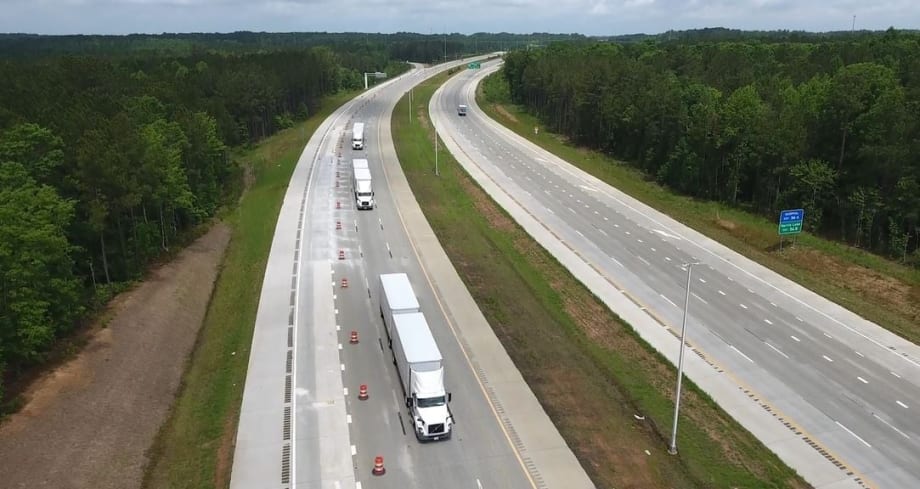
Volvo Trucks North America and FedEx are collaborating on a project testing three-truck platooning with different trailer configurations on an 18-mile stretch of North Carolina turnpike.
Photo courtesy Volvo Trucks North America
Volvo Trucks North America teamed up with FedEx and the North Carolina Turnpike Authority for an on-highway demonstration June 27 of its truck platooning technology on N.C. 540, the Triangle Expressway. It’s the first such demo we’re aware of in the U.S. to actually involve a trucking transportation provider and is part of a highway testing project that’s been ongoing since April. It’s also the first demonstration we’ve seen here of a three-truck platoon. and the first with twin trailers.
The platoon consisted of three trained, professional Volvo test fleet truck drivers in Volvo VNL tractors, each pulling double 28-foot FedEx trailers. Through Volvo’s Cooperative Adaptive Cruise Control, a wireless vehicle-to-vehicle (V2V) communication technology, the tractors and trailers remained in constant communication. They traveled at speeds of up to 62 mph while keeping a time gap of 1.5 seconds, maintaining a closer distance – approximately 132 feet – than what is typical for on-highway tractors. Staged and unplanned vehicle cut-ins demonstrated how the technology handles common traffic situations.
When trucks can drive closely behind one another, fuel efficiency is improved as a result of reduced drag. Drag accounts for up to 25% of a truck’s total fuel consumption, and the closer the trucks drive to each other, the greater the fuel-saving potential. Reducing the traveling distance between vehicles also allows for greater highway utilization, helping with traffic congestion.
N.C. 540 was chosen due to its proximity to Volvo Trucks’ North American headquarters and its designation as a proving ground for advanced vehicle technology. It’s one of 10 locations around the country that the U.S. Department of Transportation has designated for demonstrating advanced vehicle technologies, like platooning, through research initiatives such as this one.
Since April 2018, three Volvo VNL tractors have been paired with various combinations of FedEx trailers to simulate real-world routes and trailer loads while traveling on N.C. 540. The potential benefits of platooning that are being studied during this collaborative research include faster responses to hard braking while maintaining safety and fuel efficiency. Volvo engineers started working on developing the test trucks last fall.
More on Volvo’s Platooning Technology
The vehicle-to-vehicle communication system helps reduce the reaction time for braking and enables vehicles to follow closer, automatically matching each other’s speed and braking. The advanced technology is meant to serve as an aid – not a replacement – for skilled professional truck drivers, Volvo emphasized.
In the trucks, a tablet showed the status of the platoon. (We were not allowed to photograph it.) In real-world situations, drivers would have a touch screen that would give them status and also allow them to do things like manage the gap.
Keith Brandis, VTNA vice president for product planning, explained that of the five levels of vehicle automation defined by the Society of Automotive Engineers, we’ve been working with level 1, cruise control, for many years. “We have a lot of our standard safety systems on board, to which we’ve added the Adaptive Cruise Control, and we’ve put a layer on top of that of technology from our global platforms for Cooperative Advanced Cruise Control.”
Vehicle-to-vehicle technology allows the trucks to “talk” to each other and is key to platooning.

Coming up alongside second truck in platoon in car that will cut in between the two trucks to show how the system responds to traffic.
Photo: Deborah Lockridge
“Volvo’s V2V technology is based on Dedicated Short-Range Communication (DSRC) radio, which has proven its capability to perform well in the V2V environment," said Keith Brandis, Volvo Trucks North America vice president for product planning. “Dedicated bandwidth within the 5.9GHz spectrum is critical for the successful deployment of V2V applications like truck platooning.”
However, he explained to HDT, the Federal Communications Commission wants to be able to sell that bandwidth. Volvo, the American Trucking Associations and others have been urging the FCC to reserve that bandwidth for these automated truck technologies.
The technology development also is being done in conjunction with Volvo’s global engineering expertise. Parent company Volvo Trucks has done platooning demonstrations and research in Europe, as well as piloting automated trucks in applications such as mining, agriculture, and refuse.
“How do we take the various technologies and bring them to this market on our trucks?” Brandis told reporters, pointing out that there are differences in factors such as speed, weight, roads, load characteristics, and regulatory environments. “All of those things we’re adapting for this market.
The trucks for the demonstration were equipped with DRSC antennas atop each window, allowing for line of sight communication. They also each had an additional radar sensor in the front bumper and a camera mounted in the windshield to collect data.
The Future for Truck Platooning
Volvo Trucks and FedEx plan to continue developing the Volvo CACC technology on N.C. 540 into the foreseeable future, with the goal of continuing to learn about the potential benefits offered by vehicle platooning. This advanced testing will allow the participants to adapt to the technological and regulatory developments that will ultimately determine the commercial viability of platooning technology in the United States, Volvo noted.
Brandis explained to reporters that the trucks are equipped with extra data gathering equipment. “As we get miles on these trucks we will take video and data link of the various applications we’re going to be demonstrating, so we can take a step wise approach to build the future generations of software and components and sensors we’re going to need.”
“Volvo Trucks has long supported platooning because it benefits freight companies and professional drivers alike through safer, more fuel-efficient operations,” said Per Carlsson, acting president of Volvo Trucks North America. “We continue preparing for deployment of trucks with greater vehicle-to-vehicle communication capabilities that support higher levels of [advanced driver assistance systems]. We know these technologies will be part of our future, but exact timing depends on many things, namely regulations, infrastructure, safety standards, and market demand.”
Watch this video for more on Volvo's platooning tests
Click here for a photo gallery
Related: Truck Platoons on the Horizon?
More Equipment

How Volvo Updated Its D13 for EPA 2027 [Watch]
Volvo’s updated D13 promises lower emissions without sacrificing performance or fuel economy. Take a closer look at what changed inside the engine in this HDT Spotlight video.
Read More →
Michelin Tire Improves Efficiency and Durability for Regional Fleets
The Michelin X Multi Energy D2 is a regional haul drive tire engineered to help fleets improve fuel efficiency, durability and traction in demanding stop-and-go operations.
Read More →
ZF Expands Commercial Vehicle Push in North America
ZF is expanding its North American commercial-vehicle presence with new transmission applications, electrification, trailer technology and autonomous-driving systems.
Read More →
Tesla Wants a Self-Driving Semi. Are Cameras Enough?
Could Tesla’s camera-only autonomous driving technology work on an 80,000-pound Semi? In this commentary, HDT's Deborah Lockridge takes a look at Tesla, Cybercab, and how autonomous trucks see the road.
Read More →
Kodiak: Driverless Long-Haul Truck Launch on Track for 2026
Kodiak AI says its driverless long-haul safety case is 93% complete and it remains on track to begin commercial operations by year-end 2026.
Read More →
What DOT’s Automated Vehicle Strategy Means for Trucking
The U.S. Department of Transportation issued a new automated-vehicle strategy that outlines plans for driverless-truck regulations, cross-state freight corridors, and federal safety standards.
Read More →
East Coast Port Launches $45M Electric Truck Push
The Port Authority of New York and New Jersey announced millions in incentives for zero-emission drayage trucks, yard tractors, and new charging hubs near the port.
Read More →
PlusAI Going Public to Fund Autonomous Truck Launch
A SPAC deal could provide PlusAI with up to $300 million as it works toward a 2027 commercial launch of factory-built autonomous trucks.
Read More →
NHTSA Moves to Rewrite Truck Fuel-Economy Rules
The National Highway Traffic Safety Administration says it lacks authority to regulate medium- and heavy-duty truck engines separately from complete vehicles, but the existing standards have not yet been eliminated.
Read More →
Detroit Opens Orders for EPA 2027 Engines
Detroit isn’t starting from scratch to meet EPA 2027 diesel emissions standards. Its Gen 6 DD13 and DD15 engines keep much of today’s platform while updating the fuel and aftertreatment systems.
Read More →