




Schneider eCascadias Log 6 Million Emission-Free Miles
Schneider National has reduced CO2 emission by 20 million pounds since the company started using electric trucks — equivalent to removing more than 2,100 gasoline-powered passenger vehicles from the road for one year.

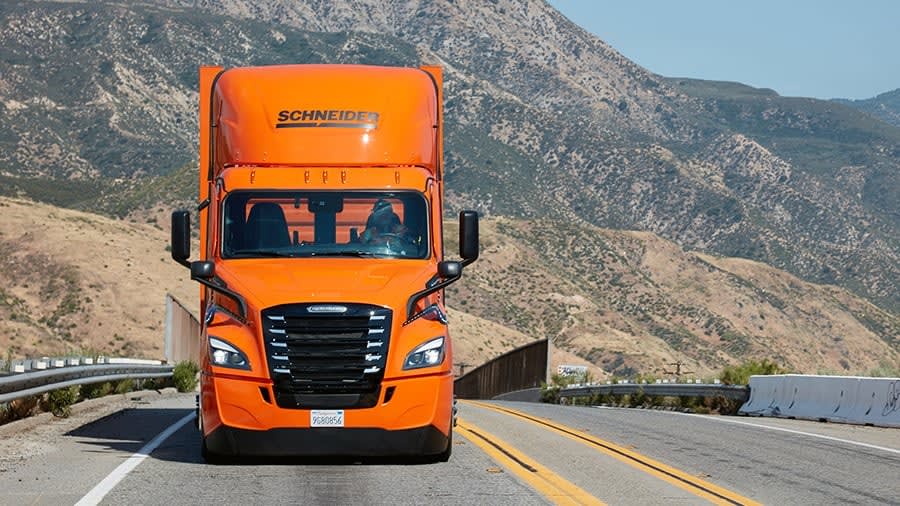
Schneider operates one of the largest BEV fleets in North America, which includes nearly 100 Freightliner eCascadias.
Photo: Schneider National
Schneider National is marking another significant zero-emissions milestone. The company announced that its battery electric vehicle (BEV) fleet has surpassed 6 million zero-emission miles, highlighting its commitment to reducing carbon emissions and advancing cleaner transportation.
The milestone means Schneider has cut 20 million pounds of carbon dioxide (CO2) emissions since the company started using BEVs — equivalent to removing more than 2,100 gasoline-powered passenger vehicles from the road for one year.
Schneider operates one of the largest battery-electric truck fleets in North America, which includes nearly 100 Freightliner eCascadias from Daimler Truck North America.
To power its electric fleet, the company operates a large charging depot at its Southern California Operations Center in South El Monte. The depot features 16 350 kW dual-corded dispensers, allowing the company to charge 32 trucks simultaneously.
“Schneider is a great example of the kind of forward-thinking entrepreneurship our industry needs,” said David Carson, senior vice president, sales and marketing at DTNA.
“They’ve achieved over 6 million zero emission miles, which is a reminder for us all to keep working on overcoming challenges together on the path to zero emissions."
Schneider's Electric Trucks Offer Benefits for Customers and Drivers
Schneider said it has established aggressive sustainability goals and invests in energy-efficient equipment.
“Reaching 6 million zero emission miles is a testament to our steadfast dedication to sustainability and innovation,” said Schneider President and CEO Mark Rourke. “Leading the way in adopting electric vehicle technology not only benefits the environment but also serves as an example of the broad service capabilities and flexibility we can offer to customers.”
These efforts also support customers in meeting their own sustainability ambitions, and the electric-truck fleet has been a key differentiator for customers looking for more efficient transportation solutions.
In 2023, Schneider said it was the first third-party carrier to haul zero emission shipments for PepsiCo globally, traveling more than 31,000 zero-emission miles in a few short months.
"PepsiCo is proud to celebrate this milestone driven by Schneider in California. As the first partner using their electric fleet, we’ve demonstrated the power of cross-industry collaboration in reducing emissions. Together, we are working towards a cleaner, healthier environment," said David Allen, vice president and chief sustainability officer, PepsiCo Foods North America.
Schneider drivers have also embraced the electric trucks because of the excellent on-road experience. The feedback has been overwhelmingly positive, with drivers appreciating the smooth ride, reduced engine noise and ease of steering.
“Once you drive an electric truck, you won’t want to go back to a diesel truck,” said longtime Schneider driver Marty Boots. “The ride quality and the quietness make a huge difference in our daily operations.”
The eCascadias primarily operate in Southern California, where they have significantly reduced emissions and contributed to cleaner air quality while transporting freight and getting ahead of the state's Clean Trucks Act and Clean Fleets Act regulations.
How Grants Helped Schneider Scale its Electric Truck Fleet
Schneider's fleet was made possible through a number of grants from organizations such as California Air Resources Board and the California Energy Commission’s Joint Electric Truck Scaling Initiative (JETSI), with additional support from the South Coast Air Quality Management District (AQMD).
Fifty of Schneider’s 92 eCascadias were made possible by the JETSI — a California-wide initiative working to reduce greenhouse gas emissions, strengthen the economy, and improve public health and the environment, particularly in disadvantaged communities.
Of the additional 42 trucks, five are jointly funded by the U.S. EPA FY18 Targeted Airshed Grant and Hybrid and Zero-Emission Truck and Bus Voucher Incentive Program (HVIP), seven are funded by the Volkswagen Environmental Mitigation Trust and 30 trucks are funded by HVIP.
Schneider's goal is to reduce CO2 emissions by 7.5% per mile by 2025 and achieve a 60% reduction in CO2 emissions per mile by 2035, extending its sustainability efforts beyond its electric fleet with a broader commitment throughout the industry.
The company is exploring a variety of solutions to reduce carbon emissions in addition to electric trucks, such as renewable natural gas and hydrogen internal combustion engines.
Additionally, all of Schneider’s non-electric tractors currently use a mixture of biodiesel — a renewable alternative made from organic waste such as vegetable oil and animal fats — and conventional diesel, reducing traditional diesel consumption.
More Fuel Smarts

How Volvo Updated Its D13 for EPA 2027 [Watch]
Volvo’s updated D13 promises lower emissions without sacrificing performance or fuel economy. Take a closer look at what changed inside the engine in this HDT Spotlight video.
Read More →
Diesel Price Spike Shortens Payback for Natural Gas Trucks, Report Says
Energy Vision estimates fleets could recover the higher purchase price of an RNG-fueled Class 8 tractor in 1.3 to 2.8 years under current fuel-price scenarios.
Read More →
Calstart Becomes Catalyst Mobility, Reflecting Broader Focus
Calstart is now Catalyst Mobility, reflecting the nonprofit’s growing national role in clean transportation, including zero-emission trucks, infrastructure and incentive programs.
Read More →

Record Diesel Prices Squeeze Trucking Fleets
Average U.S. diesel prices have climbed to nearly $6 a gallon, surpassing the 2022 record as tight refinery capacity and Middle East disruptions keep fuel costs elevated.
Read More →
How Fuel Delivery Shapes Engine Performance
Fuel delivery depends on more than what happens at the injector. For fleet, maintenance and technical professionals, looking at the full path from pump to injector can provide useful context for understanding engine performance.
Read More →
East Coast Port Launches $45M Electric Truck Push
The Port Authority of New York and New Jersey announced millions in incentives for zero-emission drayage trucks, yard tractors, and new charging hubs near the port.
Read More →
California Bill Could Shed Light on Electric Truck Prices
Why do battery-electric Class 8 trucks remain so expensive? A California bill headed to Gov. Gavin Newsom would give fleets and state agencies more visibility into what manufacturers charge.
Read More →
Detroit Opens Orders for EPA 2027 Engines
Detroit isn’t starting from scratch to meet EPA 2027 diesel emissions standards. Its Gen 6 DD13 and DD15 engines keep much of today’s platform while updating the fuel and aftertreatment systems.
Read More →
Zero-Emission Truck Corridor Planned for West Coast
California, Oregon, Washington, British Columbia and Baja California are coordinating plans for truck charging and hydrogen fueling from Canada to Mexico.
Read More →
A Closer Look at Kenworth’s Electric T880E Vocational Truck [Video]
Learn more about Kenworth's T880E battery-electric vocational truck at the Paccar Technical Center, including its range, applications, upfitting considerations, and PTO options, in this HDT Spotlight video.
Read More →