




Study Group Issues Autonomous Truck Guidelines
Almost four years in the making, a study group led by the Virginia Tech Transportation Institute has issued a set of best practices to help guide the widespread adoption of autonomous trucks in North America.

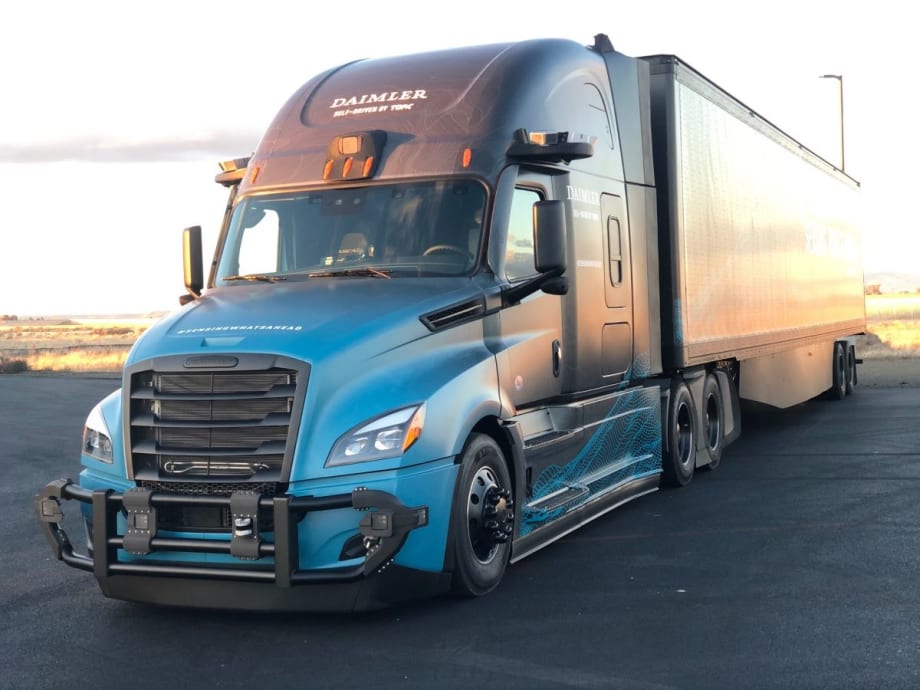
As the autonomous age dawns in trucking, VTTI has led a four year study to determine best practices as these trucks become operational.
Photo: Daimler Trucks North America
After four years, a guidebook for the future of autonomous trucking has driven across the finish line. In 2020, the Virginia Tech Transportation Institute (VTTI) and 17 partners were awarded a $7.5 million grant from the U.S. Department of Transportation to develop a concept of operations.
The final report, published in July, includes best practices for the implementation of automated driving systems (ADS) in large trucks and policy issues for fleets to consider across eight topic areas.
8 Key Operational Issues
“We’re excited that the Federal Motor Carrier Safety Administration's grant to the Virginia Tech Transportation Institute for the Fleet Concept of Operations exceeded the grant requirements for both activities and matching contributions,” said Tom Kelly, the Federal Motor Carrier Safety Administration's technical point of contact for the grant. “They accomplished their goal to demonstrate several different concepts of potential ADS truck applications and research key operational issues such as insurance, roadway readiness, and fleet safety management practices. All of this culminated in a ‘playbook’ for trucking fleets considering ADS operations in the future. In addition to the research findings, the grant created a publicly available data set containing thousands of miles of ADS operations data.”
The guidelines focus on eight topic areas:
Fleet specifications
System installation and maintenance guide
ADS inspection procedures
Drive state monitoring
Motor carrier guide to insuring automated driving system-equipped trucks
Identification of automated driving system-equipped truck safety metrics and variables
Road readiness assessment system
Data transfer and cybersecurity best practices
Fleet Concept Operations
The guidelines were just one outcome of the work, known as the Fleet of Concept Operations project (CONOPS), which also included four other goals:
Observe and report on practices related to safely integrating automated driving system-equipped trucks into the U.S. on-road transportation system.
Collect data to support the modernization of regulations by the U.S. Department of Transportation.
Demonstrate the integration of automated driving system-equipped trucks in a productive, cooperative way into existing road freight ecosystems.
Collaborate with government entities, university and research institutes, trucking associations, and private partners.
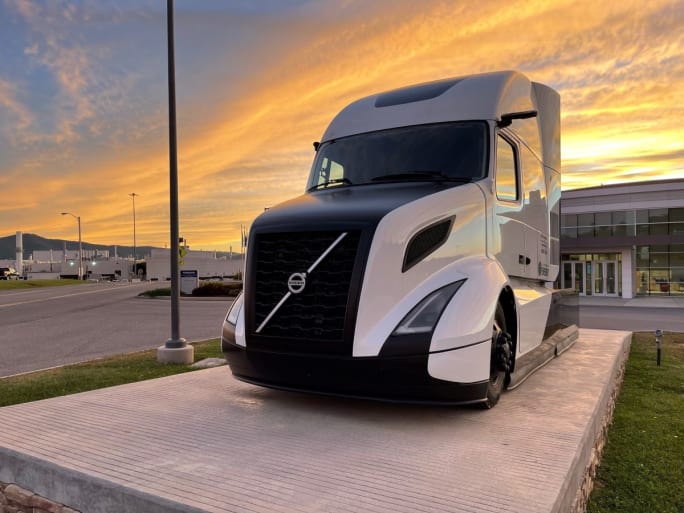
Future truck designs will feature enhanced degrees of autonomous functions, according to Volvo engineers.
Photo: Jack Roberts
“The goal of the CONOPS project was to provide the trucking industry with guidelines on how to safely implement, integrate, and benefit from automated driving system-equipped trucks," said Rich Hanowski, director of the division of freight, transit, and heavy vehicle safety at VTTI. “The research conducted, including the on-road demonstrations, provides new insights and examples of successful deployments that fleets interested in integrating ADS can emulate."
To accomplish these four goals and develop the eight guidelines, the research team conducted in-the-field operational use cases, organized a variety of demonstrations and public outreach activities, and developed a Dataverse.
Operational Use Cases
The primary source of data collection was three operational use cases in which an automated driving system-equipped truck would be beneficial:
A five-day deployment at the Port of Oakland in California
A team completing five cross-country road trips with an automated driving system-equipped truck, totaling more than 15,000 miles
An evaluation of drivers’ actions when a vehicle is operating in an autonomous function in Whitter, Alaska, and an analysis of other ways autonomous functions could improve the supply chain
Demonstrations and Public Outreach
Throughout the data collection and use cases, VTTI also hosted a series of public outreach events.
This included events in Charlotte, Orlando, and Dallas, during which patrons saw automated driving system demonstrations, viewed a live streamed of the cross-country data collection, and even had the opportunity to ride in an automated truck.
These events were aided by VTTI’s multiple project partners, including the San Francisco-based autonomous trucking company Pronto.ai.
“We showcased different aspects of Level 4 truck automation [high automation that still allows for human override] operations and what those might be able to look like in the future,” said Ognen Stojanovski, co-founder of Pronto.ai. “This was a demonstration of being able to integrate and deploy these kinds of technologies into the existing transportation ecosystem.”
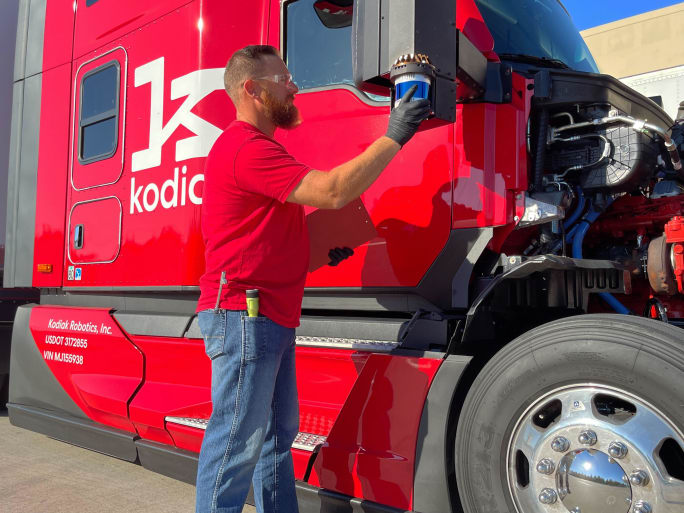
Developing inspection protocols for autonomous trucks was a main focus of the VTTI-led study.
Photo: Kodiak Robotics
During the event in Dallas, Kodiak Robotics provided a demonstration of an enhanced commercial motor vehicle inspection on a truck equipped with an automated driving system.
“As a leader in the autonomous technology industry, we are incredibly excited about the opportunity to enhance the safety of American highways that use the enhanced inspection program,” said Daniel Goff, Kodiak’s head of policy. “This enhanced inspection ensures that all trucks are inspected to an incredibly high standard so that law enforcement has confidence in the quality of the inspection and the roadworthiness of the trucks.”
Data Usage
To support the collected data, the CONOPS Dataverse was developed to house data from the events and deployments. Hosted by VTTI, the Dataverse includes four separate collections consisting of 94 data sets each, including the following:
Data generated from the operation of the advanced driver assistance systems and automated driving system-equipped trucks, including video, kinematic, radar, GPS, and other sensors
Driver monitoring datasets from the automated driving system-equipped vehicles during the three use cases
Survey responses obtained from the public during the outreach events. The data is publicly available for use by researchers, policymakers, and others seeking insights into the future of automation in trucking.
The Road Ahead
While further research and development is needed for total fleet adoption, researchers said the Fleet of Concept Operations project guidelines provide the essential starting point for any fleet as well as a baseline understanding of where the industry stands with the implementation of automated driving systems in the field and what next steps are required for successful adoption.
“Automation should be developed in partnership with the humans operating around or responsible for the system,” said Andrew Krum, the project’s principal investigator and senior research associate at VTTI. “While many factors still need to be addressed, specifically fleet by fleet, this concept of operations is the first of its kind and can help to guide the future of automation in trucking fleets."
More Fleet Management

Color Match Smarter: Tools That Restore & Perform
For fleet managers and collision repair professionals keeping heavy-duty trucks on the road, getting the color right the first time isn't just about appearance — it's about efficiency, turnaround time, and bottom-line results. Discover how today's digital color tools are transforming the repair process from guesswork to precision.
Read More →
FMCSA Pauses Biennial-Update Enforcement Amid Motus Transition
Carriers whose updates were due on or after June 1 have more time, while FMCSA works to stabilize its new registration system and warns of phishing sites impersonating its new carrier registration system, Motus.
Read More →
2026 Blueprint for Countering Smarter Supply Chain Theft
Cargo theft is no longer just the cost of doing business. It's a multi-billion-dollar criminal enterprise exploiting vulnerabilities across your fleet, drivers, and supply chain.
Read More →


How Telematics Improves Visibility, Control, and Performance in Refrigerated Fleets
Explore how telematics help refrigerated fleets improve visibility, uptime, efficiency, compliance, and cargo protection across connected cold chain operations.
Read More →
What the U.S.-Canada Trade War Means for Trucking
Escalating U.S.-Canada tariffs could disrupt cross-border freight, reduce truck volumes, raise costs, and create new uncertainty for carriers on both sides of the border.
Read More →
What Are Trucking’s Top Concerns for 2026?
The American Transportation Research Institute wants to know what's worrying trucking fleet managers, drivers, and other stakeholders in its annual Industry Issues survey.
Read More →
American Trucking Associations Looks for a New Leader
ATA President and CEO Chris Spear abruptly left his job at the association on August 21, at a pivotal time for the trucking industry.
Read More →
Public Wi-Fi Cybersecurity Risks: How Truck Drivers and Fleets Can Protect Their Data
Public Wi-Fi can expose truck drivers and fleets to credential theft, malware, and other cyber threats. Here’s how to reduce the risk on the road.
Read More →
For Nicky Cupp, Fleet Innovation Starts With Frustration
HDT Truck Fleet Innovator Nicky Cupp turns everyday pain points at Fraley & Schilling into opportunities for better technology and smarter processes.
Read More →
Adam Buttgenbach’s Approach to Electric Trucks: Start With Where They Fit
HDT Truck Fleet Innovator Adam Buttgenbach helped PepsiCo build one of North America’s largest EV fleets by focusing on where electric trucks make operational sense.
Read More →