




Canadian Refuse Fleet Deploys Eight Mack LR Electric Trucks
The order, by Emterra Environmental, marks the largest order of Mack LR Electric trucks so far.

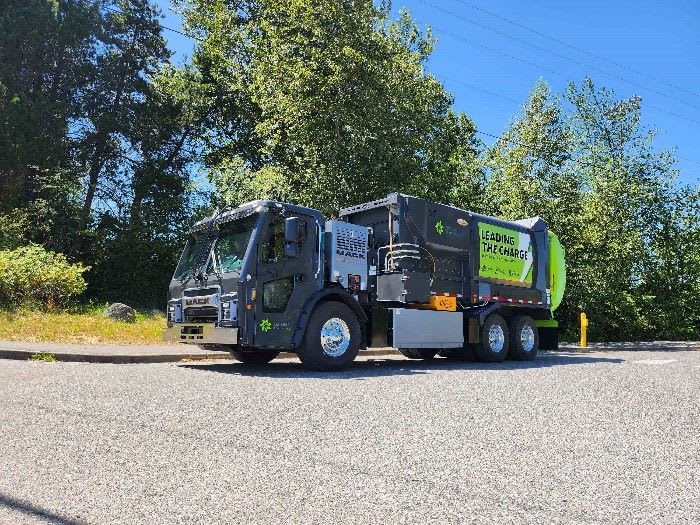
Emteera Environmental's eight new Mack LR Electric trucks will operate in the Comox Valley on Vancouver Island.
Photo: Mack Trucks
Emterra Environmental is one of the largest integrated waste to resource management companies in Canada. On July 17, it announced that it is launching its first electric vehicle fleet. The new trucks are eight Mack LR Electric refuse vehicles. They will operate in the Comox Valley on Vancouver Island.
This is largest order of Mack LR Electric vehicles thus far in North America, according to Mack Trucks. Emterra Environmental also has a Mack LR Electric refuse vehicle operating in the Peel Region of Ontario, Canada, which was delivered in October 2023.
“We are excited that Emterra Environmental and the City of Courtenay and Town of Comox chose the Mack LR Electric refuse vehicle to help them accomplish their goals of reducing greenhouse gas emissions (GHG),” said Jonathan Randall, president of Mack Trucks North America. “This investment by Emterra signifies that refuse companies and municipalities recognize the importance of sustainability and trust that Mack Trucks can help them reduce their environmental footprint with a reliable, durable and quiet truck.”
Emterra Environmental made the announcement during an event at Comox Marina Park, Town of Comox, British Columbia, Canada.
Josie Osborne, Minister of Energy, Mines and Low-Carbon Innovation in British Columbia was in attendance alongside representatives of Emterra Environmental, BC Hydro-Power and Mack Trucks.
Environmental Early-Adopter
Emterra Environmental has a decades-long record of being an early adopter of the latest low-carbon technologies. The fleet has long sought to find municipal partners that share their sustainability vision of reducing carbon emissions.
Emterra proactively approached the City of Courtenay and the Town of Comox with the opportunity of a battery-electric vehicle (BEV) fleet as part of Emterra’s multi-year contract with them for residential curbside collection.
“The launch of our fully electric fleet in Comox Valley builds on our circular economy legacy,” said Emmie Leung, founder and CEO, Emterra Group. “We introduced the first successful municipal curbside recycling program in British Columbia in the early 1980’s, and now we are introducing the first entirely zero emissions collection fleet in Canada. We are committed to leading the way through entrepreneurship, innovation and sustainability.”
The launch of the Mack LR Electric fleet is in line with the CleanBC Program, which has a goal of reducing climate-changing emissions by 40% by 2030. Officials say that transportation accounts for about 40% of the annual GHG emissions in British Columbia, so the transition to an electric refuse fleet will help assist Courtenay and Comox achieve their emissions reductions goals.
Operations Begin in August
“I’m thrilled to see Emterra Environmental take this significant step towards a greener future with the launch of the largest fleet of Mack LR Electric trucks in North America,” Osborne said. “This initiative aligns with our CleanBC goals, reducing greenhouse gas emissions and demonstrating the tangible benefits of adopting clean technology with thousands of households and businesses throughout the Comox Valley enjoying quieter, more efficient waste collection services."
The eight Mack LR Electric models will begin operations in August and will service about 25,000 households and businesses. The LR Electric models are equipped with an automated side loader from Labrie and will be serviced by Nanaimo Mack.
The next generation Mack LR Electric offers a standard 376 kWh total battery capacity for 42 percent more energy and increased range between vehicle charges. Twin electric motors produce 448 continuous horsepower and 4,051 lb.-ft. of peak torque output from zero RPM.
Four NMC (Nickel Manganese Cobalt Oxide) lithium-ion batteries, charged through a 150 kW, SAE J1772-compliant charging system, power the vehicle and all onboard accessories through 12V, 24V and 600V circuits. The two-stage regenerative braking system helps recapture energy from the hundreds of stops the vehicle makes each day with an increasing load.
The truck proudly displays a copper-colored Bulldog to make it easily identifiable as a Mack and denotes the electric drivetrain.
Related: Why This Wisconsin Mack Dealer is All-In on Electric Trucks
More Fuel Smarts

How Volvo Updated Its D13 for EPA 2027 [Watch]
Volvo’s updated D13 promises lower emissions without sacrificing performance or fuel economy. Take a closer look at what changed inside the engine in this HDT Spotlight video.
Read More →
Diesel Price Spike Shortens Payback for Natural Gas Trucks, Report Says
Energy Vision estimates fleets could recover the higher purchase price of an RNG-fueled Class 8 tractor in 1.3 to 2.8 years under current fuel-price scenarios.
Read More →
Calstart Becomes Catalyst Mobility, Reflecting Broader Focus
Calstart is now Catalyst Mobility, reflecting the nonprofit’s growing national role in clean transportation, including zero-emission trucks, infrastructure and incentive programs.
Read More →

Record Diesel Prices Squeeze Trucking Fleets
Average U.S. diesel prices have climbed to nearly $6 a gallon, surpassing the 2022 record as tight refinery capacity and Middle East disruptions keep fuel costs elevated.
Read More →
How Fuel Delivery Shapes Engine Performance
Fuel delivery depends on more than what happens at the injector. For fleet, maintenance and technical professionals, looking at the full path from pump to injector can provide useful context for understanding engine performance.
Read More →
East Coast Port Launches $45M Electric Truck Push
The Port Authority of New York and New Jersey announced millions in incentives for zero-emission drayage trucks, yard tractors, and new charging hubs near the port.
Read More →
California Bill Could Shed Light on Electric Truck Prices
Why do battery-electric Class 8 trucks remain so expensive? A California bill headed to Gov. Gavin Newsom would give fleets and state agencies more visibility into what manufacturers charge.
Read More →
Detroit Opens Orders for EPA 2027 Engines
Detroit isn’t starting from scratch to meet EPA 2027 diesel emissions standards. Its Gen 6 DD13 and DD15 engines keep much of today’s platform while updating the fuel and aftertreatment systems.
Read More →
Zero-Emission Truck Corridor Planned for West Coast
California, Oregon, Washington, British Columbia and Baja California are coordinating plans for truck charging and hydrogen fueling from Canada to Mexico.
Read More →
A Closer Look at Kenworth’s Electric T880E Vocational Truck [Video]
Learn more about Kenworth's T880E battery-electric vocational truck at the Paccar Technical Center, including its range, applications, upfitting considerations, and PTO options, in this HDT Spotlight video.
Read More →