




Mobile, Alabama, Fleet Takes Delivery of Mack LR Electric Refuse Truck
The Gulf Coast port city of Mobile, Alabama, will begin evaluating a Mack LR electric in its refuse operations later this year.

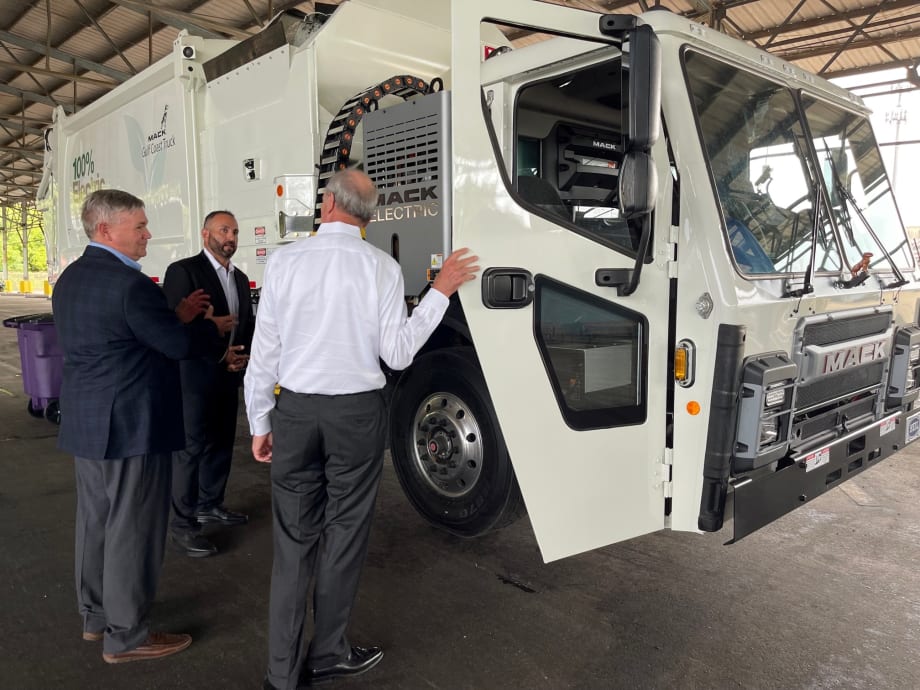
Mack's Dana Court (center) briefs Mobile Mayor Sandy Simpson (right) on the Mack LR Electric refuse truck.
Photo: Jack Roberts
The Gulf Coast port city of Mobile, Alabama, took delivery of the first battery-electric municipal refuse truck in the state on July 13, during a brief ceremony at the city’s municipal fleet headquarters.
Mobile Mayor Sandy Simpson took the ceremonial delivery of a new Mack LR Electric truck from Dana Counts, the Northeast and Southeast regional sales manager for Mack.
“We are very excited about taking ownership of this vehicle,” Simpson told attendees at the ceremony. “This is more than just a first-generation electric truck for us. This vehicle gives us flexibility and allows us to start to explore what will eventually do in terms of powering our entire fleet of garbage trucks in the city of Mobile.”
Mobile, which has a population of 187,000 according to the 2020 Census, currently operates a fleet of 26 diesel-powered refuse trucks.
Simpson noted that the price tag for the Mack LR Electric was approximately $600,000. The same diesel-powered truck would cost $300,000. "But, in this case, that cost difference was paid for by a grant from the Alabama Department of Economic and Commercial Affairs. We were one of few cities able to obtain an ADECA grant of this magnitude. So, this evaluation project is really a joint partnership with the city of Mobile, ADECA, and our friends at Alabama Power Company.”
ADECA was awarded money as part of the 2014 Volkswagen diesel emissions scandal, in which the German automaker agreed to pay over $14.7 billion to settle allegations it cheated on diesel emissions for its passenger cars. That money, which ADECA has been allocated a share of, is used by state and local governments to help offset the costs of electric vehicles during the introductory phase of development and expedite evaluations in real-world fleet operations.
Mobile, Simpson added, is the first city in Alabama to obtain an electric truck of any sort for evaluation and testing. The city will continue to seek additional ADECA grants for charging stations and the longer-term development of a comprehensive electric vehicle plan.
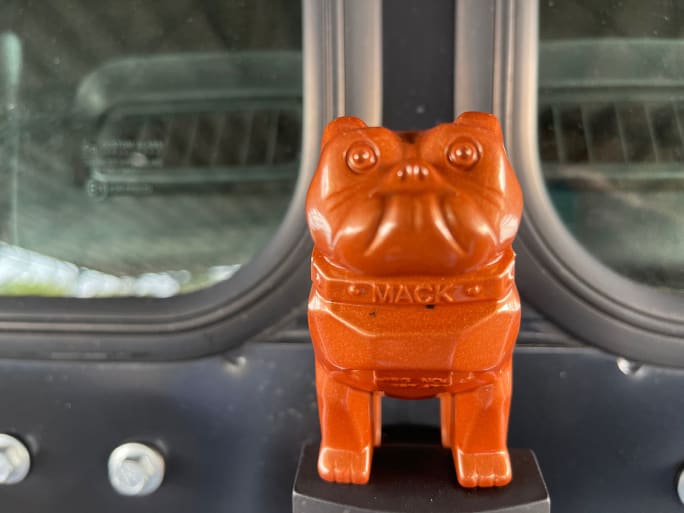
The Mack LR Electric features a copper bulldog to differentiate it as a BEV.
Photo: Jack Roberts
The Mack LR is powered by four NMC (nickel manganese cobalt oxide) lithium-ion batteries, charged through a 150 kW, SAE J1772-compliant charging system. This system powers the truck as well as all onboard accessories through 12V, 24V and 600V circuits. Twin electric motors produce 448 continuous horsepower and 4,051 lb.-ft. of peak torque output from zero rpm. The two-stage regenerative braking system helps recapture energy from the hundreds of stops the vehicle makes each day with an increasing load.
The cab of the LR Electric features a copper-colored Bulldog to signify its all-electric powertrain. The same driver- and passenger-side configurations, as well as seat and door options, are available for the Mack LR Electric as those that are offered in the diesel Mack LR model. The LR Electric can be fitted with bodies from various manufacturers to meet each customer’s unique set of needs.
Mobile's Electric-Truck Decision-Making Process
Speaking to HDT after the ceremony, Mack's Counts noted that the deal for Mobile to acquire the LR Electric took a little over three months to finalize.
“The city wants to electrify and transform into a sustainable, green city,” he said. “They’ve already done that downtown, as evidenced by multiple charging stations that have been installed for passenger vehicles. And during the acquisition process, the city had very generalized concerns — questions, really — about the usual things: the range of the truck, the length of time to charge, battery life — very common questions that we get. We were able to show them data gathered from other Mack LR Electric trials in New York City and Ocala, Florida, that range will be perfectly fine for their operations.”
Counts added that Mack has developed an online tool that anyone interested in initial assessments of electric truck performance can access and use to key in operating factors for refuse fleets (such as topography, geography, number of stops and total distance traveled) to begin to understand how these trucks will perform in their fleets.
“We encourage fleets to use that tool before we ever get to a purchase stage, so that Mack electric truck experts can definitely tell them how this product will fit in their operations,” he said.
Electric Trucks Aren't a One-All Fix
For most fleets, electric trucks will likely be only one part of a zero-emissions solution, Counts added.
“For most fleets, electric trucks will not be a one-all fix for everything,” he said. “Compressed natural gas and diesel will still have a place in their operations for a long time to come. But, the bulk of many fleets in an urban setting have routes that are within a 50-mile radius. The Mack LR Electric can easily meet those operating demands today. And crucially, as Mayor Simpson just pointed out, the availability of grant money from Volkswagen and other funds out there can offset the higher purchase price for an electric truck right now to the point that experimenting with this new technology just makes sense.”
Charles Sumrall, fleet manager for the city of Mobile, told HDT he was primarily interested in overall operational cost savings with the electric truck.
“We’re still very much in the exploratory stage, now,” he said. “I went to South Florida for a demonstration of the truck before we purchased it. And I was impressed by what I saw.”
Sumrall says driver analysis and feedback will be critical in the coming weeks and months as the new Mack goes through its paces.
“Mainly I’m interested in how the maintenance aspect is going to work out,” he added. “There’s no engine. No transmission. Instead we have gear motors — which are easy to maintain. We’ll have to drain fluids every six months to a year, do brake job once a year and put tires on it about every two years. So I’m interested to see how those costs eventually compare to a diesel truck.”
More Equipment

ZF Expands Commercial Vehicle Push in North America
ZF is expanding its North American commercial-vehicle presence with new transmission applications, electrification, trailer technology and autonomous-driving systems.
Read More →
Tesla Wants a Self-Driving Semi. Are Cameras Enough?
Could Tesla’s camera-only autonomous driving technology work on an 80,000-pound Semi? In this commentary, HDT's Deborah Lockridge takes a look at Tesla, Cybercab, and how autonomous trucks see the road.
Read More →
Kodiak: Driverless Long-Haul Truck Launch on Track for 2026
Kodiak AI says its driverless long-haul safety case is 93% complete and it remains on track to begin commercial operations by year-end 2026.
Read More →
What DOT’s Automated Vehicle Strategy Means for Trucking
The U.S. Department of Transportation issued a new automated-vehicle strategy that outlines plans for driverless-truck regulations, cross-state freight corridors, and federal safety standards.
Read More →
East Coast Port Launches $45M Electric Truck Push
The Port Authority of New York and New Jersey announced millions in incentives for zero-emission drayage trucks, yard tractors, and new charging hubs near the port.
Read More →
PlusAI Going Public to Fund Autonomous Truck Launch
A SPAC deal could provide PlusAI with up to $300 million as it works toward a 2027 commercial launch of factory-built autonomous trucks.
Read More →
NHTSA Moves to Rewrite Truck Fuel-Economy Rules
The National Highway Traffic Safety Administration says it lacks authority to regulate medium- and heavy-duty truck engines separately from complete vehicles, but the existing standards have not yet been eliminated.
Read More →
Detroit Opens Orders for EPA 2027 Engines
Detroit isn’t starting from scratch to meet EPA 2027 diesel emissions standards. Its Gen 6 DD13 and DD15 engines keep much of today’s platform while updating the fuel and aftertreatment systems.
Read More →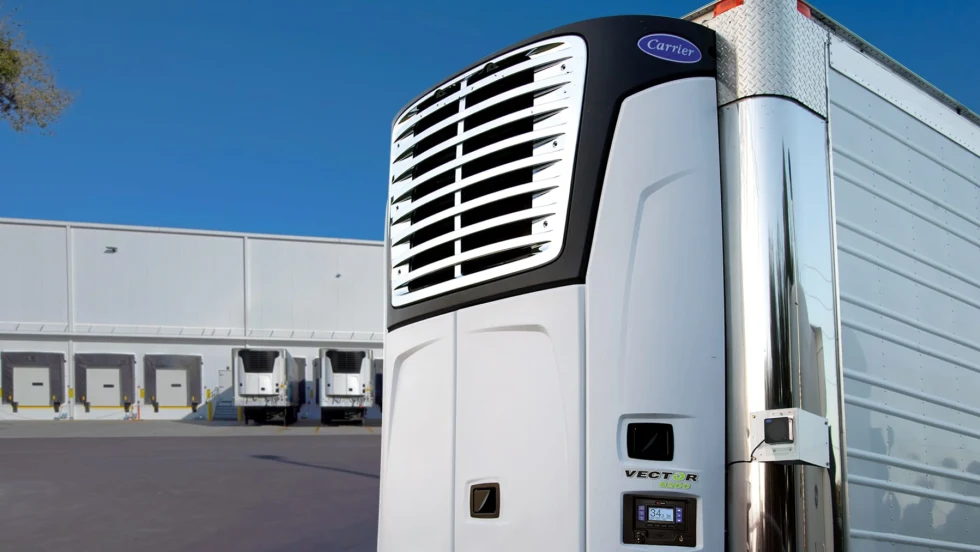
Carrier Transicold Adds All-Electric TRU for Stationary Cold Storage
Carrier Transicold’s new Vector 8200 all-electric transport refrigeration unit gives fleets a diesel-free option for temporary refrigerated and frozen trailer storage.
Read More →
A Closer Look at Kenworth’s Electric T880E Vocational Truck [Video]
Learn more about Kenworth's T880E battery-electric vocational truck at the Paccar Technical Center, including its range, applications, upfitting considerations, and PTO options, in this HDT Spotlight video.
Read More →