




Heliox Launches 60 kW EV Charger for North America
Heliox’s new 60 kW charger comes in three variants that allows users to choose various installation methods from wall or floor-mounted pedestal to mobile cart configurations.

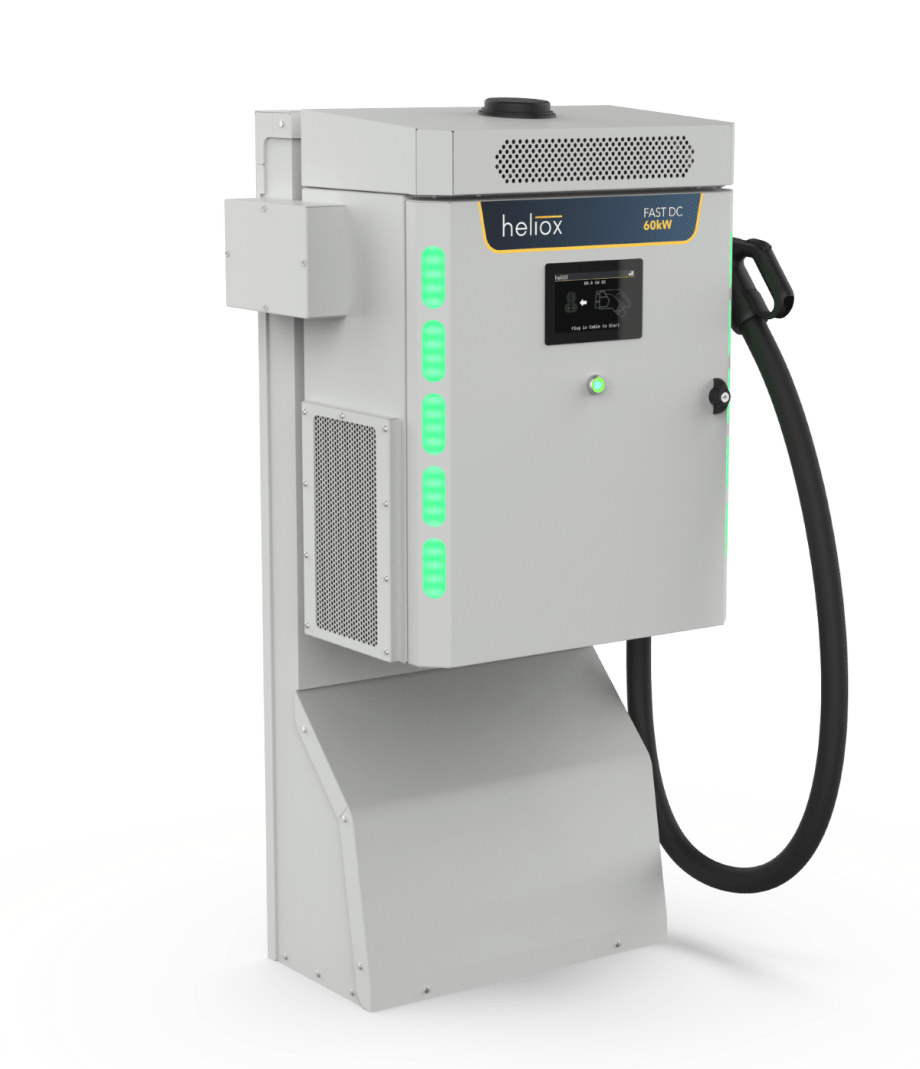
The Heliox 60 charging system is designed for low-profile installations.
Photo: Heliox
Heliox, a Siemens business and supplier of DC charging systems for medium- and heavy-duty vehicles, has launched its new Heliox 60 charger.
The 60kW EV charger is certified (UL2202, CSA C22.2, Energy Star) and made specifically for the North American market.
Building on the success of its previously released 50 kW charger, the Buy-American compliant Heliox 60 represents an enhanced iteration of cost-effective, low-power DC charging, according to the company.
The solution satisfies the majority of DC charging use cases today, Heliox said.
A Compact and Power-Dense Charging Solution
The Heliox 60 delivers 150 A output. This is capable of delivering full 60 kW for both traditional 400-volt and modern 800-volt vehicles, according to the company.
Heliox designed the system to be one of the most compact and power-dense chargers available. The system features a single CCS-1 (SAE J1772) output. Heliox has plans to incorporate NACS (SAE J3400) and multi-output configurations into the system. Additionally, the unit allows for a 30 kW version within the same cabinet design.

Heliox's new 60kW charging system is complemented by a range of accessories including a floor-mounted pedestal, cable management solutions, and a mobile cart configuration.
Photo: Heliox
“Since first ramping up the US team, the Heliox 60 was destined to be a staple in our product portfolio,” said David Aspinwall, president, U.S., Heliox. “There are many exciting collaborations and pilots focused on high-power and megawatt charging systems (MCS), but application-appropriate power and high-value chargers are paramount in the present state of the EV industry.”
Designed with scalability and convenience in mind, the Heliox 60's form factor allows for low-profile installations. Heliox said the system is complemented by a range of accessories including a floor-mounted pedestal, cable management solutions, and a mobile cart configuration similar to the 50 kW predecessor.
The new chargers also feature an LCD display and high-visibility LED energy status bars.
Siemens’ Distribution and Service
As part of Siemens’ acquisition of Heliox announced earlier this year, the Heliox 60 will also be available through select Siemens distributors in addition to Sourcewell and partnerships with leading vehicle OEMs and developers. Ongoing interoperability testing guarantees seamless operation with the newest medium- and heavy-duty vehicles. Additionally, all Heliox chargers leverage Open Charge Point Protocol (OCPP) for cloud-based monitoring and control.
Now a Siemens business, Heliox complements Siemens’ existing eMobility charging portfolio, adding products and solutions ranging from 30kW to 1MW for depots and en-route charging, with a focus on DC fast charging for eBus and eTruck fleets.
More Fuel Smarts

Wex Adds Cardless Fuel Payments for Over-the-Road Customers
A new fuel card feature for Wex customers offers convenience and security.
Read More →
New California Law Could Shed Light on Electric Truck Prices
Why do battery-electric Class 8 trucks remain so expensive? A California bill signed by Gov. Gavin Newsom would give fleets and state agencies more visibility into what manufacturers charge.
Read More →
How Volvo Updated Its D13 for EPA 2027 [Watch]
Volvo’s updated D13 promises lower emissions without sacrificing performance or fuel economy. Take a closer look at what changed inside the engine in this HDT Spotlight video.
Read More →

Diesel Price Spike Shortens Payback for Natural Gas Trucks, Report Says
Energy Vision estimates fleets could recover the higher purchase price of an RNG-fueled Class 8 tractor in 1.3 to 2.8 years under current fuel-price scenarios.
Read More →
Calstart Becomes Catalyst Mobility, Reflecting Broader Focus
Calstart is now Catalyst Mobility, reflecting the nonprofit’s growing national role in clean transportation, including zero-emission trucks, infrastructure and incentive programs.
Read More →
Record Diesel Prices Squeeze Trucking Fleets
Average U.S. diesel prices have climbed to nearly $6 a gallon, surpassing the 2022 record as tight refinery capacity and Middle East disruptions keep fuel costs elevated.
Read More →
How Fuel Delivery Shapes Engine Performance
Fuel delivery depends on more than what happens at the injector. For fleet, maintenance and technical professionals, looking at the full path from pump to injector can provide useful context for understanding engine performance.
Read More →
East Coast Port Launches $45M Electric Truck Push
The Port Authority of New York and New Jersey announced millions in incentives for zero-emission drayage trucks, yard tractors, and new charging hubs near the port.
Read More →
Detroit Opens Orders for EPA 2027 Engines
Detroit isn’t starting from scratch to meet EPA 2027 diesel emissions standards. Its Gen 6 DD13 and DD15 engines keep much of today’s platform while updating the fuel and aftertreatment systems.
Read More →
Zero-Emission Truck Corridor Planned for West Coast
California, Oregon, Washington, British Columbia and Baja California are coordinating plans for truck charging and hydrogen fueling from Canada to Mexico.
Read More →