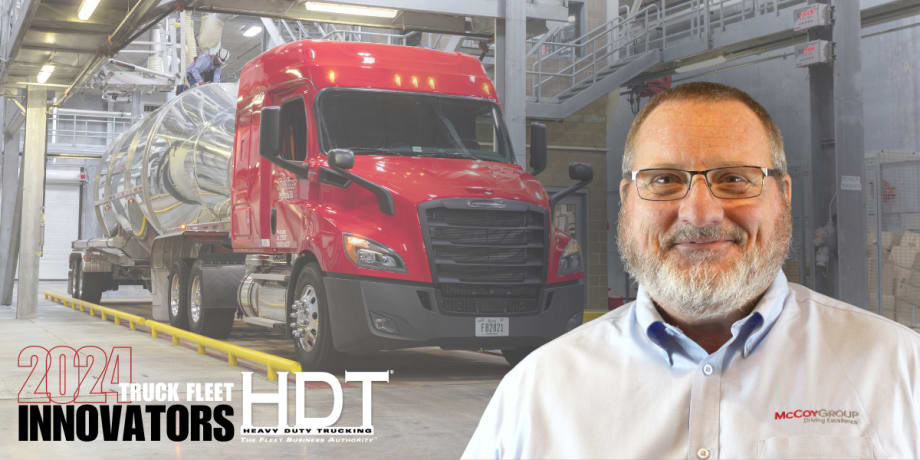
If your fleet operates dry bulk or tanker trailers, there’s a good chance that you might be using some innovative technology and options that Foodliner's Kyle Neumann worked on developing. Learn more about this 2024 HDT Truck Fleet Innovator.
HDT Truck Fleet Innovator Kyle Neumann of Foodliner has worked to improve safety for drivers and others on top of bulk trailers.
Image: HDT graphic | Foodliner photos
9 min to read
If your fleet operates dry bulk or tanker trailers, there’s a good chance that you might be using some innovative technology and options that Kyle Neumann worked on developing.
Ad Loading...
As vice president of maintenance for Foodliner in Dubuque, Iowa, he oversees spec’ing and maintenance for over 1,600 power units, 3,500 trailers, and 35 shops.
“We’re trying to make the next-generation trailer. That’s my goal before I hang it up,” Neumann says.
Neumann got his start in trucking working for a truck dealer in high school. He worked his way up from turning wrenches and working the parts counter to heading up dealerships.
Twenty years ago, the company he was working for, McCoy Group, asked him to run a new fleet maintenance solutions business. Two years later he became director of maintenance for Foodliner and sister company Questliner, also owned by McCoy Group, and was promoted to vice president of maintenance in 2021.
Foodliner hauls bulk food-grade products such as flours, liquid sugars, liquid molasses, and dry starches. Quest Liner targets the chemical and biofuels markets.
Creating the Next-Generation Tank Trailer
Working with suppliers, Neumann has driven a number of innovative features to address safety, quality, driver comfort, and longevity.
John Paape, VP of Information Technology, Roehl Transport
“One of the problems we have with food-grade trailers is you're always up on top of the trailer,” he explains. But the non-slip material they were using didn’t work that well and wouldn’t stay put.
After experimenting with different options, he and his team landed on an aluminum nonslip material that could be welded to the top of the trailers. It reduced the risk of someone slipping and falling and it eliminated the need to replace nonslip tape.
“We had a concern about, sooner or later, some of that nonslip material is going to go into the vessel,” he adds. “And I don't know about you, but I don't want to eat nonslip material.”
It worked so well that MAC, Polar and Heil trailers added it as a databook option.
Another challenge is making sure rodents or insects don’t get into the trailers and contaminate the load. Years ago, he worked with BTI (Bulk Tank Inc.) to create the Critter Stopper valve, which keeps these “critters” from entering a bulk tank trailer through the blow-down exhaust pipe.
Ad Loading...
Over the last two years he has worked with BTI to help design the second generation of the Critter Stopper, making it even better.
The device is a spring-loaded flap that attaches to the end of the blow-down line and remains closed when not in operation. It allows the internal air pressure in the tank to be emptied after the unloading process while not allowing anything to enter back through the blow-down line, “to make sure that [the load] stayed food grade even when it was sitting in the parking lot.”
Again, it worked so well that BTI started selling the Critter Stopper to other fleets.
A recently completed project with BTI addressed another top-of-the-trailer safety issue.
“We were tasked with a project from our customers,” he explains. The standard procedure for loading the trailers is going to the left front of the trailer and opening the blowdown for the Critter Stopper so it vents the trailer.
Ad Loading...
If that valve is not opened, when someone gets on top of the trailer and opens the hatch, the resulting pressure could knock the person off.
“We have gotten two prototypes installed, and they are working fantastically,” Neumann says.
“Basically, anytime our drivers hook up a hot hose and pressurize the trailer to unload, the driver can then close the blowdown as normal. When the driver stops pressurizing the trailer, [the device] automatically opens and it locks in the open position. So, the trailer cannot build pressure again until the hose is hooked up to pressurize it again.
“Now, our customer won’t have to worry about that trailer being pressurized and their people will be safe on top of the trailer.”
In addition, there was a safety concern for people having to get on top of the trailer to vent it while unloading. He worked with Girard Vents to come up with a venting cap that can go on top of the dome lid.
Ad Loading...
“Now drivers don't have to go up on top at all, and we’re safe that we're not going to implode a trailer,” Neumann says.
The company is working with several manufacturers to get it added as a data book option.
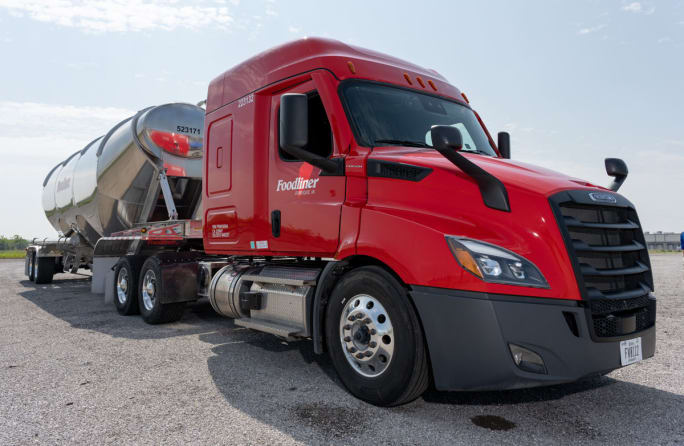
Working with suppliers, Neumann has driven a number of innovative features for Foodliner's bulk trailers to address safety, quality, driver comfort, and longevity.
Photo: Foodliner
Smarter Suspensions
Another supplier Neumann works closely with is Hendrickson, which nominated him for the award. He was an early tester of the company’s Zero Maintenance Damping suspension system.
While the original intent of the ZMD was to lower maintenance costs by eliminating shock absorbers and redesigning the air bag so it would provide the damping, when Neumann tested the system with a couple of veteran drivers, it quickly became obvious there was another benefit, as well.
After the run with the new air bags, Neumann asked the drivers if they had noticed anything different. The response was so enthusiastic that Neumann wanted to put in orders for the system right away.
Ad Loading...
One driver responded, “I don’t know what you did, but don’t change it back!” The other said, “Oh my God, you’ve made it ride so much better; what did you do?”
Given that the product was still in early beta testing at the time, it took longer to actually get them into his fleet than Neumann wanted.
“It took us a while, but we finally did get it as a data book option,” he says.
Added benefits, he says, are that it eliminates leaking shocks, and the fleet is seeing less cracking of the tanker vessels.
“We run trailers longer than a van carrier,” he notes. “Our goal is to run a food grade vessel 25 years. So we need to do everything we can do to protect that vessel.”
Ad Loading...
90,000-Mile Oil Drain Intervals
Of course, as VP of maintenance, new equipment specs are just one part of Neumann’s job.
He emphasizes technician training. The company pays techs offline to continue their education. How well they score on tests makes them eligible for cash prizes and entrance into an annual technician skills contest, where first place gets the winner $5,000. It’s part of why the company’s technician retention rate is very high.
Eighteen years ago, Neumann started a project to extend oil drain intervals, which at the time were 24,000 miles or 90 days. Citgo was willing to work with him and required oil sampling ports and a regular oil analysis schedule. He doubled the drain intervals from 24,000 to 48,000, with an oil analysis and dry PM at the halfway point.
“You know, back in those days, if you say to somebody you’re going to 48,000 miles… it made me shiver,” Neumann says.
After another half-dozen years or so, with the help of Citgo heavy lubricant manager Mark Betner, Foodliner upped the drain interval to 72,000 miles, where it stayed for a number of years.
Ad Loading...
“And this whole time we hadn't lost a motor,” Neumann recalls. “I’m like OK, it’s working. Everybody’s saying, ‘Hey, you’re at the cutting edge, don't go any farther. You’ve already surpassed manufacturer recommendations.'
“About four years ago, Mr. Betner came in right before he retired and he handed out a whole stack of oil samples and said, ‘Neumann, are you going to quit throwing out my good oil?’
“I'm like, ‘Mark, we’re at 72,000, we can't go any further.’ He's like, ‘yes, we can.’ Again, I about shivered.
Today the fleet is on a 170-day, 45,000-mile dry PM, and then a 340-day or 90,000-mile wet PM.
“But you really got to be diligent on getting oil samples pulled and getting your PMs done on time," he says.
Ad Loading...
“Even at 90,000 miles, we have not lost a motor due to oil. Everybody's saying, ‘You can't do that.’ Well, we are doing it.”
Keeping Tire Costs Down and Extending Tire Life
About 15 years ago, the company started really managing its tire program, with tires being its biggest expense. As a result, costs have remained flat even though prices have risen, Nuemann says, and the fleet has doubled the miles on its tires.
About five years ago, Neumann posed a question to Hendrickson’s engineers about the irregular tire wear caused by trailers going out loaded and coming back empty. He wanted to be able to automatically lower the tire pressure when those trailers are coming home empty, but autofill before they go back out loaded.
The eventual result was the Tiremaax Pro-LB, which inflates, relieves and equalizes tire pressures across all wheel positions and makes load-based pressure adjustments.
Another key to success has simply been focusing on the issue.
Ad Loading...
“Teammates in our shops, they’re checking air pressures, they’re checking if there’s irregular wear,” Neumann says. “We talk about that a lot with our team.”
A biweekly call with the foremen of all 36 shops, just talking about what issues they are seeing in their shops, helps the company stay on top of any potential problems, whether it's tires or other areas.
“They hear an issue and they’re taking it down to their team in the shop saying, ‘Here’s something we’ve got to be looking at.’ And it really helps correct the problem.
“Communication is a great thing, and my belief is you’ve got to do it verbally. I don’t like sending out an email and then saying, ‘Well, I sent you an email. Did you read it?’”
What’s Next?
But don’t let that make you think Neumann doesn’t embrace digital technology.
Ad Loading...
A new software program, FleetOps, is helping the company take a deeper dive into areas such as utilization costs per asset, technician productivity, and the performance of individual pieces of equipment.
And Neumann is currently working with Foodliner’s IT department on a trailer-tracking project using QR codes.
“But we want to put that a little bit on steroids,” he says. “In case a driver takes the wrong trailer, if the QR codes don’t match the bill of lading, we want to lock the blower out or the PTO out on the truck so that he can’t unload it. So we don’t put the wrong product in the wrong side.”
Reflecting on 42 Years of Change in Trucking
Neumann has been in the industry for 42 years, so he’s seen a lot of change.
“I’ll be the first to tell you, when I was turning wrenches at an early age out in the shop and they said, ‘We’re going to put electronics on motors,’ I'm like, ‘Not in my career time!’
Ad Loading...
“But I'm glad they did. You know, every time we look at it, we get looking at new fuel mappings or whatever, it’s just amazing what we’re doing with fuel economy and longevity with these motors anymore.”
The McCoy Group Inc. is the parent company for six subsidiaries in the truck, transportation, and construction and forestry industries and is owned and operated by the McCoy family. Truck Country, Stoops Freightliner-Western Star, and Stoops Trailers are a group of 27 Freightliner/Western Star truck and Wabash trailer dealerships in the Midwest. The McCoy transportation group consists of Foodliner and Quest Liner. McCoy Construction & Forestry serves customers in eight states.
For fleet managers and collision repair professionals keeping heavy-duty trucks on the road, getting the color right the first time isn't just about appearance — it's about efficiency, turnaround time, and bottom-line results. Discover how today's digital color tools are transforming the repair process from guesswork to precision.
Carriers whose updates were due on or after June 1 have more time, while FMCSA works to stabilize its new registration system and warns of phishing sites impersonating its new carrier registration system, Motus.
Cargo theft is no longer just the cost of doing business. It's a multi-billion-dollar criminal enterprise exploiting vulnerabilities across your fleet, drivers, and supply chain.
Explore how telematics help refrigerated fleets improve visibility, uptime, efficiency, compliance, and cargo protection across connected cold chain operations.
Escalating U.S.-Canada tariffs could disrupt cross-border freight, reduce truck volumes, raise costs, and create new uncertainty for carriers on both sides of the border.
The American Transportation Research Institute wants to know what's worrying trucking fleet managers, drivers, and other stakeholders in its annual Industry Issues survey.
HDT Truck Fleet Innovator Adam Buttgenbach helped PepsiCo build one of North America’s largest EV fleets by focusing on where electric trucks make operational sense.