




Wave to Deploy 500kW EV Charger in Cold Climates
Wave Charging will deploy its 500kW ultra-fast BEV wireless charging system in the Midwest in a cold climate.

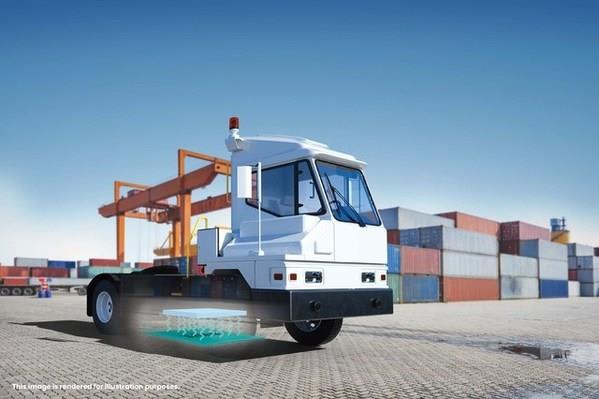
WAVE Charging will be providing its 500kW wireless charging system for a Venture Logistics location.
Source: Ideanomics
Wave Charging will deploy its 500kW ultra-fast wireless BEV charging system, developed in conjunction with Cummins and the Department of Energy, in cold climates for the first time.
15-Minute Charging
This wireless charging system fully charged a Class 8 electric truck in less than 15 minutes in a previously announced series of successful tests. For context, a typical household in the United States uses approximately 30kWh of electricity per day, according to WAVE parent company Ideanomics.
A 500kW charger could theoretically supply a day's worth of energy to a home in just 3.6 minutes or provide a full day’s worth of energy to 400 homes, the company explained, and this energy is transmitted wirelessly at a comparable level of efficiency to wired charging.
Midwest Commercial BEV Charging Deployment
Wave (Wireless Advanced Vehicle Electrification) now plans to deploy and demonstrate the 500kW wireless inductive charger at a Venture Logistics facility in the Midwest, in partnership with Cummins, Venture Logistics, and the U.S. Department of Energy,
Venture Logistics is a privately held, full-service logistics company. As part of this initial project, the Wave 500kW system will power two Class 8 electric trucks beginning in the first quarter of 2024.
Supported by an $8.4 million U.S. Department of Energy grant, the Wave Wireless 500kW charger is being deployed as part of a consortium project. Ideanomics said the high-power wireless charging systems will help operators to more easily meet zero-emission goals with minimal impact on operations.
Cold Climate Charging
The project with Venture Logistics, Ideanomics said, is a further example of how high-power wireless charging is bringing zero-emission capabilities to cold climates where ice and snow create challenging transportation environments. Wireless charging eliminates the need to handle heavy high-power charging cables at low temperatures.
Electrification
The Inflation Reduction Act (IRA) provides more than $75 billion in programs and tax credits for vehicle electrification. Several of these programs and incentives include specific designations to electrify heavy-duty vehicles operating in disadvantaged communities and warehouses.
“Our demonstration project with Venture Logistics will show that for medium- and heavy-duty vehicles that demand perpetual operations and require charging infrastructure, wireless charging is the most effective solution at scale,” said Robin Mackie, COO of Ideanomics.
Benefits of the Wave Wireless charging system, according to Ideanomics, are:
Embedded in the road surface, the WAVE Wireless system charges the truck batteries quickly and conveniently during regularly scheduled stops without the need to handle heavy high-power cables.
The speed and convenience means charging can occur within the vehicle’s duty cycle, allowing the battery-electric trucks to match the duty cycle of their fossil-fueled internal combustion engine counterparts.
The pavement-embedded systems have no moving parts, for low maintenance and high availability.
Unlike legacy plug-in charging systems, the Wave Wireless systems are flush to the ground, reducing the risk of collisions with vehicles in an already busy and congested area.
The risks of trips and falls associated with cables are eliminated.
“We're demonstrating that electric heavy-duty vehicles can operate continuously, recharging during their regular operations,” said Mackie. “The advantages of this technology are evident: fleet operators enhance efficiency by eliminating vehicle downtime spent refueling or connecting to a central depot.”
Logistics Company Purchases Charging System
Wave Charging also announced it's received an approximately $500,000 purchase order for a new commercial proof of concept project with a major retail and logistics company in the United States.
The project will involve the deployment of BYD yard tractors equipped with Wave's wireless charging technology. The battery-electric yard tractors will be employed at one of the customer’s distribution centers to facilitate the movement of containers as part of a project contributing to a reduction in the customer’s overall emissions footprint.
Ideanomics said Wave’s and the customer’s objectives are to scale the deployment to wider use within the customer's operations, both at distribution centers and other warehouse and middle-mile scenarios.
More Fuel Smarts

How Volvo Updated Its D13 for EPA 2027 [Watch]
Volvo’s updated D13 promises lower emissions without sacrificing performance or fuel economy. Take a closer look at what changed inside the engine in this HDT Spotlight video.
Read More →
Diesel Price Spike Shortens Payback for Natural Gas Trucks, Report Says
Energy Vision estimates fleets could recover the higher purchase price of an RNG-fueled Class 8 tractor in 1.3 to 2.8 years under current fuel-price scenarios.
Read More →
Calstart Becomes Catalyst Mobility, Reflecting Broader Focus
Calstart is now Catalyst Mobility, reflecting the nonprofit’s growing national role in clean transportation, including zero-emission trucks, infrastructure and incentive programs.
Read More →

Record Diesel Prices Squeeze Trucking Fleets
Average U.S. diesel prices have climbed to nearly $6 a gallon, surpassing the 2022 record as tight refinery capacity and Middle East disruptions keep fuel costs elevated.
Read More →
How Fuel Delivery Shapes Engine Performance
Fuel delivery depends on more than what happens at the injector. For fleet, maintenance and technical professionals, looking at the full path from pump to injector can provide useful context for understanding engine performance.
Read More →
East Coast Port Launches $45M Electric Truck Push
The Port Authority of New York and New Jersey announced millions in incentives for zero-emission drayage trucks, yard tractors, and new charging hubs near the port.
Read More →
California Bill Could Shed Light on Electric Truck Prices
Why do battery-electric Class 8 trucks remain so expensive? A California bill headed to Gov. Gavin Newsom would give fleets and state agencies more visibility into what manufacturers charge.
Read More →
Detroit Opens Orders for EPA 2027 Engines
Detroit isn’t starting from scratch to meet EPA 2027 diesel emissions standards. Its Gen 6 DD13 and DD15 engines keep much of today’s platform while updating the fuel and aftertreatment systems.
Read More →
Zero-Emission Truck Corridor Planned for West Coast
California, Oregon, Washington, British Columbia and Baja California are coordinating plans for truck charging and hydrogen fueling from Canada to Mexico.
Read More →
A Closer Look at Kenworth’s Electric T880E Vocational Truck [Video]
Learn more about Kenworth's T880E battery-electric vocational truck at the Paccar Technical Center, including its range, applications, upfitting considerations, and PTO options, in this HDT Spotlight video.
Read More →