





What Happens if a Freight Broker Can't Pay its Motor Carrier Bills?
New FMCSA Regulation Targets Fraudulent and Insolvent Freight Brokers
The Federal Motor Carrier Safety Administration said its new rules about financial responsibility requirements for freight brokers can help cut down on fraud and non-payment of motor carriers.
November 15, 2023
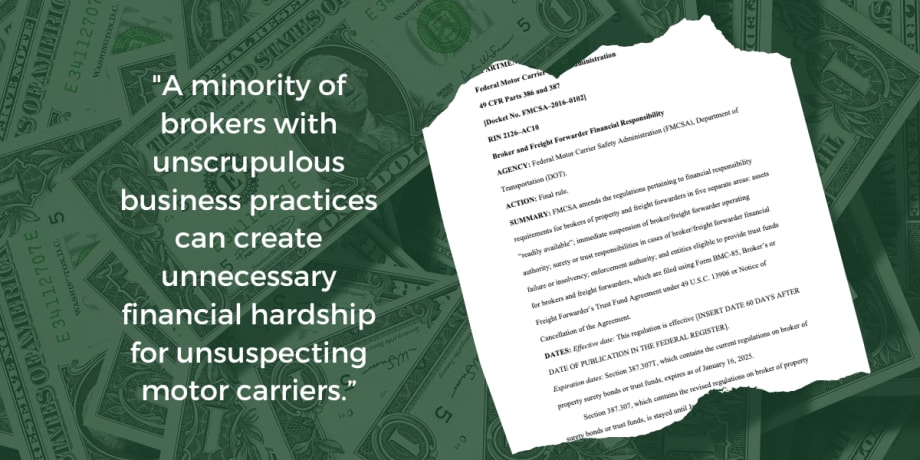
Will FMCSA's new broker financial responsibility rules go far enough?
HDT Graphic
9 min to read
The Federal Motor Carrier Safety Administration has published a final rule tightening financial responsibility requirements for brokers and freight forwarders in an attempt to cut down on fraud and non-payment of motor carriers.
It’s been more than a decade since Congress directed the Federal Motor Carrier Safety Administration in 2012 to make changes to broker financial requirements in the Moving Ahead for Progress in the 21st Century Act (MAP-21). Provisions of that law increased the financial security requirement for freight brokers and established a financial security requirement for freight forwarders for the first time.
In January, FMCSA issued a Notice of Proposed Rulemaking on rule revisions for the financial requirements for brokers and freight forwarders. The agency solicited comments for 90 days and held a listening session on this rulemaking and other broker-related matters in conjunction with the Mid-America Trucking Show in Louisville, Kentucky.
The final rule on broker financial responsibility is scheduled to be posted in the Federal Register on Nov. 16.
The Broker Problem
FMCSA said it believes that most brokers operate with integrity and uphold the contracts made with motor carriers and shippers. However, the agency said, a minority of brokers with unscrupulous business practices can create unnecessary financial hardship for unsuspecting motor carriers.
Just last week, for instance, HDT reported on motor carriers left in the lurch by Pennsylvania-based broker Elite Transit Solutions.
The agency estimates that approximately 1.3% of brokers will experience a drawdown on their surety bond or trust fund within a given year, with average claim amounts of approximately $1,900. Of these brokers, 18% may have total claims more than the $75,000 minimum required by law.
When this happens, the resulting process of trying to get claims paid by the surety company or other financially responsible party can be costly and time-consuming. Motor carrier claims end up being paid pro rata, often resulting in payment of only pennies on the dollar.
The Transportation Intermediaries Association issued a statement applauding the agency "for moving forward on this long overdue rule."
TIA President & CEO Anne Reinke said, "3PLs and brokers are in the midst of a fraud epidemic, and a significant aspect of that fraudulent activity centers around trust fund providers and fraudulent entities in the marketplace.
"The FMCSA's efforts to increase the barrier of entry into the brokerage industry through the elimination of fraudulent trust fund providers will make it more challenging for criminals and scammers to establish a presence in the marketplace as easily."
What Does the New Broker Financial Responsibility Rule Do?
The final rule targets five areas:
Assets “readily available”
Immediate suspension of broker/freight forwarder operating authority
Surety or trust responsibilities in cases of broker/freight forwarder financial failure or insolvency.
Enforcement authority.
Entities eligible to provide trust funds for brokers and freight forwarders, which are filed using Form BMC-85, Broker’s or Freight Forwarder’s Trust Fund Agreement under 49 U.S.C. 13906 or Notice of Cancellation of the Agreement.
Assets Readily Available
In the Moving Ahead for Progress in the 21st Century Act (MAP-21), Congress mandated that broker/freight forwarder trust funds consist of “assets readily available to pay claims without resort to personal guarantees or collection of pledged accounts receivable.”
The final rule sets out a list of the acceptable asset types a BMC-85 trust may contain: cash, ILCs issued by a Federally insured depository institution, and Treasury bonds.
FMCSA has determined that these asset types are readily available because they are stable in value and can be easily liquidated within seven calendar days of an event that triggers a payment from the trust.
Its January proposed rule proposed a list of prohibited asset types. However, after getting feedback and comments, it changed the rule to list accepted types.
The changes were responding to concerns among commenters on the proposed rule about ambiguity. There were also concerns that only listing prohibited asset types could encourage financial institutions to create new asset classes in an attempt to circumvent the regulations.
The Transportation Intermediaries Association was concerned that bad actors could “seek a potential asset that isn’t on the list and note that it is ‘readily available’ due to the fact it isn’t included on the agency’s list of non-compliant assets.”
Compliance with this provision will be required on January 16, 2026.
Immediate Suspension of Broker Operating Authority
When a broker or freight forwarder’s available financial security falls below $75,000, the rule allows FMCSA to suspend its operating authority registration.
That “available financial security” may fall below $75,000 because a broker or freight forwarder consents to a drawdown, or if a broker or freight forwarder does not respond to a valid notice of claim from a surety or trust provider, or if a claim against the broker or freight forwarder is converted to a judgment.
If the available financial security falls below $75,000 and the broker or freight forwarder does not replenish funds within seven calendar days after notice from FMCSA, the agency will issue a notification of suspension of operating authority to the broker or freight forwarder.
FMCSA intends to use its forthcoming Unified Registration System (URS) platform to receive information from surety providers, trustees, brokers, and freight forwarders and to administer FMCSA’s responsibilities regarding immediate suspension of operating authority registration.
In feedback on its January proposal, there were comments that the $75,000 minimum was too low (from owner-operators and motor carriers) or too high (from small brokers.) The agency’s response was that Congress set that $75,000 in MAP-21 so it was outside the scope of this rulemaking.
The final rule also expanded the criteria for determining the timing of the suspension.
FMCSA determined that a bond or trust fund should be considered to have fallen below $75,000 when either an actual drawdown occurs, or when the surety provider or financial institution receives legitimate claims that have not been adequately addressed by the broker and will inevitably result in the bond or trust fund falling below that amount.
“Expanding the criteria in this manner will allay concerns from surety providers and financial institutions about their ability to quickly notify FMCSA of brokers warranting suspension while still adhering to the 60-day period for public advertisement and subsequent 30-day period for paying claims specified in 49 U.S.C. 13906(b)(6),” FMCSA explained. “This is because surety providers and financial institutions will not be required to actually make a payment from the bond or trust fund before notifying FMCSA that the assets have fallen below $75,000, and will thus be able to continue aggregating claims throughout the statutory claims period.”
Compliance for this provision will be required on January 16, 2025.
Surety or Trust Responsibilities in Case of Financial Failure or Insolvency
This rule requires that if the surety/trustee becomes aware that a broker or freight forwarder is experiencing financial failure or insolvency, it must notify FMCSA and initiate cancelation of the financial responsibility. FMCSA will then publish a notice of failure in the FMCSA Register.
If the broker or freight forwarder subsequently cures the default, and the surety company or financial institution reinstates the bond or trust or the broker or freight forwarder obtains a new bond or trust, FMCSA will lift the suspension notice and update the FMCSA Register.
As with the immediate suspension provision, FMCSA intends to use the forthcoming URS platform to receive information and carry out its own responsibilities under this provision.
In its original proposal, the agency proposed to define the terms financial failure and insolvency as a bankruptcy or state insolvency proceeding.
Many commentors were against this, pointing out that a significant period often elapses between the time a broker stops paying motor carriers and the time a bankruptcy or insolvency proceeding actually starts. And in some instances, a broker simply moves on and never files for bankruptcy.
FMCSA modified the definition of financial failure or insolvency to allow surety providers or financial institutions flexibility to exercise their judgment and expertise in determining financial failure or Insolvency.
Compliance with this provision will be required on January 16, 2025.
Enforcement Authority
With this rule, FMCSA implements the requirement in MAP-21 for suspension of a surety or trust fund provider’s authority in certain circumstances.
The agency will first provide notice of the suspension to the surety/trust fund provider, followed by 30 calendar days for the surety or trust fund provider to respond before a final Agency decision is issued.
The new rule also adds monetary penalties and a statutorily mandated suspension in 49 Code of Federal Regulations (CFR) part 386, appendix B, for violations of the new requirements.
Compliance for this provision will be required on January 16, 2025.
Entities Eligible to Provide Trust Funds for BMC-85 Filings
The new rule removes loan and finance companies from the list of providers eligible to serve as BMC-85 trustees, “because this type of institution is not subject to the rigorous Federal regulations applicable to chartered depository institutions or to the state regulations applicable to insurance companies.”
Loan and finance companies will now be prohibited from offering BMC-85 trusts unless they obtain certification to operate as another type of financial institution that remains on the list of eligible providers.
Compliance for this provision will be required on January 16, 2026.
But What About Double Brokering and Fraud?
A number of commenters on the January notice of proposed rulemaking wanted to see additional penalties beyond suspension of operating authority, but FMCSA said such penalties would exceed the agency’s statutory authority.
There also were comments expressing concerns about the proposal not going far enough — that it would not keep brokers from accumulating claims and exceeding their financial security. That it would not resolve the broader issue of nonpayment, as it will be challenging to trigger a broker or freight forwarder’s financial failure status, which may not result in the immediate suspension of their operating authority.
“Trust funds will continue to be expended on a ‘first come, serve served’ basis and leave everyone else in the cold,” said one insurance company.
The agency responded that the changes made in the final rule to the reporting requirements for immediate suspensions and to the definition of financial failure or insolvency “will ensure that surety providers and financial institutions can initiate the immediate suspension process more quickly once certain conditions are met. This will help reduce the risk that brokers and freight forwarders can continue accumulating claims for an extended period.”
FMCSA also noted that it received more than 150 comments concerning issues beyond the scope of its proposed rulemaking.
Commenters complained that brokers often behave in various fraudulent ways and are not currently sufficiently regulated by DOT or FMCSA. In particular, commenters mentioned those who operate under fake/stolen business information, as multiple businesses with different operating authority numbers.
A common complaint was “double-brokering” of loads. This term is commonly used to refer to a situation where a motor carrier accepts a load from a broker and then transfers the load without the shipper’s or original broker’s knowledge to another motor carrier who actually delivers the load.
In many instances, the motor carrier who completes the load does not receive payment for their services, as the original broker pays the motor carrier with whom it has contracted and believes the transaction is complete, but that motor carrier does not pay the second motor carrier with whom it has subcontracted.
FMCSA responded that while it appreciates commenters for bringing up these issues, they are outside the scope of this rulemaking, as they do not specifically pertain to the issues presented in the NPRM.
“Regarding the accusations of fraud, FMCSA is aware of increasing concerns in this area and is actively examining approaches to address the problems, including potential rule changes in other areas. FMCSA and DOT are also looking at new tools and practices to better enforce existing regulations against companies engaging in fraud.”
Updated 11/17/23 to add statement from Transportation Intermediaries Association
More Fleet Management

What Will ATA’s New Leader Bring to Trucking's Table?
Incoming President and CEO Mark Colson’s record in Alabama offers clues about his priorities and approach following Chris Spear’s abrupt departure as the head of the American Trucking Associations.
Read More →
Volvo, Waabi Start Commercial Autonomous Operations in Texas
Volvo VNL Autonomous trucks, powered by the Waabi Driver, are hauling freight directly to third-party facilities for a customer in Texas.
Read More →
Samsara Launches Custom AI Agent Builder
Agent Studio lets fleets create AI tools for hours-of-service monitoring, reporting and driver support, including agents that communicate by phone.
Read More →
Einride Driverless Electric Trucks Begin Daily Freight Operations in Ohio
Two cabless electric trucks are hauling freight between EASE Logistics facilities in Marysville, Ohio, as part of a multi-state truck automation project.
Read More →
Geotab Links Fleet Card to Vehicle Data
The new card combines fuel discounts with telematics-based purchase controls. Geotab’s analysis also points to potential savings from choosing lower-priced fuel stops.
Read More →
How MFA Helps Protect Trucking Fleets
Multi-factor authentication adds protection when passwords are stolen. Here’s how it works and where fleets should start.
Read More →
How Better Freight Data Helps Trucking Teams Get Ahead of Disruption
Trucking and logistics teams have plenty of data. The problem is getting the right information in front of the right people soon enough to act. Better-connected data can help teams spot trouble earlier and make smarter decisions before small problems become big ones.
Read More →
Trimble: Taking Artificial Intelligence in Trucking Beyond Faster Tasks
At Insight 2026, Trimble executives argued that fleets may need to redesign workflows to get more from AI as it introduced new products and enhancements. AI’s value will depend on how fleets combine automation with their people's knowledge.
Read More →
Sponsored•September 28, 2026
Build a bulletproof fleet: Uniting ELDs and dash cams for total compliance
An ELD can prove compliance, but it cannot always prove what happened on the road. Discover how uniting accurate ELD data with AI-powered dash cam video can help your fleet strengthen compliance, defend against liability, protect drivers and reduce operational costs.
Read More →
Nominations Open for HDT Emerging Leaders
Heavy Duty Trucking is looking for accomplished trucking fleet professionals under 40 who are making an impact and helping lead the industry forward.
Read More →