




New Trailer Refrigeration Tech Coming to North America
Utility Trailer and European trailer maker Schmitz Cargobull are bringing a new transport refrigeration unit technology and brand to North America.

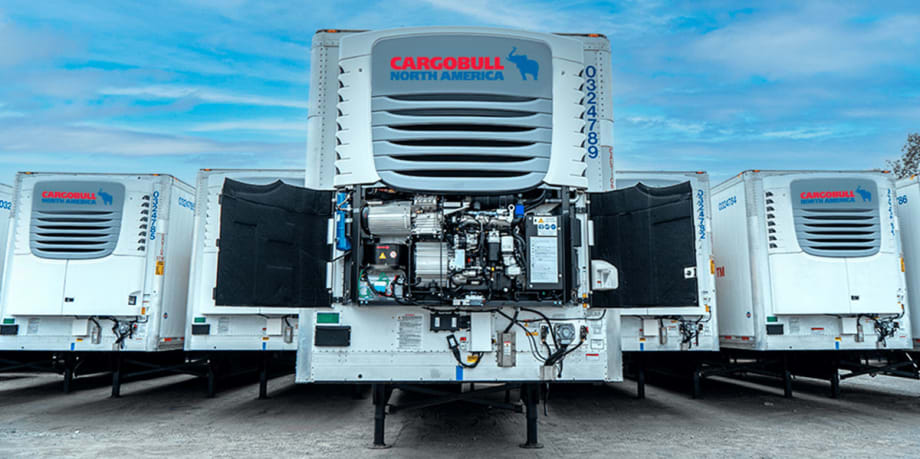
The new Cargobull TRU technology already meets California’s stringent emission standards for 2030. It’s also compliant with California Air Resources Board ultra-low-emission TRU (ULETRU) regulations.
Photo: Utility Cargobull
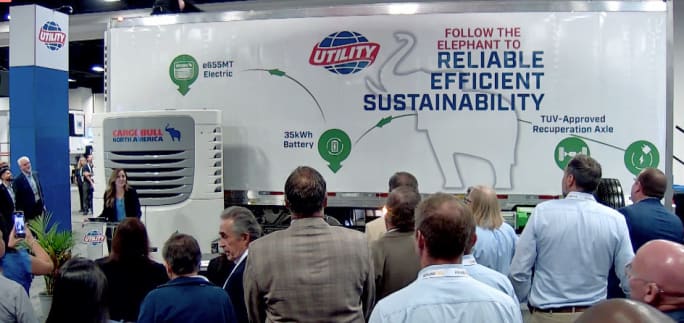
Utility announced the Cargobull news during the International Foodservice Distributors Association’s 2023 Solutions Conference.
Screen capture from virtual news conference
Utility Trailer Manufacturing Company and European trailer manufacturer Schmitz Cargobull Corp. are bringing a new transport refrigeration unit technology and brand to North America.
Under the name Cargobull North America, Utility Trailer is the exclusive North American distributor of Schmitz Cargobull’s latest TRU technology on Utility’s 3000R line of refrigerated trailers.
Schmitz Cargobull is the market leader in TRU technology in Europe, according to the announcement, with 30,000 TRUs currently on the road.
The Cargobull technology offers as much as 20% less fuel consumption, according to the company, with plug-in hybrid and all-electric units to reduce and eliminate emissions.
“This technology is new to North America and will be available exclusively on our 3000R, providing a giant leap forward in terms of TRUs,” said Jeff Bennett, Utility’s new president and CEO, during a press conference at the International Foodservice Distributors Association’s 2023 Solutions Conference.
Cargobull TRUs
The new lineup coming to North America on Utility’s 3000R reefers includes the 625 single-temperature and 655MT multi-temperature hybrid TRUs. Both can hold temperatures from minus 20 to 80 degrees. The compact, low-profile design allows for a shorter gap between tractor and trailer for better aerodynamics.
The multi-temp TRU offers up to three different temperature zones in the trailer. An innovative snorkel and air chute system help eliminate hot spots. The evaporator has three high-velocity vans and an ultra-low profile for more clearance inside the trailer.
The shore power receptacle is located at the back of the trailer.
The TRU technology already meets California’s stringent emission standards for 2030. It’s also compliant with California Air Resources Board ultra-low-emission TRU regulations without using a diesel-particulate filter or exhaust-gas-recirculation.
Because the units can be plugged in at a loading dock, operators will lower emissions while maximizing cooling efficiencies.
The new Utility and Cargobull North America TRUs include a Hatz industrial diesel engine with fuel-sipping common-rail injection, a reliable hybrid powertrain, fully embedded shore power, and noise-dampening options that come standard.
Trailer Telematics
Schmitz Cargobull is also bringing its advanced trailer telematics to monitor and manage fleet logistics.
“The trailer is becoming more and more of an Internet of Things vehicle,” said Schmitz Cargobull Chairman of the Board Andreas Schmitz. Today’s customers need real-time, up-to-date data to monitor loads and operate their fleets more efficiently. And customers increasingly require fleets to share real-time data on their loads.
The Utility TrailerConnect Pro telematics solution is factory-installed and offers temperature-control management with active monitoring and intelligent remote control of the refrigeration units.
The TrailerConnect Pro Integrates the TRU and trailer telematics. In addition to monitoring the TRU, the systems provides monitoring of trailer ABS, brakes and tire pressure monitoring, as well as predictive maintenance for both the TRU and the trailer.
Standard integrated solar panels ensure telematics remain in communication.
The telematics platform is also designed so transport companies can easily share the data with their partners.
“We’re using a simple API,” Schmitz explained, with an open system allowing customers to integrate the data into their existing systems. There’s also a mobile app available.
“We are fully aware that this data belongs to our customers, not to us,” he said. “The customer can choose who he wants to share that data with. He doesn’t have to be afraid we will use that data for something else.”
At the same time, he said, there’s an extensive security system protecting both the hardware on the truck and the data that’s in the cloud.
Future Enhancements
Schmitz highlighted some of the systems that, while not available in North America immediately, will be made possible by the telematics.
For instance, an integrated door-locking system will only open the door when the trailer is in certain geofenced locations.
Fully electric models with battery-recuperation axles are on the way. The system is being tested with prototypes already running in Europe. An electric e-axle will recuperate energy from the axle to charge the battery and power an all-electric cooling unit. Plans are to make it available in North America, as well.
“We can see ourselves eventually optimizing cooling cycles based on the individual use of the customer,” Schmitz said. Some loads may require temperatures to be held in an extremely narrow range, while other runs that have more flexibility could be programmed to operate more fuel-efficiently.
Cargobull foresees setting up a manufacturing plant in North America by 2026.
Family-Owned Trailer Makers with a Long History
The two companies are both family-owned and operated, on their fourth generation of leadership with a fifth in the wings.
“I am very much looking forward to our collaboration,” said Schmitz Cargobull Chairman of the Board Andreas Schmitz in a news release. “Above all, I am convinced that together we will provide added value to North American customers and revolutionize the market.”
Utility President and CEO Jeff Bennett said, “We don’t just want to be the biggest, but also the best, holistic destination for everything reefer customers need, from strong and lightweight boxes to energy-efficient TRUs and high-tech telematics — all in one trailer.”
More Equipment

How Volvo Updated Its D13 for EPA 2027 [Watch]
Volvo’s updated D13 promises lower emissions without sacrificing performance or fuel economy. Take a closer look at what changed inside the engine in this HDT Spotlight video.
Read More →
Michelin Tire Improves Efficiency and Durability for Regional Fleets
The Michelin X Multi Energy D2 is a regional haul drive tire engineered to help fleets improve fuel efficiency, durability and traction in demanding stop-and-go operations.
Read More →
ZF Expands Commercial Vehicle Push in North America
ZF is expanding its North American commercial-vehicle presence with new transmission applications, electrification, trailer technology and autonomous-driving systems.
Read More →
Tesla Wants a Self-Driving Semi. Are Cameras Enough?
Could Tesla’s camera-only autonomous driving technology work on an 80,000-pound Semi? In this commentary, HDT's Deborah Lockridge takes a look at Tesla, Cybercab, and how autonomous trucks see the road.
Read More →
Kodiak: Driverless Long-Haul Truck Launch on Track for 2026
Kodiak AI says its driverless long-haul safety case is 93% complete and it remains on track to begin commercial operations by year-end 2026.
Read More →
What DOT’s Automated Vehicle Strategy Means for Trucking
The U.S. Department of Transportation issued a new automated-vehicle strategy that outlines plans for driverless-truck regulations, cross-state freight corridors, and federal safety standards.
Read More →
East Coast Port Launches $45M Electric Truck Push
The Port Authority of New York and New Jersey announced millions in incentives for zero-emission drayage trucks, yard tractors, and new charging hubs near the port.
Read More →
PlusAI Going Public to Fund Autonomous Truck Launch
A SPAC deal could provide PlusAI with up to $300 million as it works toward a 2027 commercial launch of factory-built autonomous trucks.
Read More →
NHTSA Moves to Rewrite Truck Fuel-Economy Rules
The National Highway Traffic Safety Administration says it lacks authority to regulate medium- and heavy-duty truck engines separately from complete vehicles, but the existing standards have not yet been eliminated.
Read More →
Detroit Opens Orders for EPA 2027 Engines
Detroit isn’t starting from scratch to meet EPA 2027 diesel emissions standards. Its Gen 6 DD13 and DD15 engines keep much of today’s platform while updating the fuel and aftertreatment systems.
Read More →