




Deadline Looms for New CARB Transport Refrigeration Unit Emissions Rules
Refrigerant, particulate emissions get stricter for transport refrigeration units in California soon.

CARB regulations affect transport refrigeration units based outside the state, too.
Source: CARB
New transport refrigeration unit requirements are now in effect in California, according to an email reminder from the California Air Resources Board.
New regulatory requirements as a result of the 2022 amendments to the Airborne Toxic Control Measure for In-Use Diesel-Fueled Transport Refrigeration Units (TRU) and TRU Generator Sets, and Facilities Where TRUs Operate (2022 Amendments) became effective Oct. 1, 2022.
CARB adopted the TRU ATCM in 2004, and amended it in 2010 and 2011, to reduce PM (particulate matter) emissions from diesel-powered TRUs. On Feb. 24 of this year, CARB adopted amendments to the TRU ATCM (2022 Amendments) to achieve additional emission reductions from diesel-powered TRUs.
Beginning Dec. 31, 2022:
Newly manufactured truck TRUs, trailer TRUs, and domestic shipping container TRUs must use refrigerant with a global warming potential less than or equal to 2,200, or no refrigerant at all.
Model year 2023 and newer trailer TRU, domestic shipping container TRU, railcar TRU, and TRU generator set engines must meet a PM emission standard of 0.02 grams per brake horsepower-hour or lower.
Vehicle owners of TRU-equipped trucks or tractor-trailers equipped with a TRU shall ensure the TRU is compliant. If requested, drivers shall allow CARB personnel to conduct a visual inspection of their TRU.
Beginning Dec. 31, 2023:
Owners of refrigerated warehouses or distribution centers with a building size of 20,000 square feet or greater, grocery stores with a building size of 15,000 square feet or greater, seaport facilities, and intermodal railyards with TRU activity (applicable facilities) must register the facility with CARB, pay fees every three years, and report all TRUs that operate at their facility to CARB quarterly, or alternatively ensure that only compliant TRUs operate at their facility (i.e., those with a valid CARB compliance label or showing as compliant on CARB’s website).
TRU owners shall report all TRUs (including out-of-state based) that operate in California to CARB.
TRU owners shall pay TRU operating fees and affix CARB compliance labels to their TRU every three years, for each TRU operated in California.
TRU owners shall turn over at least 15% of their truck TRU fleet (defined as truck TRUs operating in California) to zero-emission technology each year (for seven years). All truck TRUs operating in California shall be zero-emission by Dec. 31, 2029

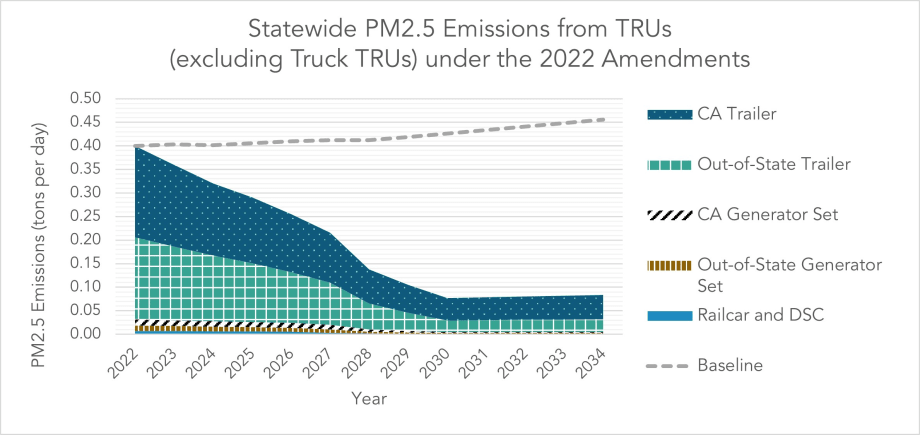
CARB's TRU rules are designed to slash particulate emissions.
Source: CARB
CARB staff developed a regulatory advisory, fact sheet, and Frequently Asked Questions document on the regulatory requirements:
More Fuel Smarts
Electric Yard Tractors Move Beyond Pilots
Operating-cost savings have overtaken sustainability goals as the leading reason surveyed fleets are adopting battery-electric terminal tractors, according to new NACFE research.
Read More →
Geotab Links Fleet Card to Vehicle Data
The new card combines fuel discounts with telematics-based purchase controls. Geotab’s analysis also points to potential savings from choosing lower-priced fuel stops.
Read More →
Fleet Economics Shape Electric Truck Outlook
ACT Research expects costs, charging infrastructure, and technology improvements to drive zero-emission commercial vehicle adoption as federal regulations and incentives retreat.
Read More →
Wex Adds Cardless Fuel Payments for Over-the-Road Customers
A new fuel card feature for Wex customers offers convenience and security.
Read More →
New California Law Could Shed Light on Electric Truck Prices
Why do battery-electric Class 8 trucks remain so expensive? A California bill signed by Gov. Gavin Newsom would give fleets and state agencies more visibility into what manufacturers charge.
Read More →
How Volvo Updated Its D13 for EPA 2027 [Watch]
Volvo’s updated D13 promises lower emissions without sacrificing performance or fuel economy. Take a closer look at what changed inside the engine in this HDT Spotlight video.
Read More →
Diesel Price Spike Shortens Payback for Natural Gas Trucks, Report Says
Energy Vision estimates fleets could recover the higher purchase price of an RNG-fueled Class 8 tractor in 1.3 to 2.8 years under current fuel-price scenarios.
Read More →
Calstart Becomes Catalyst Mobility, Reflecting Broader Focus
Calstart is now Catalyst Mobility, reflecting the nonprofit’s growing national role in clean transportation, including zero-emission trucks, infrastructure and incentive programs.
Read More →
Record Diesel Prices Squeeze Trucking Fleets
Average U.S. diesel prices have climbed to nearly $6 a gallon, surpassing the 2022 record as tight refinery capacity and Middle East disruptions keep fuel costs elevated.
Read More →
East Coast Port Launches $45M Electric Truck Push
The Port Authority of New York and New Jersey announced millions in incentives for zero-emission drayage trucks, yard tractors, and new charging hubs near the port.
Read More →