




FleeTec Academy: Creating New Techs for Cox Automotive
Rather than focusing on finding and hiring technicians in a competitive environment, Cox Automotive Mobility creates its own by recruiting them, then training them at one of two FleeTec Academy locations.


Terry Rivers, senior manager of vehicle services training, Cox Automotive Mobility, explains FleeTec Academy during a tour of its Indianapolis location.
Photo: Wayne Parham
Rather than focusing on finding and hiring technicians in a competitive environment, Cox Automotive Mobility creates its own by recruiting them, then training them at one of its two FleeTec Academy locations. One is in Indianapolis, Indiana, and the other in Phoenix, Arizona.
HDT had the opportunity to visit the FleeTec Academy in Indianapolis and learned how it all works directly from Terry Rivers, senior manager of vehicle services training, Cox Automotive Mobility.
After military service, then many years of service work and even sales, Rivers started an academy for technicians in New York. Cox later bought Rivers’ company and asked him to come on board to start what is now FleeTec Academy.
One key way FleeTec Academy is different from other technician training programs is the time commitment. Rivers said that many colleges and technical schools want technicians to complete two, or maybe even four years of education. It can be $70,000 and years later before a technician can turn his or her first wrench for pay.
FleeTec Academy’s approach is to find the right candidate, then provide the training, support, and tools needed to launch a new career.
“What they do here is they take guys who have never been mechanics before and they make them into mechanics,” Rivers said.
Rivers shared the story of meeting a young man, the son of a Cox Automotive technician. He told Rivers that he had always wanted to be a diesel mechanic like his dad. Rivers asked why he never followed that dream.
The young man, who had been a 4.0-GPA student in high school and earned a bachelor’s degree in psychology, simply explained “They didn’t have scholarships for that,” recalled Rivers.
FleeTec Academy does not require students to take on debt, and there is no scholarship needed in the traditional sense. That same young man completed the academy and has now worked as a tech for Cox Automotive for four-and-a-half years.
“He's one of our best techs. He's been a Top Tech; he's absolutely amazing,” added Rivers.
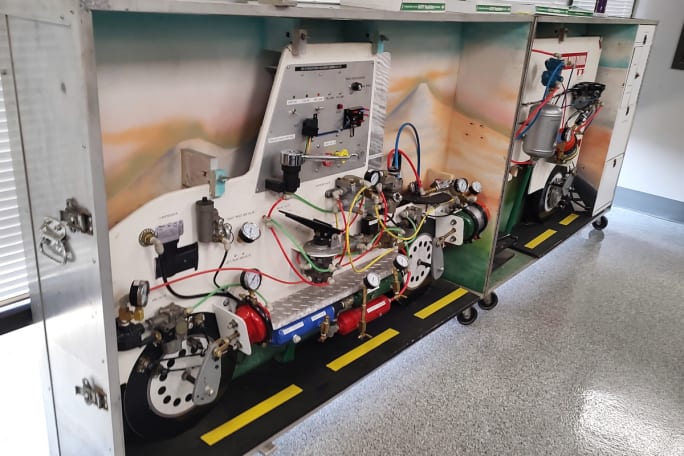
The FleeTec Academy location in Indianapolis features a variety of training aids.
Photo: Wayne Parham
An Intensive 16-Week Technician Training Program
The new students arrive at FleeTec Academy and for four weeks learn how to do preventive maintenance on vehicles.
“Every minute of every day is accounted for the whole time they're here,” Rivers said.
Students are earning a paycheck as soon as they start the academy. They are paid throughout the entirety of the 16-week program, which includes a six-week internship in a Cox automotive shop, and have a job to step into when they complete the training.

FleeTec Academy has a Class 8 tractor in-house for training.
Photo: Wayne Parham
Training Technicians to Deal With Fleet Maintenance Pain Points
Rivers said based on what he has seen over many years, the two main pain points in fleet maintenance are electrical and wheel ends. But that will not be a problem for FleeTec Academy graduates.
“When you go around this academy, you'll see a lot of wheel-end trainers and a lot of electrical trainers," he said. "It has been a weak point for 25 years and we don't want it to be ours.”
Rivers explained that once they are done with the academy and working, the new techs are mostly autonomous, have their own customers, and within about four months will be “just shy” of the average productivity of the more than 1,400 technicians already working in the company.
“So, they're by far not an A tech, they're probably a mid to low C-level technician and they'll work their way up to a B, or an A with more advanced work," Rivers said. "When it comes to the C-tech responsibility, their efficiency, daily revenue, and productivity are pretty parallel with the rest of the company."
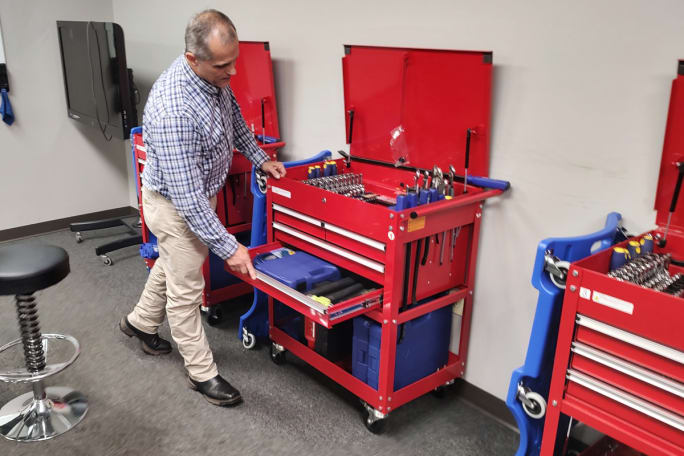
Terry Rivers shows the $20,000 worth of tools that FleeTec Academy graduates keep if they stay with the company for two years.
Photo: Wayne Parham
$20k in Tools
Cox Automotive has removed another barrier to entry that might keep some from becoming technicians. Typically, to acquire the needed tools would take a large sum of money for an aspiring tech.
At FleeTec, not only are they paid during training, but they are also provided with all the tools they need. They walk away with $20,000 in tools that are theirs to keep if they stay with the company for two years.
“They're free and clear after two years of service to us. If we haven't done our job and earned their loyalty, shame on us in those two years. But most of the time, they stay,” Rivers said.
Recruiting the Right Technician Trainees
FleeTec Academy does not want to simply take people who are looking for a job.
“Job is an acronym for Just Over Broke," Rivers said. "We want someone looking for a career."
The Cox interview process usually can tell the difference between those just looking for work, and the career-minded candidates that will stick with the academy and the career, he said.
According to Arthur Lon, senior director of talent management, Cox Automotive Mobility recruitment is focused on recruiting three types of candidates:
Veterans and spouses.
Entry-level candidates with barriers to entry.
Entry-level female candidates.
After the techs complete FleeTec Academy and begin work, they are eligible for more than $22,000 in bonuses and incentives per year, such as:
$4,000 for four technician referrals
$1,410 for six sales leads
$4,200 for 26 weeks of five-star excellence
$1,200 for becoming an ASE Master technician
The Cox Mobility technicians, in their first year, also receive 31 paid days off plus seven paid holidays.
Advanced Mobile Training
For ongoing advanced training after techs are on the job, the academy has an Advanced Mobile Training program that takes the training to the techs.
When Rivers joined Cox, he said,, the approach was to bring about 450 mechanics to Indianapolis for a week of advanced training. But taking 450 mechanics who each generate $1,500 per day away from work is very costly. It turned out to be far cheaper to send the trainer to the techs.
“Instead of taking them out of the field, instead of them flying here, our instructor flies there. So, it's only one guy traveling instead of 450,” he explained.
Once the instructor is on-site, the training is condensed into just two days instead of five.
Technician Retention Rather Than Recruiting
Fowler explained that the national average for technician retention is about 50%. He points back to the days when he said it was “taboo” to try to recruit a technician from another company but said that is fairly common now.
FleeTec Academy creates a steady flow of new fleet maintenance technicians for Cox Automotive, eliminating the need to go out and recruit from other employers. At Cox Automotive, retention is around 75%, according to Rivers.
More Maintenance

Color Match Smarter: Tools That Restore & Perform
For fleet managers and collision repair professionals keeping heavy-duty trucks on the road, getting the color right the first time isn't just about appearance — it's about efficiency, turnaround time, and bottom-line results. Discover how today's digital color tools are transforming the repair process from guesswork to precision.
Read More →
Wrong Repair Prompts Recall of Freightliner, Western Star 4x2 Trucks
DTNA is recalling more than 2,400 trucks that received an incompatible software fix instead of the hardware repair required to address brake valve corrosion.
Read More →
Truck Drivers Need More Than Another Alert
Fleets have more visibility into truck health, safety events, and driver activity than ever. The next challenge is turning all that information into useful guidance for the person who has to decide what to do next.
Read More →
The Maintenance Checks Trucking Fleets Should Prioritize Before Fall Freight Picks Up
Making it through August isn’t the same as being ready for the next several months of operation. Find out what systems may have suffered from summer heat and need to be checked out before fall.
Read More →
What Three Fleets Are Doing Differently When Buying Truck Parts in 2026
With freight improving but costs still climbing, fleet maintenance executives explain how they're balancing price, quality, and supplier relationships.
Read More →
Paccar Recalls 2027 Trucks Built This Summer for Possible Electrical Problem
The nearly 6,000 Kenworth and Peterbilt trucks in the recall could potentially lose engine power, among other things.
Read More →
Will API PC-12 Oil Change Trucking Fleet Maintenance?
The new API PC-12 heavy-duty engine oil category reflects the changing demands of modern diesel engines. But fleets like Foodliner are looking to getting their own data before making decisions on adopting the new oils and questions such as extending oil drain intervals.
Read More →
Brake Safety Week to Focus on Drums and Rotors
Commercial vehicle inspectors are focusing on truck brakes during CVSA's Brake Safety Week, August 23-29.
Read More →Possible Battery-Cable Fires Prompt Recall of 15,000+ International MV and HV Trucks
On the recalled vehicles, manufacturing variations can cause the battery interconnect cable to contact the auxiliary stud and hold down the bracket.
Read More →
Rush, MCT Team Up to Grow Refrigeration Service Network
The joint venture will operate MCT's network of Carrier Transicold dealerships and mobile service locations, with the companies promising greater service capacity and uptime for refrigerated fleets.
Read More →