




WattEV Opens Heavy-Duty Truck Charger Depot at Long Beach Port
WattEV, working with several companies, launched what it calls the largest charging depot for electric trucks in the nation.
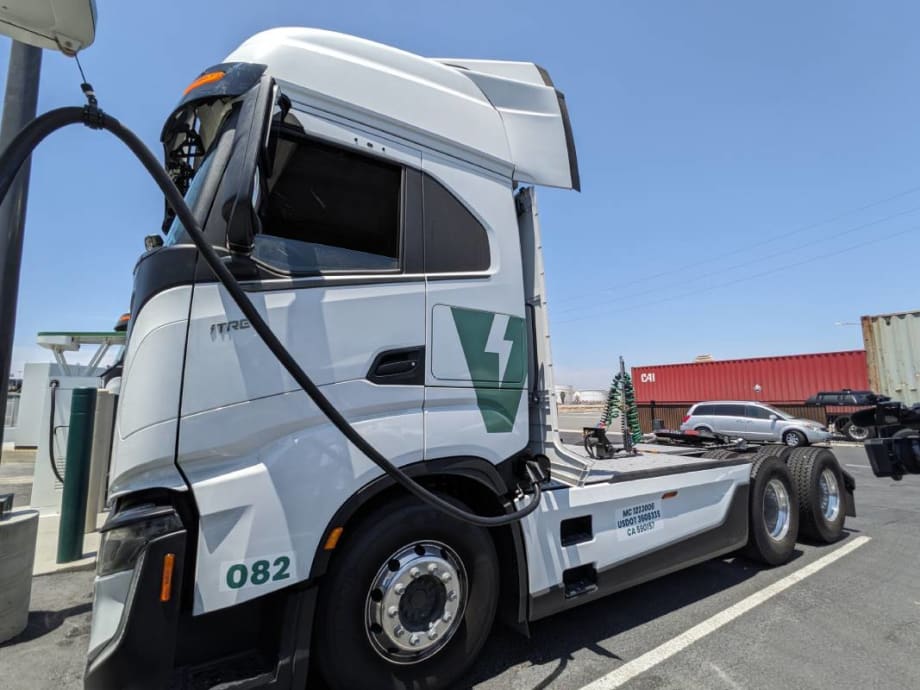
A new Nikola Tre battery-electric truck charges at the just-opened WattEV charging depot at the Port of Long Beach, California. Charging the Class 8 tractor takes 2-3 hours.
Photo: Christian Lopez / Bobit
The Port of Long Beach on July 24 revealed its first electric charging depot for medium- and heavy-duty trucks in a grand opening ceremony.
This facility, located at Pier A in the Port of Long Beach, will operate 14 brand-new Nikola Tre electric trucks. To accelerate zero-emission transportation, WattEV plans to acquire 12,000 heavy-duty trucks to put on the road by 2030.
This facility endeavor took 14 months of construction, with estimated costs around $5 million to $6 million funded in partnership with several companies and nonprofit organizations such as Calstart, Southern California Edison, and the Harbor Community Benefit Foundation.
“We know that the future of, not just our ports, but the country is electric; it’s the transition to clean energy,” said House Rep. Robert Garcia, D-42nd District, in his speech. “So, this is a very exciting time for the Port of Long Beach, and also the state and the country.”
The ceremony, hosting multiple industry, government and environmental partners and stakeholders, highlighted the importance of such a site helping to reduce diesel exhaust emissions generated by trucks working in the port.
“Being a leader in accelerating the transition of U.S. trucking transport to zero emissions is what WattEV does,” said David Chow, vice president and chief operating officer at green tech nonprofit Calstart.
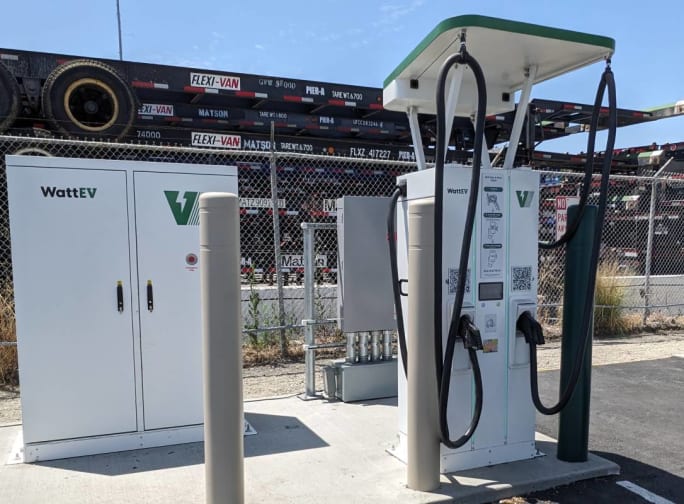
WattEV charging station, producing 360 kilowatts, can achieve a full charge in 2-3 hours.
Photo: Christian Lopez / Bobit
The charging depot has 13 dual-cord CCS 360 kW charging stations. These chargers, while primarily intended for WattEV brand trucks, can be used to charge other electric truck models as well, under its Truck-as-a-Service Model that seeks to make electric Class 8 trucks accessible, affordable, and reliable for all carriers and owner-operators.
Under full charge, which can take about two to three hours, the trucks can travel around 200 to 300 miles. This means vehicle range is an issue compared to diesel-powered trucks. Conventional trucks powered by internal combustion engines can travel more than four times the distance that a battery-electric truck can on a full tank of diesel fuel and only need 20–30 minutes to refuel.
Acknowledging these problems, WattEV CEO Salim Youssefzadeh stressed the development and future implementation of megawatt charging at this facility to help bring that two- to three-hour charging window down to the average.
“Megawatt charging is an important aspect of our business in terms of getting us to where we want to be for battery charge,” Youssefzadeh said.
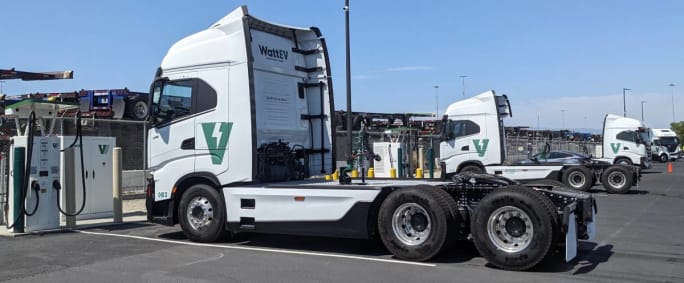
WattEV just took delivery of 14 new Nikola Tre battery-electric trucks. But the company will consider other zero-emission models in the future.
Photo: Christian Lopez / Bobit
Future Electric-Truck Charging Facilities
Although WattEV said this depot is the largest of its kind not only in California, but in the nation, it only takes up 1.5 acres. This will soon change, as there are three more sites under construction and set to be finished by the end of the year in San Bernardino, Gardena, and Bakersfield, California.
“This is our smallest facility. Some of our other ones would be much larger and have the traditional rest area amenities. Bakersfield, for instance, that's 115 acres,” said Youssefzadeh in an interview.
After the four other facilities are finished, WattEV hopes to expand outside of the state in Arizona and New Mexico, while also looking toward the East Coast.
Correction: A caption has been corrected that erroneously identified the Nikola Tre truck.
More Fuel Smarts
Trucking’s Diesel Squeeze Isn’t Letting Up
With diesel topping $6 a gallon nationally, ATA's Bob Costello explains why fleets should prepare for continued pressure at the pump.
Read More →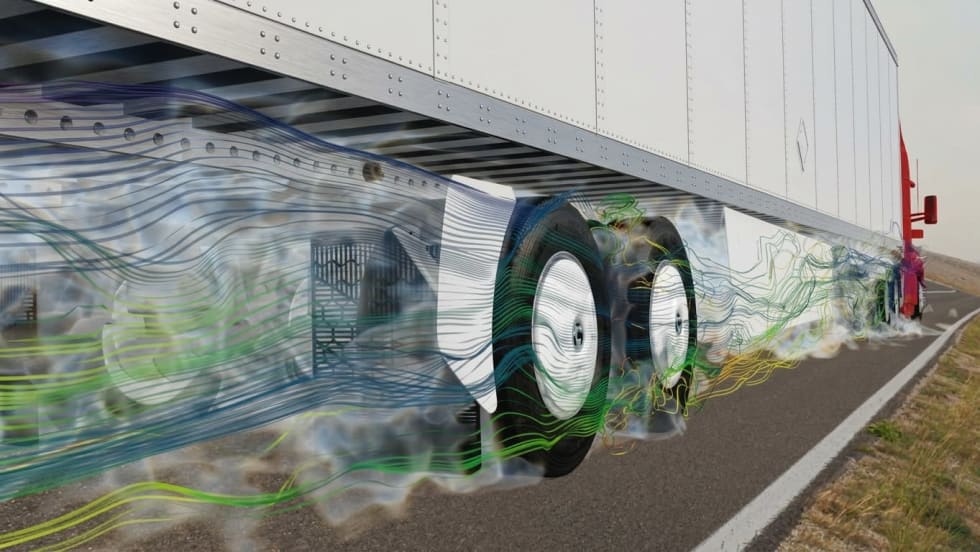
FlowBelow Redesigns Trailer AeroSlider to Cut Fuel Use
The lighter trailer aerodynamic system installs in less than 45 minutes, according to the company, with potential payback in under a year depending on fuel prices and trailer mileage.
Read More →
Why Diesel Price Relief Efforts May Fall Short
Diesel prices have eased from September’s record high, but doubts about additional Russian supply and limits on dyed-diesel tax relief mean trucking fleets still face expensive fuel. And prices could go higher.
Read More →
Why Small Fuel Savings Matter in Trucking
Can better fuel economy help pay for driver raises? In this podcast, GP Transco explains how small efficiency gains create room to reinvest in its people.
Read More →
How GP Transco Cuts Trucking Fuel Costs, a Tenth of a Gallon at a Time
What’s another tenth of a mile per gallon worth? GP Transco shares how equipment upgrades and driver coaching turn small gains into meaningful fuel savings.
Read More →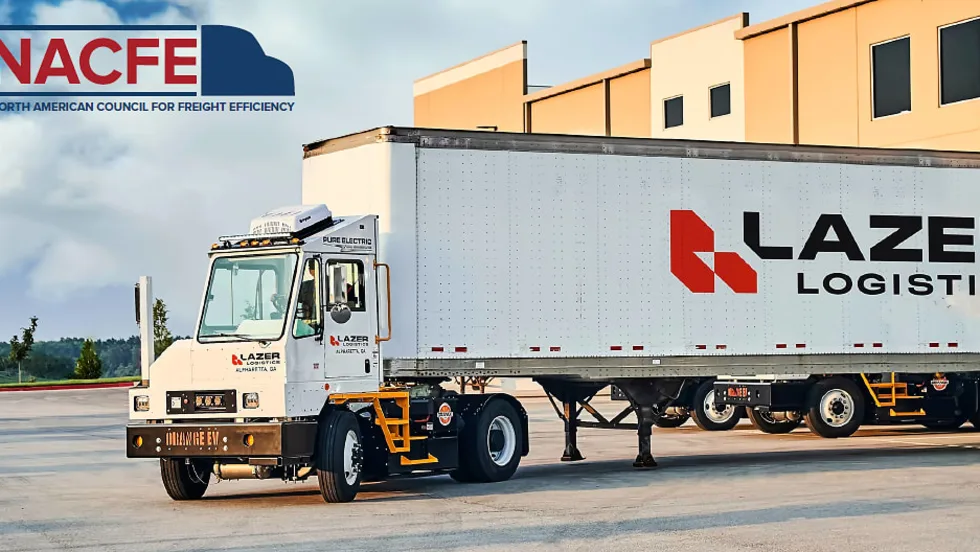
Electric Yard Tractors Move Beyond Pilots
Operating-cost savings have overtaken sustainability goals as the leading reason surveyed fleets are adopting battery-electric terminal tractors, according to new NACFE research.
Read More →
Geotab Links Fleet Card to Vehicle Data
The new card combines fuel discounts with telematics-based purchase controls. Geotab’s analysis also points to potential savings from choosing lower-priced fuel stops.
Read More →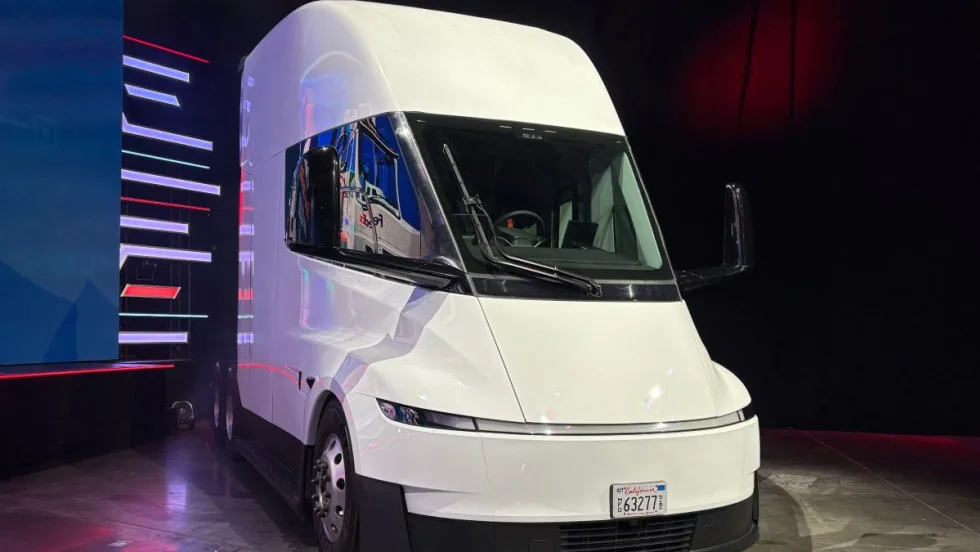
Fleet Economics Shape Electric Truck Outlook
ACT Research expects costs, charging infrastructure, and technology improvements to drive zero-emission commercial vehicle adoption as federal regulations and incentives retreat.
Read More →
Wex Adds Cardless Fuel Payments for Over-the-Road Customers
A new fuel card feature for Wex customers offers convenience and security.
Read More →
New California Law Could Shed Light on Electric Truck Prices
Why do battery-electric Class 8 trucks remain so expensive? A California bill signed by Gov. Gavin Newsom would give fleets and state agencies more visibility into what manufacturers charge.
Read More →