





Dig Deeper: 9 Keys to Drawing a Roadmap to Zero Fleet Emissions
The Winding but Accelerating Road to Zero Emissions for Trucking
What do the next 30 years hold for the decarbonization of trucking? Cummins President and CEO Jennifer Rumsey offered a look in her keynote address to the annual Green Truck Summit.
March 7, 2023
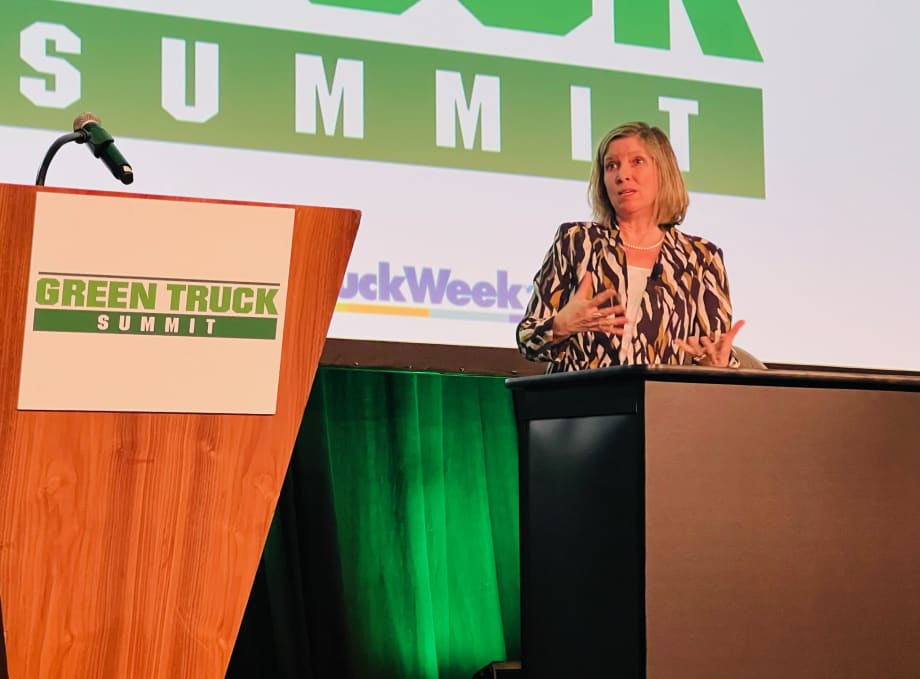
After her keynoter, Cummins CEO Jennifer Rumsey answered questions submitted electronically by members of the audience.
Photo: David Cullen
3 min to read
Trucking’s ongoing energy transition “will unfold with different technologies for different applications, which means there will be no one solution,” said Cummins President and CEO Jennifer Rumsey in her keynote address to the annual Green Truck Summit on March 7 in Indianapolis. The one-day conference is held alongside the Work Truck Show, which runs through March 10.
By contrast, Rumsey said the technologies that will be in play over roughly the next 30 years to decarbonize transportation will range from clean diesel, natural gas, and propane to battery-electric, hydrogen, and fuel cell powertrains.
She also made a point of stressing that advances along these pathways to zero-emission commercial vehicles will overlap and proceed at varying paces. And at any mile marker along the way, there will be more than one solution for fleets to leverage to meet emissions regulations as well as to hit their own green targets.
“The idea [for Cummins] is to invest with a mind to meet different goals and time frames,” said Rumsey. “Our customers know how to operate and achieve a profit. But they are facing growing headwinds,” including inflation, supply constraints, ESG pressures, and “knowing you must try alternatives.
However, she said Cummins can help by “shining some light on uncertain regulatory frameworks, the uncertainty of charging infrastructure, and which of the new technologies may work for your needs.”
Key Fleet Considerations
Rumsey listed four considerations for fleets when adopting technology:
Can the technology get the job done, considering power, torque, range, efficiency, etc.?
Is it economically feasible? What is the fleet’s total cost of ownership?
Is the infrastructure in place to support it?
Will the fleet be able to have this equipment serviced and maintained?
Taking into account the energy sources being developed for decarbonization, the need for infrastructure investment to put them into service, further regulatory advancements, and the level of “customer pull,” Rumsey presented Cummins’ view of how the energy transition will look going from today, to the waypoint of the mid-2030s, to the goalpost of the mid- 2040s to 2050 for the decarbonization of trucking.
The Quarter Century Sprint into the Future
Rumsey said that “we’re starting from today to get to zero by 2050.” Starting from now, efforts will continue to “advance today’s solutions and accelerate solutions for the future.”
By around 2035, “many solutions will be deployed and progressing at varied paces.”
The momentum from there will lead to further progress so that from around 2045 onto 2050, “zero-emissions solutions will become broadly available.”

The path to zero emissions will require a variety of solutions for trucking fleets.
Photo: David Cullen
Hydrogen on the Rise
Cummins’ role in driving to that goalpost is based on its reputation for investment and overcoming challenges, Rumsey said.
To that end, in 2019, the world’s largest manufacturer of diesel engines rebranded its electrification business as Cummins New Power. The name change also reflects the company’s growing development of hydrogen generation and hydrogen fuel cell power. She noted that where things stand now, hydrogen will be part of the solution, including fuel cells for longer vehicle range.
Generally agreed upon by the marketplace is that the basic two uses of hydrogen in a truck are:
Hydrogen fuel in an internal-combustion engine. Compared to a diesel engine, this produces no CO2 — but it may produce NOx.
A hydrogen fuel cell can be used to power a zero-emissions electric vehicle, sometimes with a small onboard battery.
“With our New Power division,” Rumsey said, “we can invest in different technologies and leverage partnerships” to advance to zero emissions. “We can also replicate our [global] powertrain leadership position and sustain growth well into the future.”
In reply to an audience question, Rumsey remarked that the U.S. EPA 2027 rules for GHG emissions from trucks are a positive development in that they “present tough but clear standards that are technologically neutral.” She added that Cummins seeks to be “fuel agnostic” on the road to zero truck emissions and that stance includes “working with a commonality of [engine/powertrain] platforms."
More Fuel Smarts
Why Small Fuel Savings Matter in Trucking
Can better fuel economy help pay for driver raises? In this podcast, GP Transco explains how small efficiency gains create room to reinvest in its people.
Read More →
How GP Transco Cuts Trucking Fuel Costs, a Tenth of a Gallon at a Time
What’s another tenth of a mile per gallon worth? GP Transco shares how equipment upgrades and driver coaching turn small gains into meaningful fuel savings.
Read More →
Electric Yard Tractors Move Beyond Pilots
Operating-cost savings have overtaken sustainability goals as the leading reason surveyed fleets are adopting battery-electric terminal tractors, according to new NACFE research.
Read More →
Geotab Links Fleet Card to Vehicle Data
The new card combines fuel discounts with telematics-based purchase controls. Geotab’s analysis also points to potential savings from choosing lower-priced fuel stops.
Read More →
Fleet Economics Shape Electric Truck Outlook
ACT Research expects costs, charging infrastructure, and technology improvements to drive zero-emission commercial vehicle adoption as federal regulations and incentives retreat.
Read More →
Wex Adds Cardless Fuel Payments for Over-the-Road Customers
A new fuel card feature for Wex customers offers convenience and security.
Read More →
New California Law Could Shed Light on Electric Truck Prices
Why do battery-electric Class 8 trucks remain so expensive? A California bill signed by Gov. Gavin Newsom would give fleets and state agencies more visibility into what manufacturers charge.
Read More →
How Volvo Updated Its D13 for EPA 2027 [Watch]
Volvo’s updated D13 promises lower emissions without sacrificing performance or fuel economy. Take a closer look at what changed inside the engine in this HDT Spotlight video.
Read More →
Diesel Price Spike Shortens Payback for Natural Gas Trucks, Report Says
Energy Vision estimates fleets could recover the higher purchase price of an RNG-fueled Class 8 tractor in 1.3 to 2.8 years under current fuel-price scenarios.
Read More →
Calstart Becomes Catalyst Mobility, Reflecting Broader Focus
Calstart is now Catalyst Mobility, reflecting the nonprofit’s growing national role in clean transportation, including zero-emission trucks, infrastructure and incentive programs.
Read More →