




Volvo Emphasizes Customer Collaboration in Autonomous-Truck Development
In collaboration with Aurora, Volvo Autonomous Solutions plans to offer autonomous trucks in the U.S., while also developing a transport-as-a-service (TaaS) solution for integrated and scalable autonomous freight capacity for highway applications.


Unlike many other autonomous-truck developers, Volvo is emphasizing how the technology will work in trucking operations over what type of sensors it's using.
Photo: Deborah Lockridge
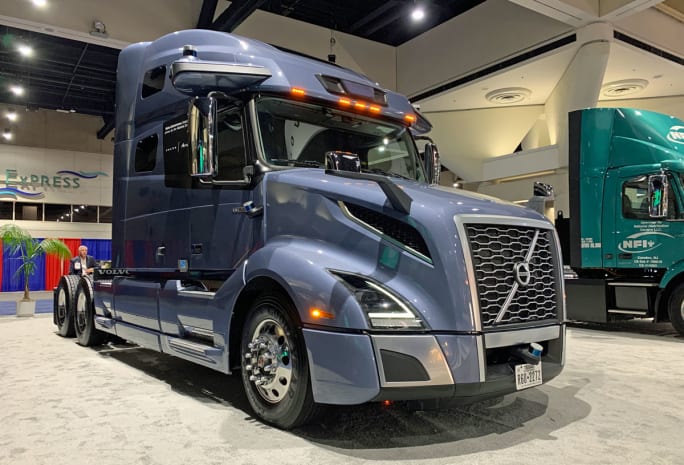
Volvo's autonomous truck was on display at the American Trucking Associations' Management Conference and Exhibition.
Photo: Deborah Lockridge
Volvo displayed a VNL 760 with Aurora autonomous-truck technology at the American Trucking Associations Management Conference & Exhibition in San Diego Oct. 23-25 but did not have many details to share, emphasizing that the company is not in a race.
As it announced earlier this year, Volvo Autonomous Solutions and Aurora are working with a key customer, DHL, on the development and testing.
“Safety is number one with all the trucks we build,” said Peter Voorhooeve, president, Volvo Trucks North America, during an ATA press conference. “Our goal is zero fatalities with Volvo trucks involved. We’re developing a solution with Aurora and key customers, DHL is one of them, but we’re not in a race.
“This will go fast,” he said, although not as fast as battery-electric truck adoption.
Volvo Autonomous Solutions
Sasko Cuklev, head of on-road solutions for Volvo Autonomous Solutions, explained in an interview with HDT that Volvo Autonomous Solutions is a separate business that’s also part of the Volvo Group. In addition to on-highway trucking, it also is working on autonomous solutions for mining and for port drayage. Its mining solutions are being developed in-house. The port autonomous technology is being developed with Nvidia. These two technologies are making their appearance in Europe. The long-haul, on-highway technology is being developed with Aurora for the U.S.
Cuklev said VAS sees autonomous technology as complementary, rather than something that’s going to replace every truck driver. “We need new types of solutions in places where it makes sense,” in applications where it would free drivers from the burden of long days on the road away from home.
He, too, emphasized the Volvo is not in a race. When asked for a progress report, Cuklev said, “We believe we are well positioned and we are going to be one of the winners.”
He said you won’t see flashy announcements from Volvo about autonomous-truck milestones such as being the first coast-to-coast “driverless” run. Instead, he said, Volvo is working on an “industrialized, scalable solution developed with our customers.” The plan is for these trucks to come right off the factory assembly line with a fully integrated autonomous solution built in.
A big part of that process, he said, is also to look at how this technology will be integrated into trucking operations. There’s so much more to consider, he said, beyond the autonomous “driver.”
Volvo-DHL Autonomous Partnership
Back in May, Volvo Autonomous Solutions announced plans to offer a new hub-to-hub autonomous transport solution in North America, designed to serve four main customer segments:
Shippers
Carriers
Logistics service providers
Freight brokers
VAS also announced that it will partner with global logistics provider DHL Supply Chain as its first customer to pilot the hub-to-hub solution.
In collaboration with Aurora, VAS has been working on a technical solution to offer autonomous trucks in the U.S., while also developing a complete transport-as-a-service (TaaS) solution for integrated and scalable autonomous freight capacity for highway applications. The Autonomous Transport Solution will be configured to different customer-segment requirements to transport freight autonomously on major U.S. highway networks. This solution, Volvo said, will:
Create value for the entire transportation ecosystem
Increase transport resource utilization and free up capacity
Reduce emissions and increase safety
“Today, the increasing demand for freight is outgrowing capacity and solutions must be bolder, safer, smarter and more sustainable to move the world forward,” said Nils Jaeger, president of Volvo Autonomous Solutions, at that time. “This is more than an autonomous truck — it is the Autonomous Transport Solution, which we believe will create value for the entire transportation ecosystem, all with optimized operations that reduce emissions and increase safety.”
VAS is working across all four customer segments to finalize strategic partnerships with additional key customers to pilot the Autonomous Transport Solution. These partnerships will allow VAS to understand the needs of each specific segment in real-world applications.
Like other autonomous-tech companies, VAS is starting with operations in Texas, Cuklev said. The weather there is favorable for driverless-truck operation, there are dense freight corridors, and the regulatory environment is favorable for autonomous trucks. The initial two lanes for pilot operations will be Dallas to Houston and Fort Worth to El Paso.
More Fleet Management

Color Match Smarter: Tools That Restore & Perform
For fleet managers and collision repair professionals keeping heavy-duty trucks on the road, getting the color right the first time isn't just about appearance — it's about efficiency, turnaround time, and bottom-line results. Discover how today's digital color tools are transforming the repair process from guesswork to precision.
Read More →
FMCSA Pauses Biennial-Update Enforcement Amid Motus Transition
Carriers whose updates were due on or after June 1 have more time, while FMCSA works to stabilize its new registration system and warns of phishing sites impersonating its new carrier registration system, Motus.
Read More →
2026 Blueprint for Countering Smarter Supply Chain Theft
Cargo theft is no longer just the cost of doing business. It's a multi-billion-dollar criminal enterprise exploiting vulnerabilities across your fleet, drivers, and supply chain.
Read More →


How Telematics Improves Visibility, Control, and Performance in Refrigerated Fleets
Explore how telematics help refrigerated fleets improve visibility, uptime, efficiency, compliance, and cargo protection across connected cold chain operations.
Read More →
What the U.S.-Canada Trade War Means for Trucking
Escalating U.S.-Canada tariffs could disrupt cross-border freight, reduce truck volumes, raise costs, and create new uncertainty for carriers on both sides of the border.
Read More →
What Are Trucking’s Top Concerns for 2026?
The American Transportation Research Institute wants to know what's worrying trucking fleet managers, drivers, and other stakeholders in its annual Industry Issues survey.
Read More →
American Trucking Associations Looks for a New Leader
ATA President and CEO Chris Spear abruptly left his job at the association on August 21, at a pivotal time for the trucking industry.
Read More →
Public Wi-Fi Cybersecurity Risks: How Truck Drivers and Fleets Can Protect Their Data
Public Wi-Fi can expose truck drivers and fleets to credential theft, malware, and other cyber threats. Here’s how to reduce the risk on the road.
Read More →
For Nicky Cupp, Fleet Innovation Starts With Frustration
HDT Truck Fleet Innovator Nicky Cupp turns everyday pain points at Fraley & Schilling into opportunities for better technology and smarter processes.
Read More →
Adam Buttgenbach’s Approach to Electric Trucks: Start With Where They Fit
HDT Truck Fleet Innovator Adam Buttgenbach helped PepsiCo build one of North America’s largest EV fleets by focusing on where electric trucks make operational sense.
Read More →