




Nikola, Iveco Show European BEV, FCEV Trucks at IAA
Orders officially opened for the European Nikola Tre battery-electric truck at the IAA show in Germany, where the company also showed off a beta version of its the European Nikola Tre fuel-cell electric truck.

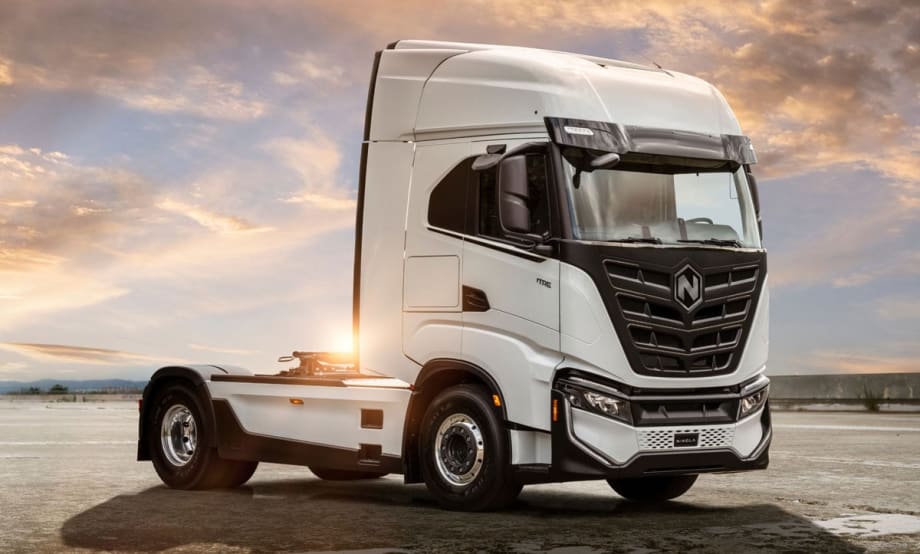
The European 4x2 Artic version of the Nikola Tre BEV boasts a range up to 530 km (about 330 miles) for regional applications.
Photo: Nikola
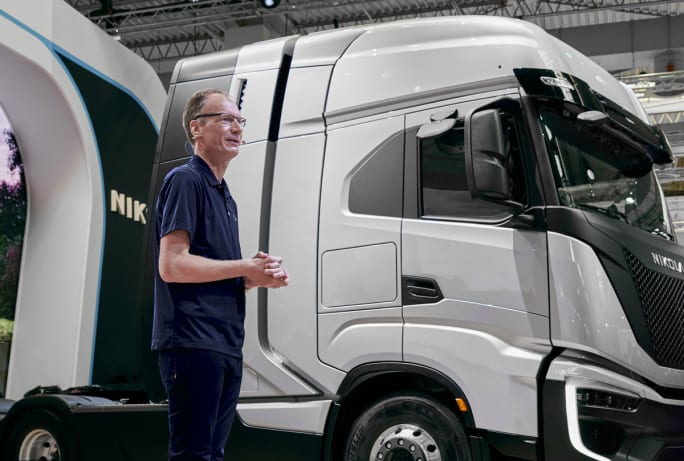
Michael Lohscheller, president of Nikola, unveiled the Nikola Tre 6x2 FCEV beta version at IAA 2022.
Photo: Nikola
Nikola Corp. and its European partner Iveco commercially launched the European Nikola Tre battery-electric truck and unveiled the European Nikola Tre fuel-cell electric beta version at the IAA Transportation Show in Hanover, Germany, Sept. 19.
The European 4x2 Artic (tractor) version of the Nikola Tre BEV is a zero-emissions heavy-duty truck. According to the company, it has a best-in-class range of up to 530 km and the performance to fit a wide range of regional applications.
The European Nikola Tre FCEV in beta version also made its debut, offering a glimpse of the soon-to-come electric propulsion semi-truck for long hauling. The fuel-cell truck is expected to launch in the second half of 2023 in North America and first half of 2024 in Europe.
The Nikola Tre FCEV Artic 6x2 in beta version features a steering tag axle and a new cab with improved aerodynamic performance. It can accommodate approximately 70 usable kilograms of hydrogen at 700-bar pressure. This capacity, together with its fast-refueling time of under 20 minutes, enables a range of up to 800 km.
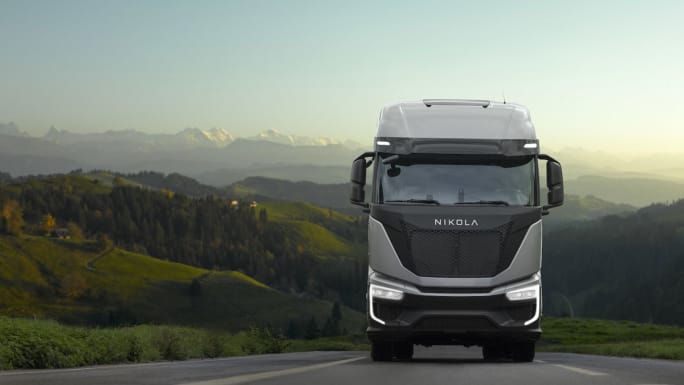
The European Nikola Tre FCEV in beta version made its debut at IAA Transportation 2022, expected to launch in the second half of 2023 in North America and first half of 2024 in Europe.
Photo: Nikola
Orders Open for European Nikola Tre BEV
The press conference marked the official opening of orders for the European 4x2 Artic version of the Nikola Tre BEV. The tractor features nine batteries with a total energy storage up to 738 kWh, which delivers a range of up to 530 km. An 80% charge takes an estimated 100 minutes at 350 kW.
With 480 kW continuous power of the FPT Industrial e-Axle, the truck has the power, torque and range to perform applications such as hub-to-hub deliveries and regional hauling, according to the announcement, and its mileage can be extended with opportunity charging.
The European Nikola Tre BEV is produced by the Nikola Iveco Europe joint venture in its dedicated manufacturing plant in Ulm, Germany. The facility, inaugurated in 2021, features a final assembly process specifically designed for electric vehicles and operates to world-class manufacturing standards.
Nikola marked the beginning of its commercial serial truck production of its Nikola Tre battery-electric Class 8 truck for North America in Coolidge, Arizona, earlier this year.
“The Nikola Tre battery-electric and fuel cell electric zero-emission trucks are true game-changers in commercial trucking,” said Michael Lohscheller, president of Nikola Corp., in a news release. “Specifically developed as electric vehicles, they deliver the performance and driving experience able to compete with their diesel-powered peers in the toughest heavy-duty missions. They offer operationally and financially viable zero-emissions solutions for regional applications and long-distance hauling that will give customers a true competitive advantage.”
Luca Sra, Iveco Group’s Truck Business Unit president, said, “It is the first-ever electric-born modular platform for articulated heavy-duty tractors hosting both energy sources: battery-electric for missions of approximately 500 km and fuel cell electric powertrain for hauling up to 800 km in its first generation. A true revolution that marks a tangible step towards our ambitious goal of achieving a zero-emissions transport.”
More Fuel Smarts

How Volvo Updated Its D13 for EPA 2027 [Watch]
Volvo’s updated D13 promises lower emissions without sacrificing performance or fuel economy. Take a closer look at what changed inside the engine in this HDT Spotlight video.
Read More →
Diesel Price Spike Shortens Payback for Natural Gas Trucks, Report Says
Energy Vision estimates fleets could recover the higher purchase price of an RNG-fueled Class 8 tractor in 1.3 to 2.8 years under current fuel-price scenarios.
Read More →
Calstart Becomes Catalyst Mobility, Reflecting Broader Focus
Calstart is now Catalyst Mobility, reflecting the nonprofit’s growing national role in clean transportation, including zero-emission trucks, infrastructure and incentive programs.
Read More →

Record Diesel Prices Squeeze Trucking Fleets
Average U.S. diesel prices have climbed to nearly $6 a gallon, surpassing the 2022 record as tight refinery capacity and Middle East disruptions keep fuel costs elevated.
Read More →
How Fuel Delivery Shapes Engine Performance
Fuel delivery depends on more than what happens at the injector. For fleet, maintenance and technical professionals, looking at the full path from pump to injector can provide useful context for understanding engine performance.
Read More →
East Coast Port Launches $45M Electric Truck Push
The Port Authority of New York and New Jersey announced millions in incentives for zero-emission drayage trucks, yard tractors, and new charging hubs near the port.
Read More →
California Bill Could Shed Light on Electric Truck Prices
Why do battery-electric Class 8 trucks remain so expensive? A California bill headed to Gov. Gavin Newsom would give fleets and state agencies more visibility into what manufacturers charge.
Read More →
Detroit Opens Orders for EPA 2027 Engines
Detroit isn’t starting from scratch to meet EPA 2027 diesel emissions standards. Its Gen 6 DD13 and DD15 engines keep much of today’s platform while updating the fuel and aftertreatment systems.
Read More →
Zero-Emission Truck Corridor Planned for West Coast
California, Oregon, Washington, British Columbia and Baja California are coordinating plans for truck charging and hydrogen fueling from Canada to Mexico.
Read More →
A Closer Look at Kenworth’s Electric T880E Vocational Truck [Video]
Learn more about Kenworth's T880E battery-electric vocational truck at the Paccar Technical Center, including its range, applications, upfitting considerations, and PTO options, in this HDT Spotlight video.
Read More →