





Listen: Inspections and Maintenance for Autonomous Trucks
unknown nodeEmbark Works on Autonomous-Truck Interactions with Law Enforcement
What do law-enforcement officials do when they need to stop a driverless truck? Autonomous truck tech developer Embark Trucks is working with the Texas Department of Public Safety to answer that question.
June 1, 2022
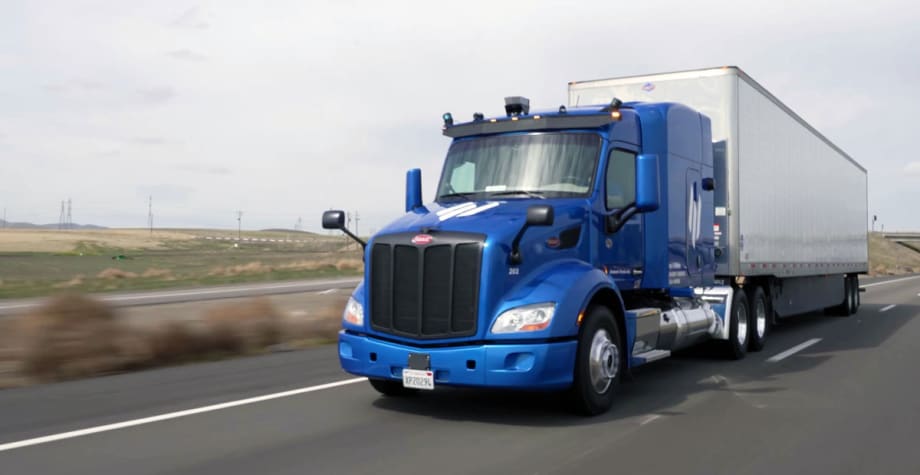
One thing Embark is exploring with the help of law enforcement is outfitting Embark trucks with clear visual cues to signal that this is an autonomous truck.
Photo: Embark Trucks
3 min to read
What do law-enforcement officials do when they need to stop a driverless truck? Autonomous truck tech developer Embark Trucks is working with the Texas Department of Public Safety to answer that question.
A recent viral video featured a confused law enforcement officer who approached a driverless car – which then proceeded to speed off into an intersection. Although it was slightly humorous, it was an illustration of some of the challenges faced in deploying autonomous vehicles.
Embark has been working to develop an emergency vehicle interaction capability for Embark-powered autonomous trucks to identify, stop for, and interface with law enforcement vehicles. The company’s working with the Texas DPS to train Embark-powered trucks to identify law enforcement vehicles in situations such as traffic stops, and to develop communication protocols and standard operating procedures between autonomous trucks and law enforcement officers.
Embark plans to publicly demonstrate the emergency vehicle interaction capability later this summer.
The emergency vehicle interaction capability is an engineering breakthrough with two key components:
Embark’s engineering team is building the technical functionality for the capability, training Embark-powered trucks to identify emergency vehicle lights and other cues to slow down and pull over safely onto highway shoulders in accordance with law enforcement requests.
Embark is developing an interaction procedure with input from law enforcement that can enable any law enforcement officer to safely stop, approach, and receive information from an autonomous truck, intuitively and without any additional equipment. This effort may include outfitting Embark trucks with clear visual cues and information to signal to law enforcement personnel that an Embark-powered truck is an autonomous vehicle and has come to a safe stop with no risk of restarting unexpectedly.
Embark also plans to outfit trucks with a lockbox accessible to law enforcement containing vehicle and load information such as registration and bills of lading, as well as contact information so law enforcement officers can reach an Embark Guardian operator to verify documentation.
Together, these features represent a comprehensive process for Embark-powered trucks to comply with law enforcement requests and, in the unlikely event of a traffic stop, pull over onto the highway shoulder so officers can safely interact with the truck.
Emergency vehicle interaction is the next capability Embark has identified in its technical capabilities roadmap1, which details 16 technology achievements it has outlined that need to happen in order to deploy autonomous technology in the U.S. Sunbelt, the region stretching across the southeastern and southwestern U.S. Embark has already achieved 11 of these milestones, and the emergency vehicle interaction capability represents the next step toward commercial deployment of its technology.
Other remaining technology milestones include evasive maneuvers, emergency vehicle interactions, blown tires, safety pulling over to the shoulder, and inspections.
More Safety & Compliance

FMCSA Pauses Biennial-Update Enforcement Amid Motus Transition
Carriers whose updates were due on or after June 1 have more time, while FMCSA works to stabilize its new registration system and warns of phishing sites impersonating its new carrier registration system, Motus.
Read More →
ZF Expands Commercial Vehicle Push in North America
ZF is expanding its North American commercial-vehicle presence with new transmission applications, electrification, trailer technology and autonomous-driving systems.
Read More →
Truck Drivers Need More Than Another Alert
Fleets have more visibility into truck health, safety events, and driver activity than ever. The next challenge is turning all that information into useful guidance for the person who has to decide what to do next.
Read More →
Tesla Wants a Self-Driving Semi. Are Cameras Enough?
Could Tesla’s camera-only autonomous driving technology work on an 80,000-pound Semi? In this commentary, HDT's Deborah Lockridge takes a look at Tesla, Cybercab, and how autonomous trucks see the road.
Read More →
What DOT’s Automated Vehicle Strategy Means for Trucking
The U.S. Department of Transportation issued a new automated-vehicle strategy that outlines plans for driverless-truck regulations, cross-state freight corridors, and federal safety standards.
Read More →
NYC Expands Speed, Pedestrian Safety Tech Across Fleet
New York City is expanding intelligent speed assistance and pedestrian-alert systems across its municipal fleet, moving the technologies from pilot programs into vehicle procurement and retrofit requirements.
Read More →
FMCSA Removes 110 Truck Driver Training Schools from Certified ELDT List
Federal regulators also are targeting more than 160 additional training providers and launching a nationwide audit of third-party CDL skills testers as part of a broader crackdown on trucking fraud.
Read More →
Beyond DOT Compliance: What Makes a Trucking Fleet Truly Safe?
A trucking fleet can follow every rule and still make unsafe decisions. The real test comes when safety conflicts with freight, productivity, or cost.
Read More →
Hours of Service Pilot Programs: FMCSA Readies for 2027 Rollout
Two pilot programs could eventually reshape hours-of-service rules, giving truck drivers options to pause their 14-hour clock or use longer split sleeper rest periods.
Read More →
New Guide Offers Pet Safety Tips for Truck Drivers
Hundreds of thousands of pets travel in truck cabs. A new safety guide from Volvo Trucks and the Center for Pet Safety offers practical advice for truck drivers who bring dogs and cats along for the ride.
Read More →