





Hydrogen and Fuel Cell Providers to Develop Class 6 Fuel Cell Electric Trucks
Ballard, Mahle Start Work on Concept Engine for Long-Haul Trucks
In a multi-year development program Ballard and Mahle will continuously refine Ballard’s compact, energy-dense fuel cell stack and an integrated engine to meet the expectations of the truck industry.
February 24, 2022

The new concept engine is a part of the ongoing development of Ballard’s future product platform to address the requirements of heavy-duty and long-haul trucks on global markets.
Photo: Ballard
2 min to read
Ballard Power Systems and Mahle Group are progressing the development of a new fuel cell engine concept for long-haul trucks, with Mahle taking delivery of a 120 Kilowatt module at the company’s hydrogen test center in Stuttgart, Germany.
The new concept engine is a part of the ongoing development of Ballard’s future product platform, which will feature power outputs from 180 kW to 360 kW, to specifically address the requirements of heavy-duty and long-haul trucks on global markets.
The joint project is a multi-year development program in which Ballard and Mahle will continuously refine Ballard’s compact, energy-dense fuel cell stack and an integrated engine to meet the quality and performance expectations of the truck industry.
“We are committed to fuel cell technology leadership, and to tailoring our fuel cell solutions to our customers’ needs,” said Seungsoo Jung, Ballard’s product director for trucks, in a press release. “We are extremely optimistic about the value of our collaboration with Mahle — combining their strength in the automotive value chain with our leadership in hydrogen fuel cell technology and products.”
The module incorporates Ballard’s FCgen- HPS Fuel Cell stack, which addresses limited engine space, and maximizes freight and cargo capacity. Based on an earlier high power density design, the technology draws on Ballard’s on-road experience of 62 million miles in service and proven fuel cell durability, exceeding 30,000 in vehicle operation as demonstrated in the London bus fleet.
The concept fuel cell module is the central building block in Ballard’s future engine, which Mahle will now test and integrate with their components, including the balance-of-plant, thermal management and power electronics, and the system assembly.
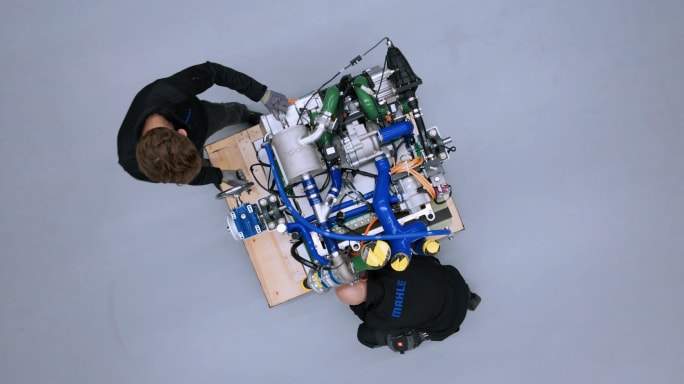
Mahle took delivery of a 120 Kilowatt module at the company’s hydrogen test center in Stuttgart, Germany.
Photo: Ballard
The new concept engine for heavy-duty vehicles will feature a 120 kilowatt module that can deliver up to 240 kW power, to serve the needs of Class 8 and long-haul freight trucks and coaches that require more power and longer range than transit buses or short-range delivery vehicles.
The module design features reduced weight, fewer parts and a more compact design. An “open engine concept design” provides access to parts and the subsystem, for easier maintenance and ultimately, a lower total life cycle cost, according to the company.
The partnership’s aim is to accelerate the development and commercialization of zero-emission fuel cell systems. Ballard has prime responsibility for system design and the fuel cell stack sub-system, while Mahle’s scope of responsibility includes balance-of-plant components, thermal management and power electronics for the complete fuel cell system.
More Fuel Smarts

How Volvo Updated Its D13 for EPA 2027 [Watch]
Volvo’s updated D13 promises lower emissions without sacrificing performance or fuel economy. Take a closer look at what changed inside the engine in this HDT Spotlight video.
Read More →
Diesel Price Spike Shortens Payback for Natural Gas Trucks, Report Says
Energy Vision estimates fleets could recover the higher purchase price of an RNG-fueled Class 8 tractor in 1.3 to 2.8 years under current fuel-price scenarios.
Read More →
Calstart Becomes Catalyst Mobility, Reflecting Broader Focus
Calstart is now Catalyst Mobility, reflecting the nonprofit’s growing national role in clean transportation, including zero-emission trucks, infrastructure and incentive programs.
Read More →

Record Diesel Prices Squeeze Trucking Fleets
Average U.S. diesel prices have climbed to nearly $6 a gallon, surpassing the 2022 record as tight refinery capacity and Middle East disruptions keep fuel costs elevated.
Read More →
Sponsored•September 9, 2026
How Fuel Delivery Shapes Engine Performance
Fuel delivery depends on more than what happens at the injector. For fleet, maintenance and technical professionals, looking at the full path from pump to injector can provide useful context for understanding engine performance.
Read More →
East Coast Port Launches $45M Electric Truck Push
The Port Authority of New York and New Jersey announced millions in incentives for zero-emission drayage trucks, yard tractors, and new charging hubs near the port.
Read More →
California Bill Could Shed Light on Electric Truck Prices
Why do battery-electric Class 8 trucks remain so expensive? A California bill headed to Gov. Gavin Newsom would give fleets and state agencies more visibility into what manufacturers charge.
Read More →
Detroit Opens Orders for EPA 2027 Engines
Detroit isn’t starting from scratch to meet EPA 2027 diesel emissions standards. Its Gen 6 DD13 and DD15 engines keep much of today’s platform while updating the fuel and aftertreatment systems.
Read More →
Zero-Emission Truck Corridor Planned for West Coast
California, Oregon, Washington, British Columbia and Baja California are coordinating plans for truck charging and hydrogen fueling from Canada to Mexico.
Read More →
A Closer Look at Kenworth’s Electric T880E Vocational Truck [Video]
Learn more about Kenworth's T880E battery-electric vocational truck at the Paccar Technical Center, including its range, applications, upfitting considerations, and PTO options, in this HDT Spotlight video.
Read More →