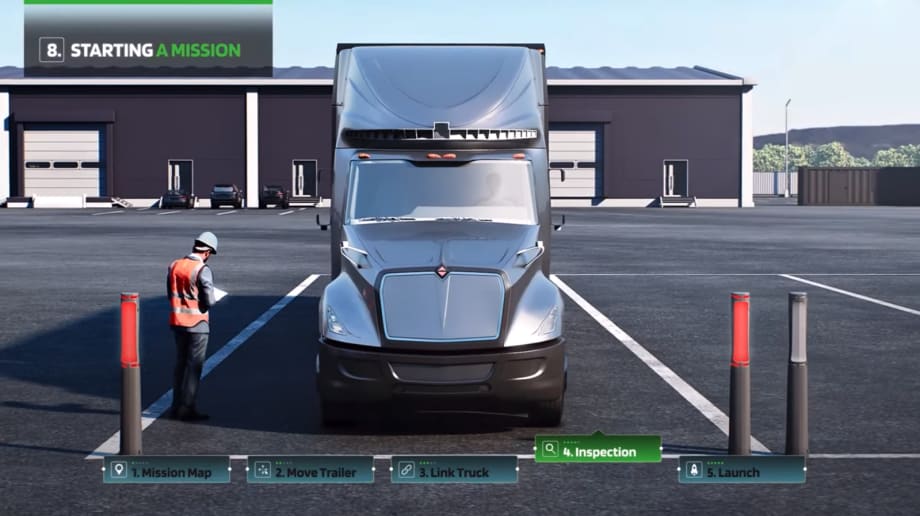
Qualified inspectors will perform pre-trip and post-trip inspections of the trailer, truck, and the autonomous driving system.
Photo: Screen capture from TuSimple video
3 min to read
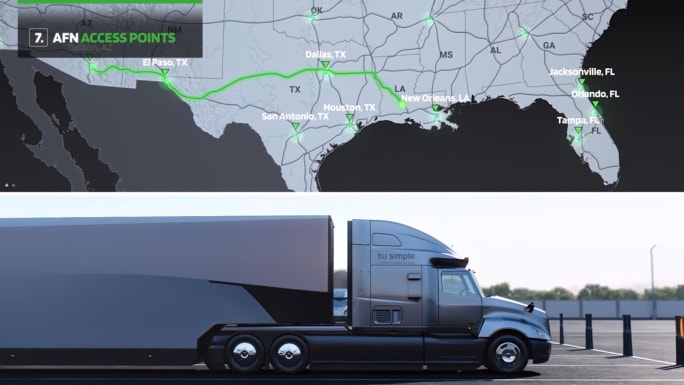
TuSimple says its trucks will be able to operate terminal-to-terminal without drivers on its Autonomous Freight Network.
Photo: Screen capture from TuSimple video
TuSimple is looking beyond the autonomous truck technology it’s been developing and testing and thinking about how commercial facilities need to be adapted for self-driving trucks.
The company is teaming up with Hillwood, a large industrial and commercial real estate developer, to integrate TuSimple’s infrastructure specifications into current and future industrial and commercial properties.
They’re starting with a million-square-foot facility built within Hillwood’s 27,000-square-acre AllianceTexas development. The AllianceTexas Mobility Innovation Zone gives partner companies access to a testing and commercialization ecosystem, resources, and partnerships to help adopt, integrate and scale SAE-Level-4 autonomous trucking operations.
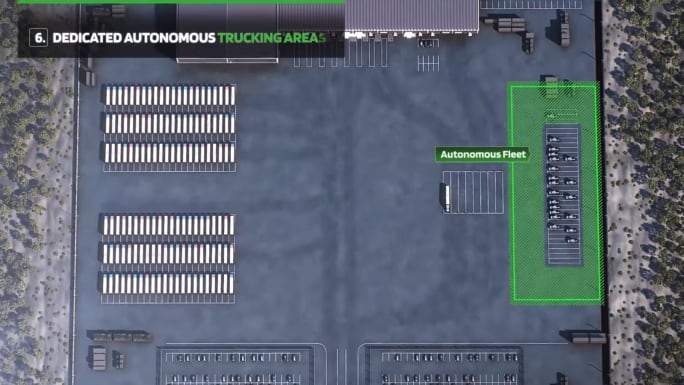
Terminals will have a dedicated area for autonomous trucking operations.
Photo: Screen capture from TuSimple video
Located just off Interstate 35 near Fort Worth Alliance Airport and near TuSimple’s major freight-partner facilities (UPS and DHL), the MIZ is also near a major distribution hub and a large freight market.
The new facility is intended to serve as an origin and destination facility for L4 autonomous trucks using TuSimple’s Autonomous Driving System. It will be designed and upfitted to meet TuSimple’s operational and technical requirements. The facility is expected to be completed in 2024. It will be compatible with the TuSimple Autonomous Freight Network, both currently and as the network expands.
The Autonomous Freight Network consists of autonomous trucks, digital mapped routes, strategically placed terminals, and TuSimple Connect, a proprietary autonomous operations monitoring system. Last year, TuSumple announced it has teamed up with Ryder to use select Ryder fleet maintenance facilities as terminals in the AFN.
How Does an Autonomous-Truck Terminal Work?
As TuSimple’s Jim Mullen, chief administrative and legal officer, explained in an HDT interview last fall, "there are a lot of unanswered questions about how the whole freight ecosystem is going to intertwine with autonomous trucks.”
True driverless trucks may be able to get from terminal to terminal, but what happens once they get to their destination?
“We see at least in the early on you would segregate the AV trucks to pull into a lane and then humans will get involved," Mullen said. "For things like refueling, you’ll see the AV truck have a segregated area and have humans fueling.”
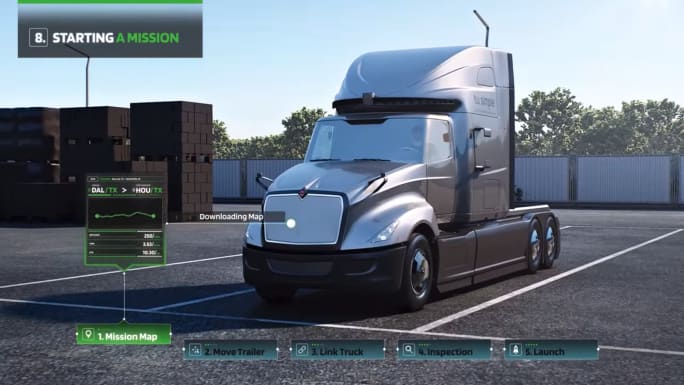
A "mission map" is downloaded into the truck. A launch pad serves as an entry point into TuSimple's Autonomous Freight Network.
Photo: Screen capture from TuSimple video
In a new video explaining how its Autonomous Freight Network works, TuSimple explains that every terminal has a clearly defined area on the property dedicated to autonomous trucking operations. Within these areas are launch pads and landing pads. A launch pad functions as the entry point to a digital map, connecting the terminal to the AFN. This allows the truck to be driven autonomously from one terminal to another.
The specific mission map is downloaded on to the truck. The trailer is then moved to the launch pad manually. Then the autonomous truck is driven manually to the launch pad and hooked to the trailer. Once truck and trailer have been successfully connected, a CDL-qualified technician will do the DOT pre-trip inspection of the truck, trailer, and autonomous driving system. Then the truck is clear for launch.
At the end of the trip, the truck arrives at the landing pad. A post-trip inspection and daily vehicle inspection report are completed. The data from the mission is uploaded and the truck is ready to be refueled, have any maintenance done, and staged for its next mission.
Ryder will soon be managing maintenance services for several fleets of autonomous vehicles. On this episode of the HDT Talks Trucking podcast, Ryder's Mike Plasencia explains what it takes to keep driverless trucks running.
Escalating U.S.-Canada tariffs could disrupt cross-border freight, reduce truck volumes, raise costs, and create new uncertainty for carriers on both sides of the border.
The American Transportation Research Institute wants to know what's worrying trucking fleet managers, drivers, and other stakeholders in its annual Industry Issues survey.
HDT Truck Fleet Innovator Adam Buttgenbach helped PepsiCo build one of North America’s largest EV fleets by focusing on where electric trucks make operational sense.
HDT Truck Fleet Innovator Deen Albert makes sure people are still at the heart of operations at Grand Island Express, even while adopting artificial intelligence tools. AI-assisted dispatch helped boost revenue 25% with the same number of trucks.
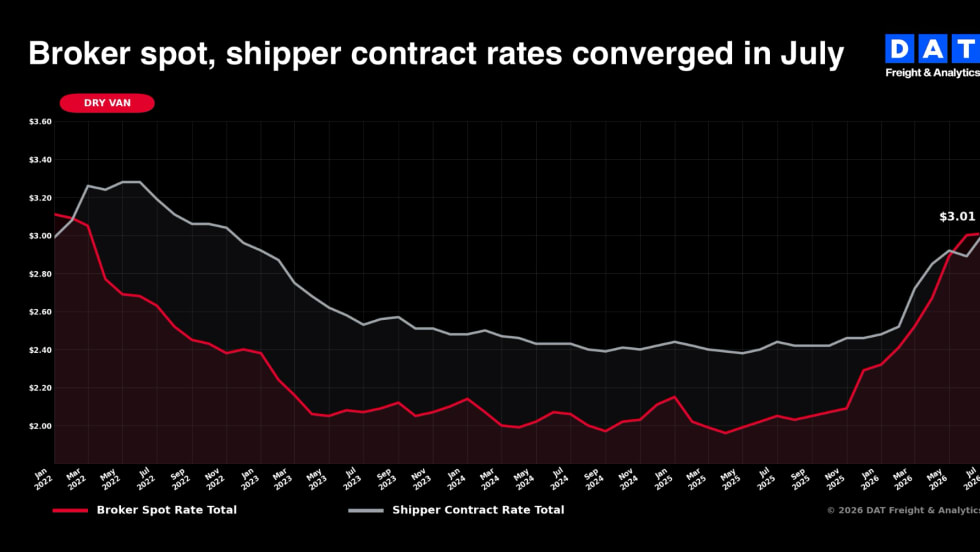
“Spot rates moving ahead of contract rates have historically signaled a tightening market, but we haven’t seen a capacity-driven market quite like this one,” said DAT's Dean Croke.