




Truck Drivers Must Be Informed of Biometric Scans in Illinois
Carriers in Illinois should supplement their existing driver policies with disclosures for collecting biometric information, including facial recognition scans via in-cab cameras.

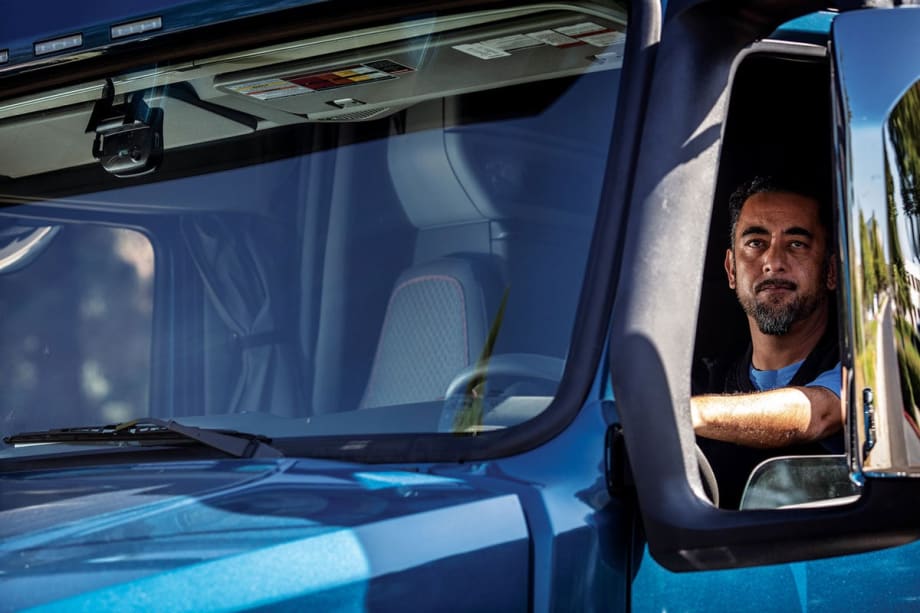
Carriers in Illinois should supplement their existing driver policies with disclosures for collecting biometric information, including facial recognition scans via in-cab cameras.
File Photo: Lytx
Collecting biometric information from drivers without their permission could get motor carriers in trouble, at least in Illinois.
A recent Illinois appellate court ruling has the potential to increase liability under Illinois' Biometric Information Privacy Act, and that could lead to more class-action lawsuits against carriers operating in the state, warned the transportation attorneys at Scopelitis, Garvin, Light, Hanson & Feary in an email alert.
The BIPA law requires private entities that obtain biometric information (such as fingerprints, facial recognition scans, and voice recognition) to first inform the subject in writing that their information is being collected and stored, inform the subject of the specific purpose and term for collection and storage, and secure a written release from the subject.
The court established that BIPA applies to every capture and use of a person’s fingerprint, hand scan and facial or voice recognition capture, not just when the company first obtains the information.
Biometric information is used to detect driver fatigue via in-cab cameras, to provide security locks on devices, to better manage a workforce, and other purposes. The use of these biometric scans is now commonplace across the transportation industry, according to the attorneys.
The ruling came after an Illinois truck driver filed a class action lawsuit against Maverick Transportation and Lytx, claiming the Drivecam dashcam illegally collects facial geometry data. The driver, Joshua Lewis, claimed the non-consensual data collection violates BIPA.
“Lewis seeks a declaration of Maverick Transportation LLC and Lytx Inc. in violation of BIPA, plus injunctive and other equitable relief, statutory damages of $5,000 for each violation of BIPA or $1,000 for each negligent violation, attorneys' fees and cost of suit,” the Madison-St. Clair Record, a local news outlet, reported.
Carriers with operations in Illinois need to take a close look at how they are using biometric data, including through facial recognition on in-cab cameras, said Brandon Wiseman, owner and president of Trucksafe Consulting, in an email response to HDT. “Ensure they supplement their existing driver policies with the required disclosures.”
“Absent a compliant BIPA policy, transportation companies using this technology could face thousands of dollars in damages for each scan,” wrote the Scopelitis attorneys.
Illinois is the only state that regulates the use and disclosure of biometric information whose statute includes a private right of action, according to the National Law Review. (A private right of action is when a private individual or entity, as opposed to the state, government or a public body, has the legal right to commence legal proceedings or file a lawsuit against another under the law.) Texas and Washington also have comprehensive laws governing biometric information. In other states, such as New York and Maryland, such legislation has failed to pass, according to the National Law Review.
More Fleet Management

Geotab Links Fleet Card to Vehicle Data
The new card combines fuel discounts with telematics-based purchase controls. Geotab’s analysis also points to potential savings from choosing lower-priced fuel stops.
Read More →
How MFA Helps Protect Trucking Fleets
Multi-factor authentication adds protection when passwords are stolen. Here’s how it works and where fleets should start.
Read More →
How Better Freight Data Helps Trucking Teams Get Ahead of Disruption
Trucking and logistics teams have plenty of data. The problem is getting the right information in front of the right people soon enough to act. Better-connected data can help teams spot trouble earlier and make smarter decisions before small problems become big ones.
Read More →

Trimble: Taking Artificial Intelligence in Trucking Beyond Faster Tasks
At Insight 2026, Trimble executives argued that fleets may need to redesign workflows to get more from AI as it introduced new products and enhancements. AI’s value will depend on how fleets combine automation with their people's knowledge.
Read More →
Build a bulletproof fleet: Uniting ELDs and dash cams for total compliance
An ELD can prove compliance, but it cannot always prove what happened on the road. Discover how uniting accurate ELD data with AI-powered dash cam video can help your fleet strengthen compliance, defend against liability, protect drivers and reduce operational costs.
Read More →
Nominations Open for HDT Emerging Leaders
Heavy Duty Trucking is looking for accomplished trucking fleet professionals under 40 who are making an impact and helping lead the industry forward.
Read More →
Why Private Fleets Are Taking More Freight
Private fleets are putting their own trucks on demanding customers and high-cost lanes as companies seek greater control over service, costs, and capacity.
Read More →
Color Match Smarter: Tools That Restore & Perform
For fleet managers and collision repair professionals keeping heavy-duty trucks on the road, getting the color right the first time isn't just about appearance — it's about efficiency, turnaround time, and bottom-line results. Discover how today's digital color tools are transforming the repair process from guesswork to precision.
Read More →
FMCSA Pauses Biennial-Update Enforcement Amid Motus Transition
Carriers whose updates were due on or after June 1 have more time, while FMCSA works to stabilize its new registration system and warns of phishing sites impersonating its new carrier registration system, Motus.
Read More →
2026 Blueprint for Countering Smarter Supply Chain Theft
Cargo theft is no longer just the cost of doing business. It's a multi-billion-dollar criminal enterprise exploiting vulnerabilities across your fleet, drivers, and supply chain.
Read More →