





Peterbilt Chief on EVs, Autonomous Tech and the New Model 579
4 Ways to Accelerate Electric Truck Adoption
At the ACT Expo in Long Beach, California, Peterbilt General Manager Jason Skoog mapped out four decisive moves he’d like to see happen to accelerate electric truck sales in North America.
September 1, 2021
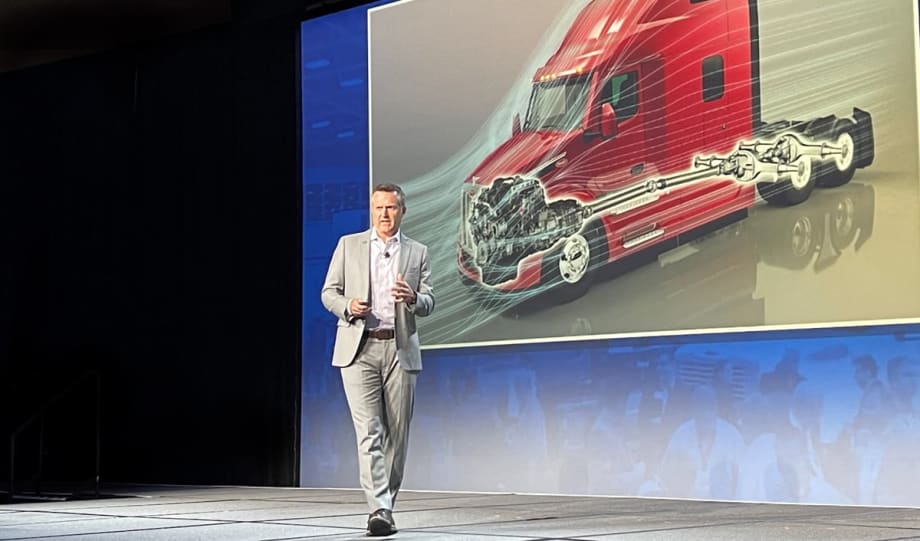
At the ACT Expo in Long Beach, California, Peterbilt General Chairman Jason Skoog mapped out four decisive moves he’d like to see happen to accelerate electric truck sales in North America.
Photo: Jack Roberts
5 min to read
Electric trucks are making headway quickly in North America and Peterbilt General Manager Jason Skoog said there are four specific things the trucking industry can do to propel electric trucks into mainstream use even sooner.
Skoog made his remarks as the keynote speaker at the Advanced Clean Transportation Exhibition (ACT Expo) on Aug. 31, and began by noting that Peterbilt designed and built its first heavy-duty electric truck back in 1998.
“That truck had a 3,000-pound lead-acid battery and got nine miles from a single charge,” he said, chuckling. “But we’re doing a lot better now with that technology.”
In 2019, Peterbilt unveiled its first generation of new electric trucks. It began series productioin of three battery-electric trucks this year, including the Model 579EV, the Model 520EV and the Model 220EV.
“We were the first OEM to announce production availability of electric trucks 12 months ago,” he added. “And today, we are very proud to announce that we have 400 orders in our backlog for these trucks today."
Peterbilt electric trucks are currently running daily routes in both Anchorage, Alaska, and Boise, Idaho. The OEM is getting “fantastic” feedback from the fleets evaluating those trucks. “We also have 10 Model 579EV tractors working at the Port of Oakland, California now,” he said. “We’ll soon have trucks working in the Port of Long Beach, California, as well, and have another 60 scheduled to be built and delivered to the ports by year’s end.”
Skoog said currently, nearly 100% of refuse truck roles can be filled by battery-electric trucks. He noted that around 35% of current Class 8 trucks average 250 miles or less per day, making them good eventual candidates for electric trucks.
“That leaves 65% of Class 8 trucks that run more than 250 miles per day,” he added. “And I think we’ll have to wait for significantly improved batteries or viable hydrogen fuel cell technology before we’ll start seeing fleets in those applications move away from diesel.”
But, Skoog said, if North American fleets are interested in electric trucks and would like to accelerate their acceptance and usage around the country, he sees four vital actions that need to happen to encourage that shift.
1. Invest in National Charging Infrastructure
“We must have a viable, national charging infrastructure,” Skoog told ACT Expo attendees. “Medium- to large-scale charging systems require heavy construction, including trenching work and installing transformers. This is expensive and time-consuming to do. Additionally, it takes significant financing to accomplish.”
To help fleets with this, Skoog said Peterbilt is offering electric truck charging systems for sale through its Paccar Parts division. Additionally, the OEM is now offering a variety of advisory services for fleets interested in electric trucks, including site assessments and project management.
“We start with the truck and move immediately to infrastructure,” he said. “We tell our customers they must start working on the infrastructure problem the moment they decide to put an electric truck in their fleet.”
2. Drive Down Prices of Electric Trucks
Secondly, Skoog said, changes need to be made to drive electric truck prices down. To help here, Peterbilt has a dedicated grant writer on staff to help fleets find government grants to assist in subsidizing the cost of electric trucks.
The OEM also has an online operating cost calculator that lets fleets plug in operating variables to get a clear picture of what an electric truck’s total operating cost will be compared to a conventional diesel truck.
“But we need more,” he said. “Right now, the 2024 California Air Resource Board Zero Emissions Sales Requirements are pushing truck OEMs to build a certain number of electric vehicles. But there is no customer purchase requirement on the other side of the equation. Now, I understand that many of you out there would prefer rules that require OEMs to build the trucks, without any requirement that you buy them. But if we’re going to get costs down and bring production to scale, we need better customer-OEM alignment on this front. And common interests — both a requirement to build and a requirement to buy — will move electric trucks forward much faster.”
3. Change Tax Rules
Skoog said he would like to see tax rules changed so fleets could take tax credits on the front end of the sale, at the time a truck is purchased.
“We are working with Calstart to put an option in that will let fleets take that credit up front,” he said. “We believe that the most effective incentives are the ones that are there at the time of purchase.”
Another financial move Skoog supports is eliminating or reducing the 12% Federal Excise Tax on new trucks.
“That’s the highest tax anyone pays for new products in this country,” he added. “I’d like to see it gone for all trucks. But if we can’t do that, can’t we at least remove it to help boost electric truck sales?”
4. Re-examine Commercial Vehicle Weight Laws
And finally, Skoog said it’s time to re-examine commercial vehicle weight laws to boost electric truck sales.
“We have a 2,000-pound offset for electric trucks now,” he said. But it’s not enough. “In some cases, electric trucks are carrying 4,000 pounds less payload than a diesel truck.”
To put that in perspective, Skoog pointed to cement mixers.
“If a mixer is pouring a house foundation, that’s four loads of cement in a diesel truck,” he said. “But with our current weight laws, an electric mixer would have to make five trips to that jobsite, with corresponding losses in time, additional traffic congestion efficiency.”
To counter these problems, Skoog said he proposes a single one-to-one weight offset for electric trucks, to make sure their productivity — and ability to make money — is on par with diesel trucks.
“This is exciting technology we’re talking about,” Skoog said. “We need to take steps to make it better.”
More Fuel Smarts

How Volvo Updated Its D13 for EPA 2027 [Watch]
Volvo’s updated D13 promises lower emissions without sacrificing performance or fuel economy. Take a closer look at what changed inside the engine in this HDT Spotlight video.
Read More →
Diesel Price Spike Shortens Payback for Natural Gas Trucks, Report Says
Energy Vision estimates fleets could recover the higher purchase price of an RNG-fueled Class 8 tractor in 1.3 to 2.8 years under current fuel-price scenarios.
Read More →
Calstart Becomes Catalyst Mobility, Reflecting Broader Focus
Calstart is now Catalyst Mobility, reflecting the nonprofit’s growing national role in clean transportation, including zero-emission trucks, infrastructure and incentive programs.
Read More →

Record Diesel Prices Squeeze Trucking Fleets
Average U.S. diesel prices have climbed to nearly $6 a gallon, surpassing the 2022 record as tight refinery capacity and Middle East disruptions keep fuel costs elevated.
Read More →
Sponsored•September 9, 2026
How Fuel Delivery Shapes Engine Performance
Fuel delivery depends on more than what happens at the injector. For fleet, maintenance and technical professionals, looking at the full path from pump to injector can provide useful context for understanding engine performance.
Read More →
East Coast Port Launches $45M Electric Truck Push
The Port Authority of New York and New Jersey announced millions in incentives for zero-emission drayage trucks, yard tractors, and new charging hubs near the port.
Read More →
California Bill Could Shed Light on Electric Truck Prices
Why do battery-electric Class 8 trucks remain so expensive? A California bill headed to Gov. Gavin Newsom would give fleets and state agencies more visibility into what manufacturers charge.
Read More →
Detroit Opens Orders for EPA 2027 Engines
Detroit isn’t starting from scratch to meet EPA 2027 diesel emissions standards. Its Gen 6 DD13 and DD15 engines keep much of today’s platform while updating the fuel and aftertreatment systems.
Read More →
Zero-Emission Truck Corridor Planned for West Coast
California, Oregon, Washington, British Columbia and Baja California are coordinating plans for truck charging and hydrogen fueling from Canada to Mexico.
Read More →
A Closer Look at Kenworth’s Electric T880E Vocational Truck [Video]
Learn more about Kenworth's T880E battery-electric vocational truck at the Paccar Technical Center, including its range, applications, upfitting considerations, and PTO options, in this HDT Spotlight video.
Read More →