




Cummins, Air Products Team up to Accelerate Hydrogen-Truck Adoption
Air Products will work with Cummins to convert its global fleet of approximately 2,000 trucks to hydrogen fuel-cell vehicles and help accelerate the overall growth of hydrogen fuel cell trucks.

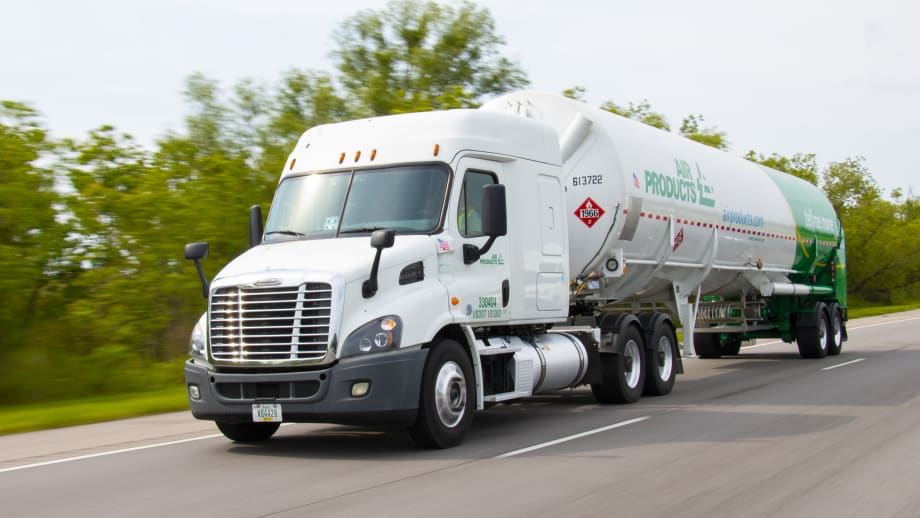
Air Products plans to convert its global fleet to hydrogen fuel cell trucks.
Photo: Air Products
Air Products, a global industrial gases company and hydrogen producer, will work with Cummins to convert its global fleet of approximately 2,000 trucks to hydrogen fuel-cell vehicles and help accelerate the overall growth of hydrogen fuel cell trucks in the Americas, Europe and Asia.
Under the memorandum of understanding, Cummins will provide hydrogen fuel cell electric powertrains integrated into selected OEM partners’ heavy-duty trucks for Air Products. A demonstration and pilot phase is expected to begin in 2022.
Cummins and Air Products also will work together to increase the accessibility of renewable hydrogen, including hydrogen infrastructure.
“We believe hydrogen is the future for heavy-duty segments of the transportation market, and we can demonstrate to the world its merits by being a first-mover in transitioning our heavy-duty fleet of trucks to hydrogen fuel cell electric vehicles,” said Seifi Ghasemi, Air Products’ chairman, president and chief executive officer. “Sustainability is Air Products’ growth strategy and creates our growth opportunities, and nothing says more about our company’s approach to sustainability than a fleet of zero-emission vehicles on the road delivering product to customers every day.”
Tom Linebarger, chairman and CEO at Cummins, called the deal “another turning point for hydrogen and the energy transition.”
“As we develop the technologies of tomorrow, we need the partnership of others to be successful, and this partnership with Air Products is the next step in leading the industry on the path to a zero-emissions future.”
In addition to heavy-duty applications such as transit fleets, where Air Products is already providing fueling solutions, the semi-truck market is a major opportunity for hydrogen, said Eric Guter, Air Products’ vice president for hydrogen for mobility solutions. “Only hydrogen fuel cell vehicles can provide the necessary range, refueling time, and weight requirements to decarbonize this important transportation sector.”
Hydrogen fuel cells are gaining momentum as a zero-emissions technology in heavy-duty applications due to the duty cycles, especially in extreme climate conditions, according to the announcement.
Air Products technologies are used in more than 1.5 million refuelings annually across 20 countries, according to the company, with Air Products having been involved in over 250 projects. Air Products has more than 60 years of global hydrogen experience in more than 50 countries.
Cummins has a broad portfolio of hydrogen technologies, including PEM electrolyzer and fuel cell solutions. To date, the company has deployed more than 2,000 fuel cells and 600 electrolyzers globally.
More Fuel Smarts

How Volvo Updated Its D13 for EPA 2027 [Watch]
Volvo’s updated D13 promises lower emissions without sacrificing performance or fuel economy. Take a closer look at what changed inside the engine in this HDT Spotlight video.
Read More →
Diesel Price Spike Shortens Payback for Natural Gas Trucks, Report Says
Energy Vision estimates fleets could recover the higher purchase price of an RNG-fueled Class 8 tractor in 1.3 to 2.8 years under current fuel-price scenarios.
Read More →
Calstart Becomes Catalyst Mobility, Reflecting Broader Focus
Calstart is now Catalyst Mobility, reflecting the nonprofit’s growing national role in clean transportation, including zero-emission trucks, infrastructure and incentive programs.
Read More →

Record Diesel Prices Squeeze Trucking Fleets
Average U.S. diesel prices have climbed to nearly $6 a gallon, surpassing the 2022 record as tight refinery capacity and Middle East disruptions keep fuel costs elevated.
Read More →
How Fuel Delivery Shapes Engine Performance
Fuel delivery depends on more than what happens at the injector. For fleet, maintenance and technical professionals, looking at the full path from pump to injector can provide useful context for understanding engine performance.
Read More →
East Coast Port Launches $45M Electric Truck Push
The Port Authority of New York and New Jersey announced millions in incentives for zero-emission drayage trucks, yard tractors, and new charging hubs near the port.
Read More →
California Bill Could Shed Light on Electric Truck Prices
Why do battery-electric Class 8 trucks remain so expensive? A California bill headed to Gov. Gavin Newsom would give fleets and state agencies more visibility into what manufacturers charge.
Read More →
Detroit Opens Orders for EPA 2027 Engines
Detroit isn’t starting from scratch to meet EPA 2027 diesel emissions standards. Its Gen 6 DD13 and DD15 engines keep much of today’s platform while updating the fuel and aftertreatment systems.
Read More →
Zero-Emission Truck Corridor Planned for West Coast
California, Oregon, Washington, British Columbia and Baja California are coordinating plans for truck charging and hydrogen fueling from Canada to Mexico.
Read More →
A Closer Look at Kenworth’s Electric T880E Vocational Truck [Video]
Learn more about Kenworth's T880E battery-electric vocational truck at the Paccar Technical Center, including its range, applications, upfitting considerations, and PTO options, in this HDT Spotlight video.
Read More →