





“I remember lying down that night on the floor in the basement of my home, [thinking], ‘What could I have done to prevent this?’”
How a Trucking Company Fought Back a Nuclear Verdict
A crash so devastating it had John Vaccaro wondering if he even wanted to continue on with the family trucking business was a wake-up call to double down on safety.
May 20, 2021
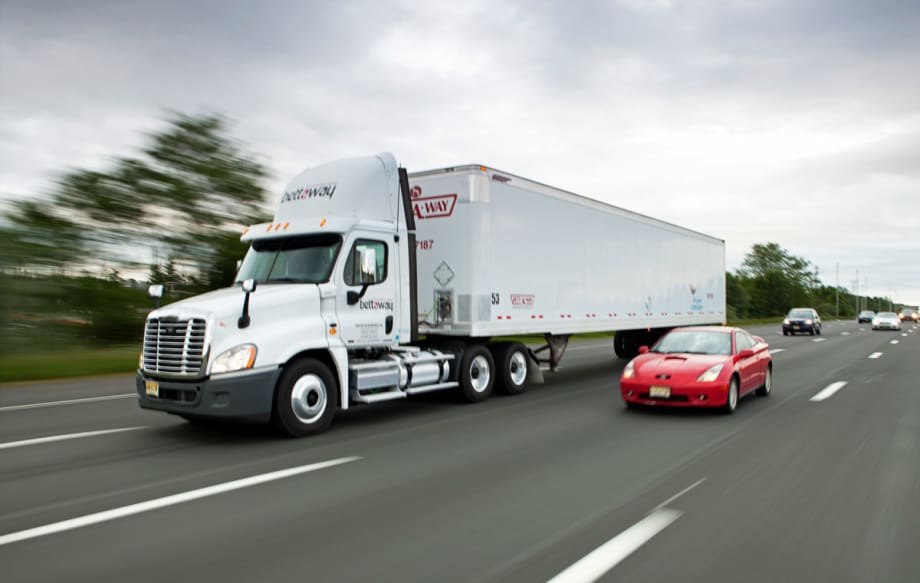
Bettaway Beverage Distributors doubled down on safety after a crash that at one point looked like it was headed toward a nuclear verdict.
Photo: Bettaway
7 min to read
John Vaccaro was having lunch with a customer when the mobile phone in his pocket started blowing up. It wouldn’t stop. He had a message from his office, “You need to call right now.”
“At that moment, I knew it was something bad,” he recalls. Yet at that moment in 2017, he really did not know just how bad it was going to get for him, his business, and his family.
Vacarro is president of Bettaway Beverage Distributors, a 38-year-old, New Jersey-based, family-owned trucking company.
Operating primarily in the congested area around New York City, where many roads were never designed for modern trucks, Vaccaro acknowledges that despite the company’s emphasis on safety, it wasn’t uncommon to have merge accidents, blind-spot accidents, fender-benders and bumper thumpers. “Nothing I would have called significant,” he says. Nevertheless, settlements had been creeping higher and higher and insurance costs were rising.
This crash was different.
One of his drivers had been involved in a crash with severe injuries among the occupants of the other vehicle – severe enough to require medevac by helicopter.
“I go home that night, and I am totally devastated,” he recalls. “I’m just overwhelmed by what occurred, even though I don’t know too much. I just knew that there was injured people. And there’s no good feeling of being the owner of a trucking company when there’s injuries involved,” no matter who’s at fault.
“I remember lying down that night on the floor in the basement of my home, [thinking], ‘What could I have done to prevent this?’”
The equipment was new, it wasn’t overloaded, and the driver still had plenty of hours of service left. (Bettaway was an early adopter of electronic logs, back in 1997.)
“I realized that what we need to do is every single thing we could possibly do to prevent” such crashes from happening in the future, Vaccaro says, from technology such as collision avoidance and in-cab cameras to stronger driver training and safety programs. “And that was the path that we set out on.”
A Three-Year Nightmare
After what Vaccaro describes as an “uncomfortable period of silence,” the attorney hired by Bettaway’s insurance company came to meet with him and other company representatives.
“It was near having the grim reaper come and visit you,” Vaccaro recalls.
The plaintiffs’ attorney, the lawyer said, was determined to go after everything he could possibly get.
“The attorney started talking about a $20, $30, $40 million dollar verdict greater than what our insurance covers. I started thinking to myself, ‘What does that mean? We don’t have that type of money.’”
At the time, Bettaway had $5 million in coverage, seven times the legal minimum, and had never had an incident that even came close to piercing the umbrella, Vaccaro says.
“After that, it was nothing but a nightmare for three years.”
The plaintiffs’ attorneys went after Bettaway’s affiliated companies, which included a third-party logistics business, a pallet business, and an operation in California. Bettaway had to hire its own attorneys to defend those, in addition to the one from the insurance company. They were eventually successful in removing those other entities from the litigation. But offers of out-of-court settlements were rejected.
As the jury was being selected, Vaccaro told his attorney he wanted one last shot at mediation.
“I was told I was wasting my time,” he recalls. “My feeling was if I stood in front of a judge and said, ‘I want to settle, I want to get this worked out,’ what judge would refuse that?”
And it worked. After an eight-hour, court-ordered mediation, a settlement was reached, narrowly avoiding what the attorney estimated could have been a $40 million to $70 million “nuclear verdict.”
A Wake-up Call
The crash was a wake-up call for Vaccaro and his company. Since then, he has put into place an aggressive driver training and risk avoidance program, including the use of in-cab cameras and collision avoidance systems.
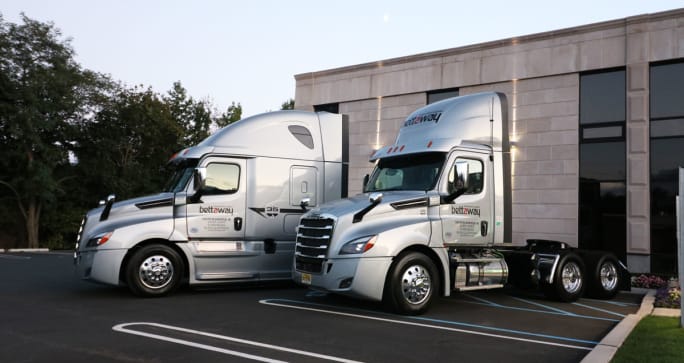
Bettaway now has advanced driver assistance systems, including collision avoidance, on at least 90% of its fleet.
Photo: Bettaway
“We doubled down, we tripled down, on technology and equipment.”
Even before the crash, Bettaway started ordering trucks with collision avoidance with active braking as soon as Freightliner made them available. But by the time of the crash in 2017, only about 15% of the fleet had the technology.
“To me, that was number one, to accelerate purchases and trade-outs of our equipment to try to get almost all of our trucks with collision avoidance,” Vaccaro says. Today, more than 90% of the fleet is equipped with the technology. All new tractors (2015 and newer models) are spec’ed with advanced driver assistance systems, including Detroit Assurance collision warning, adaptive cruise control and active brake assist, as well as the Bendix side-object detection system. The spec also includes automated transmissions so drivers can focus on driving rather than shifting.
The other big technology change he made was adopting in-cab cameras.
“There was a lot of speculation over what happened with this accident,” he recalls. “We wished there was a camera there.”
Although he had considered in-cab cameras before, the technology was undergoing major changes in this time frame. Vaccaro liked the fact that the cameras could provide video both shortly before and after a crash or a triggering incident such as hard braking. And unlike the collision-avoidance technology, he would be able to deploy it on every truck within a few weeks. He chose the DriveCam system by Lytx and rolled it out in January of 2018.
“DriveCam’s made a tremendous difference,” Vaccaro says. While some drivers and motor carriers may worry that cameras could be used against them, he says, in nearly every incident they have exonerated Bettaway and its drivers.
“We have a file of some of our favorite DriveCam clips saved. One after another, it’s people cutting off trucks, and we’ve got the video to prove it.”
He uses those videos to address concerns from drivers, especially since the system uses both forward- and driver-facing cameras.
“Whenever we have driver safety meetings, we always promote the videos of all the times it’s saved us in the previous few months.”
There are times when the DriveCam system has alerted the company to problematic driver behaviors such as holding a phone or distracted driving. However, they are few, Vaccaro says, and offer the company an opportunity to deal with them through coaching or other measures.
Changing the Narrative
Vaccaro shares a particularly egregious incident where these aggressive safety measures paid off.
Last December, a Bettaway driver was traveling along a divided highway, on a clear day, at 68 mph on cruise control. Just ahead, a passenger car had just exited the highway. Suddenly, apparently realizing it was the wrong exit, the driver cut across the area between the exit and the highway and pulled directly in front of the Bettaway truck.
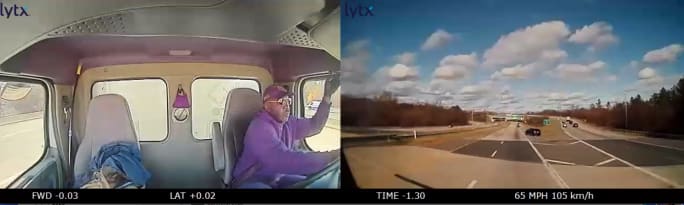
As the Bettaway driver nears the exit ramp, he and the DriveCam see the car starting to pull in front of him.
Screenshot from Lytx DriveCam, courtesy Bettaway
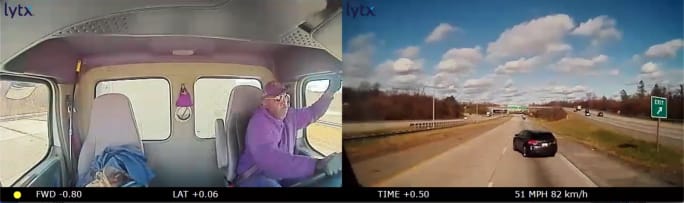
The driver and the Freightliner automatic collision avoidance system both work to slow the truck down as the driver lays on the horn.
Screenshot from Lytx DriveCam, courtesy Bettaway
Although the quick actions of the truck driver and the collision avoidance system brought the truck down to just 32 mph, he couldn’t avoid hitting the car.
All this was clearly visible in the two-way video from the in-cab camera.
The driver of the passenger vehicle was taken to the hospital, where she told police a very different story, as Vaccaro discovered a few days later when he got “a very aggressive attorney letter.” That letter said the passenger car driver was slowing her vehicle to accommodate the recommended speed of the exit ramp when she was suddenly “hit from behind at an extremely high rate of speed by your [driver].”
What that attorney didn’t know was that Bettaway had already shared the video with the police. When the police report came out, it cited the driver of the passenger vehicle for several violations and concluded she was the sole cause of the accident.
The litigation was quickly withdrawn.
“Had we not had that video, what would the narrative had been?” Vaccaro wonders.
Watch the video:
A Culture of Safety
Vaccaro says Bettaway has always prioritized safety, pointing to its early adoption of electronic logs and collision-avoidance technology.
“The accident was not an event that took us from bad to great,” he says. “It took us from good to excellent, or better than excellent.”
Each year, Bettaway puts together a comprehensive report about its safety programs and performance.
In addition to doubling down on technology, Bettaway doubled down on its driver training and safety incentives. For instance, it’s now paying out cash safety bonuses monthly.
“We don’t look for things like a broken light or mudflap to disqualify a driver,” Vaccaro says. “We don’t want to catch them being bad. We want to make opportunities where we can catch them being good.”
What does Vaccaro want other fleets to take away from his experience?
In addition to making sure you have a large umbrella policy, he says, “Don’t be scared of technology. Embrace it. Embrace the DriveCams. Embrace the collision avoidance. Embrace all of those things, because if not, you’re not going to be in business. Either the insurance is going to take you down or an accident’s going to take you down.”
Subscribe to Our Newsletter
More Safety & Compliance
More Trailer Data Through the Same Seven-Way [Video]
Can trucking’s standard seven-way connector handle more cameras and trailer data? Grote’s Adam Slade shows HDT how the company is using new technology with its 4See trailer system, not only to add a new backup camera but also to expand other capabilities — without adding another connection.
Read More →
PrePass Intelligence Mines Fleet Bypass, Toll and Safety Data
PrePass Intelligence helps fleets measure bypass savings, flag potential toll overcharges, and spot suspicious transactions by combining data from separate systems.
Read More →
Fatal Crash Exposes Toll Plaza Risks
An NTSB investigation found that last-minute lane changes and large speed differences at an Ohio toll plaza created a hazard the truck driver couldn't avoid in time.
Read More →
When Language Stops the Truck: The Return of ELP Out-of-Service Orders
English language proficiency rules for commercial drivers aren’t new, but renewed out-of-service enforcement has raised the stakes. Here’s what carriers need to know before a driver reaches a roadside inspection.
Read More →
Sponsored•October 6, 2026
A Camera Isn't a Safety Program. Here's What Brokers Are Screening for Now
Footage alone may not be enough to pass broker vetting processes. Here's what counts as a defensible safety program now.
Read More →
Marijuana and Trucking’s Drug-Testing Dilemma
Marijuana is getting stronger, laws are changing, and drug tests still can’t reliably establish impairment. What does that mean for truck drivers and the fleets that employ them?
Read More →
PrePass, Kodiak Connect Driverless Trucks to Roadside Enforcement
The system will allow enforcement agencies to verify Enhanced Inspection information and decide whether Kodiak’s autonomous trucks can bypass roadside screening sites.
Read More →
From One Generation to the Next: How Mentorship Builds Safer Truck Drivers
After three decades in trucking, Harold Perry shares what he's learned about driver safety, mentorship, and helping the next generation build confidence behind the wheel.
Read More →
FMCSA Pauses Biennial-Update Enforcement Amid Motus Transition
Carriers whose updates were due on or after June 1 have more time, while FMCSA works to stabilize its new registration system and warns of phishing sites impersonating its new carrier registration system, Motus.
Read More →
ZF Expands Commercial Vehicle Push in North America
ZF is expanding its North American commercial-vehicle presence with new transmission applications, electrification, trailer technology and autonomous-driving systems.
Read More →