



CARB Comes for Reefer Trailers
Read more about how a new round of emissions control regulations decreed by the California Air Resource Board will begin affecting refrigerated trailer and TRU design and operations next year.
 MENU
MENU SEARCH
UNFI is removing 53 of its diesel-powered TRUs from operation and enlisting Advanced Energy Machines to rebuild the units to all-electric specifications.
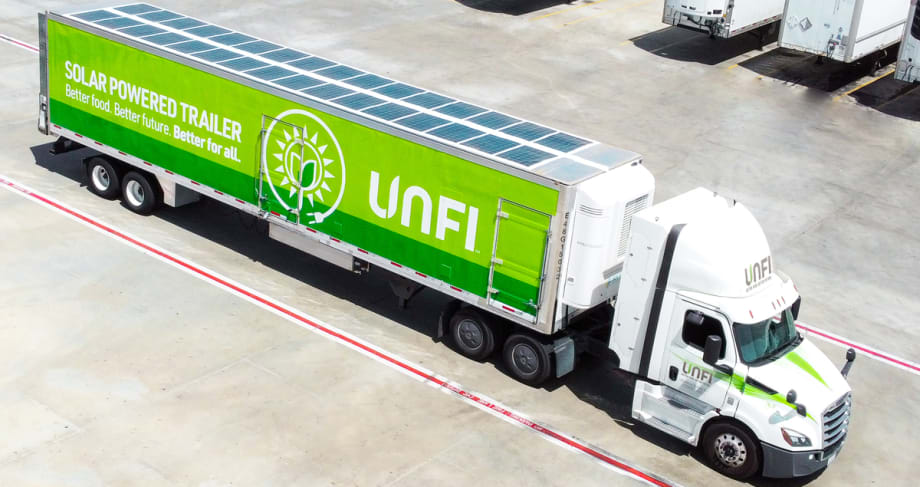
By operating the all-electric TRUs, UNFI anticipates it will save approximately 135,000 gallons of diesel fuel per year while reducing particulate matter pollutant emissions and greenhouse gas emissions.
Photo: UNFI
United Natural Foods announced the company is adding 53 all-electric transport refrigerated trailer units (TRUs) to its fleet located at the company’s distribution center in Riverside, California.
The all-electric TRU achieves zero-emission results by using a high efficiency refrigeration system powered by roof mounted solar photovoltaic panels, a wheel-momentum generator, lithium-ion batteries, and an auxiliary power unit to eliminate the requirement for diesel fuel to power the refrigeration system, UNFI officials said in a press release.
Through this process, the refrigeration system provides multi-zone temperature settings with the capability of maintaining a full load of frozen product from minus 10 to minus 20 degrees Fahrenheit throughout the distribution route.
To accomplish this work, UNFI is removing 53 of its diesel-powered TRUs from operation and enlisting Advanced Energy Machines to rebuild the units to all-electric specifications. UNFI will lease the TRUs through PLM Trailer Leasing for five years while the company continues to explore how they integrate into its operations, company officials said.
By operating the all-electric TRUs, UNFI anticipates it will save approximately 135,000 gallons of diesel fuel per year while reducing particulate matter pollutant emissions and greenhouse gas emissions.
This effort is in keeping with UNFI’s environmental, social and governance agenda, and the company’s commitments to take “innovative action on global social and environmental issues that help transform the future of food,” UNFI officials said in a press release.
The company is one of the first wholesalers to utilize the technology and comes as the California Air Resources Board announced plans in January to impose zero-emission requirements on TRUs sold or operated in California by December 31, 2029.
“Nearly 50 percent of UNFI’s direct greenhouse gas emissions are from our fleet of trucks and trailers. These 53 all-electric TRUs will help us get a head start on the proposed CARB zero-emission requirements, and are expected to allow us to decrease our emissions as we make progress on our climate action commitments under [the company’s ESG program],” said Jeff Wismans, national director of fleet operations at UNFI. “Adding these TRUs comes after an exhaustive 4-month pilot testing the equipment through a variety of conditions with the intention to replace diesel-powered TRUs. When we look at it from an operational standpoint, we’re not changing anything, but it gives us a fresh look at running our operations and finding additional efficiencies.”
To help reduce the cost of retrofitting the diesel powered TRU, PLM applied for and received vouchers on UNFI’s behalf through CARB’s Clean Off Road Equipment voucher incentive project. CARB launched CORE in 2017 to accelerate the purchase of zero-emission freight handling equipment in California by providing a streamlined voucher process to offset the higher cost of such technologies.

Volvo’s updated D13 promises lower emissions without sacrificing performance or fuel economy. Take a closer look at what changed inside the engine in this HDT Spotlight video.
Read More →
Energy Vision estimates fleets could recover the higher purchase price of an RNG-fueled Class 8 tractor in 1.3 to 2.8 years under current fuel-price scenarios.
Read More →
Calstart is now Catalyst Mobility, reflecting the nonprofit’s growing national role in clean transportation, including zero-emission trucks, infrastructure and incentive programs.
Read More →
Average U.S. diesel prices have climbed to nearly $6 a gallon, surpassing the 2022 record as tight refinery capacity and Middle East disruptions keep fuel costs elevated.
Read More →
Fuel delivery depends on more than what happens at the injector. For fleet, maintenance and technical professionals, looking at the full path from pump to injector can provide useful context for understanding engine performance.
Read More →
The Port Authority of New York and New Jersey announced millions in incentives for zero-emission drayage trucks, yard tractors, and new charging hubs near the port.
Read More →
Why do battery-electric Class 8 trucks remain so expensive? A California bill headed to Gov. Gavin Newsom would give fleets and state agencies more visibility into what manufacturers charge.
Read More →
Detroit isn’t starting from scratch to meet EPA 2027 diesel emissions standards. Its Gen 6 DD13 and DD15 engines keep much of today’s platform while updating the fuel and aftertreatment systems.
Read More →
California, Oregon, Washington, British Columbia and Baja California are coordinating plans for truck charging and hydrogen fueling from Canada to Mexico.
Read More →
Learn more about Kenworth's T880E battery-electric vocational truck at the Paccar Technical Center, including its range, applications, upfitting considerations, and PTO options, in this HDT Spotlight video.
Read More →