




Navistar, TuSimple Partner to Bring Self-driving Trucks to Market by 2024
A collaboration between Navistar and TuSimple will accelerate testing and proving of technology capable of running commercial trucks at full driverless Level 4 operation by 2024.
July 15, 2020

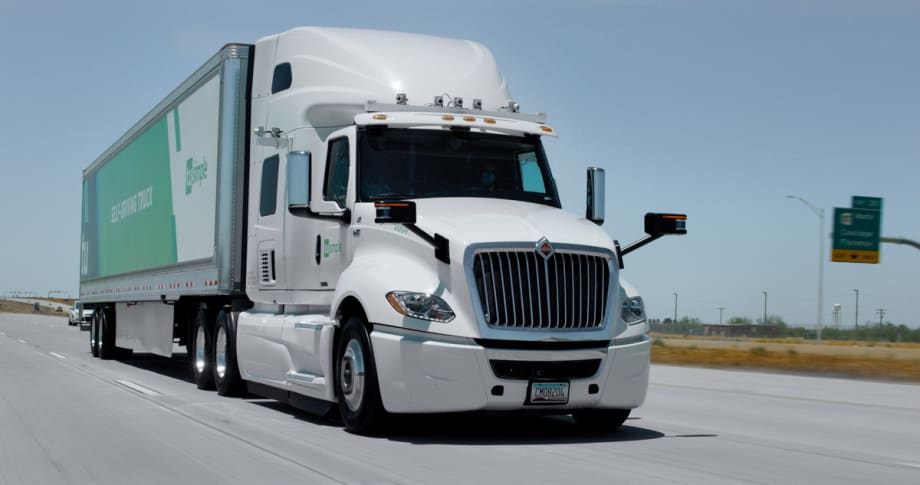
The TuSimple/Navistar collaboration will ensure a fully integrated engineering solution that will be ready for mass-production using Navistar’s vehicle manufacturing capabilities.
Photo: Navistar
5 min to read
North American truck maker Navistar is partnering with self-driving tech company TuSimple to co-develop SAE Level 4 self-driving semi-trucks targeted for production by 2024. The strategic partnership builds on a successful two-year technical relationship between the companies.
The TuSimple/Navistar collaboration will ensure a fully integrated engineering solution that will be ready for mass-production using Navistar’s vehicle manufacturing capabilities, according to the companies. Navistar said customers will be able to purchase fully autonomous trucks through its traditional sales channels in the United States, Canada and Mexico within the next three years.
Navistar also announced it has taken a minority stake in TuSimple. The value of the investment was not disclosed.
“Autonomous technology is entering our industry and will have a profound impact on our customers’ businesses,” said Persio Lisboa, President and CEO, Navistar, in an announcement. “Navistar’s strategic partnership with TuSimple positions us to be a leader in developing solutions for our customers by leveraging our organizations’ collective expertise to integrate our vehicle design and systems integration capabilities with TuSimple’s innovative autonomous technology. This announcement marks a significant milestone in our development journey with TuSimple and we look forward to furthering our relationship in the months to come.”

TuSimple and Navistar said they will offer SAE Level 4 automation in trucks.
Graphic: NHTSA
San-Diego-based TuSimple was founded in 2016 and currently operates 40 self-driving trucks (with safety drivers on board) in revenue service on routes between Arizona and Texas. The company announced two weeks ago that it had teamed up with UPS, Penske Truck Leasing, U.S. Xpress, and McLane to launch the nation's first Autonomous Freight Network, which it says will lay the groundwork for self-driving autonomous trucks to become commercially available by 2024.

“Autonomous technology is entering our industry and will have a profound impact on our customers’ businesses,” said Persio Lisboa, president and CEO, Navistar.
Photo: Navistar
"This is a big milestone for the industry. It's the first time a technology company has partnered with an OEM to manufacture trucks at scale and have a clear timeline for it," said TuSimple President Cheng Lu. "TuSimple is taking a two-pronged approach – building the most reliable autonomous driving system and bringing it to market with the Autonomous Freight Network. It's all about reliability and scale, and the partnership with Navistar is all about achieving both."
'Truly Collaborative'
Cheng told HDT the partnership with Navistar will help accelerate the development of the technology and the component integration. In previous situations, a vendor would supply components or systems to an OEM, but in this case, the two companies are developing the technology hand-in-hand.
"With our technology and autonomous systems, we have used a very specific set of sensors that only works with us. We also have requirements on the power, the queries, and ultimately what brake supplier and steering column supplier to use," Cheng said. "Within the Navistar partnership, we both have to think about these requirements. We have to balance safety, functionality and cost, and we do it together. It's a truly collaborative engineering project."
Cheng declined to provide an estimate of how many trucks he hopes to see in service by 2024. A lot of groundwork is required to determine the optimum routes for these trucks, and venturing ahead with that groundwork will depend on where the demand arises and the practically of routing autonomous trucks on those lanes.
"We don't have an exact target number yet, but we'll share it as soon as we do," he said.
Validation Work Still to Come
It's one thing to add some autonomous functionality to a truck. It's quite another to build in the required levels of redundancy and ultimately the durability and reliability. Chris Gutierrez, chief engineer of Navistar's Advanced Driver Assistance System team, told HDT that the vehicles on the road today have to be substantially modified before adding any AI (artificial intelligence) to them.
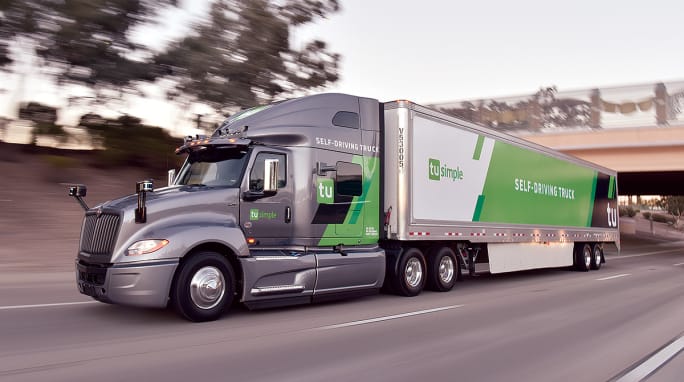
North American truckmaker Navistar is partnering with robotic truck startup, TuSimple, to produce production-ready driverless trucks by 2024.
Photo: TuSimple
"It takes a couple of hundred hours of work to modify the existing vehicles to the point where we can then subsequently add the autonomy software and hardware from a sensing perspective," he said. "And that is really to modify the brake and steering systems, modify the electrical systems, and modify the base vehicle core software. All that work must happen in order to make the 'bolt-on' AI function. So, even at the prototype phase, we need a fairly integrated approach to ensure that even these prototypes are safe. But that's still not the level we are going to go for with production-ready trucks."
At the component level, much of what is used now are available products modified for Level 4 operation pieced together to make the prototype functional in order to prove out the software's capability. They haven't been tested to 1.2 million miles or an expected 10-year product life. Under the partnership, both companies will begin designing and testing for reliability, quality and safety.
"That's really the difference between where we are now, which is making [the technology] work, and what we'll have to do for 2024, which is build a long-term, reliable, safe product that the customers can operate for their business," Gutierrez said.
Autonomous Freight Network
Meanwhile, TuSimple will move ahead with its Autonomous Freight Network, hauling customer loads with self-driving trucks (with safety drivers) over digitally mapped routes between strategically placed terminals.
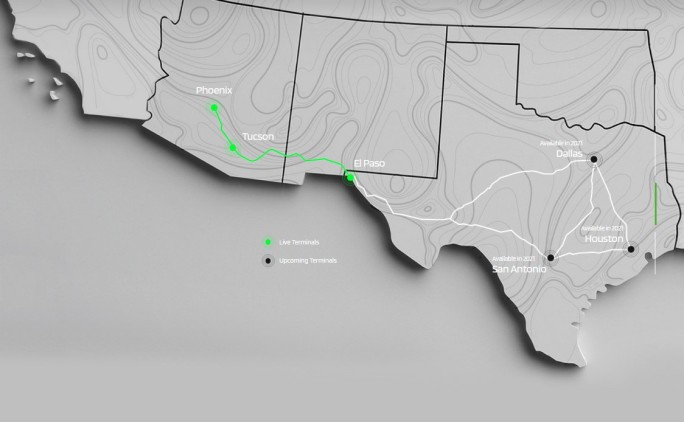
TuSimple will offer service between the cities of Phoenix, Tucson, El Paso, Dallas, Houston, and San Antonio, begining this year.
Image: TuSimple
The Autonomous Freight Network will roll out in three phases:
Phase I (2020-21) will offer service between the cities of Phoenix, Tucson, El Paso, Dallas, Houston, and San Antonio.
Phase II (2022-23) will expand AFN service from Los Angeles to Jacksonville and connect the East Coast with the West Coast.
Phase III (2023-24) will expand driverless operations nationwide, adding major shipping routes throughout the lower 48 states – allowing customers to use their own TuSimple-equipped autonomous trucks on the AFN by 2024.
"TuSimple is taking a two-pronged approach -- building the most reliable autonomous driving system and bringing that to market with the autonomous Freight Network," Chen added. "It's all about reliability and scale, and the partnership with Navistar is all about achieving both."
More Equipment
Used-Truck Remarketing Math Is Changing
Used-truck value is no longer just a concern at trade-in. Decisions made throughout a truck’s first life can influence what it’s worth years later.
Read More →
How Volvo Updated Its D13 for EPA 2027 [Watch]
Volvo’s updated D13 promises lower emissions without sacrificing performance or fuel economy. Take a closer look at what changed inside the engine in this HDT Spotlight video.
Read More →
Michelin Tire Improves Efficiency and Durability for Regional Fleets
The Michelin X Multi Energy D2 is a regional haul drive tire engineered to help fleets improve fuel efficiency, durability and traction in demanding stop-and-go operations.
Read More →
ZF Expands Commercial Vehicle Push in North America
ZF is expanding its North American commercial-vehicle presence with new transmission applications, electrification, trailer technology and autonomous-driving systems.
Read More →
Tesla Wants a Self-Driving Semi. Are Cameras Enough?
Could Tesla’s camera-only autonomous driving technology work on an 80,000-pound Semi? In this commentary, HDT's Deborah Lockridge takes a look at Tesla, Cybercab, and how autonomous trucks see the road.
Read More →
Kodiak: Driverless Long-Haul Truck Launch on Track for 2026
Kodiak AI says its driverless long-haul safety case is 93% complete and it remains on track to begin commercial operations by year-end 2026.
Read More →
What DOT’s Automated Vehicle Strategy Means for Trucking
The U.S. Department of Transportation issued a new automated-vehicle strategy that outlines plans for driverless-truck regulations, cross-state freight corridors, and federal safety standards.
Read More →
East Coast Port Launches $45M Electric Truck Push
The Port Authority of New York and New Jersey announced millions in incentives for zero-emission drayage trucks, yard tractors, and new charging hubs near the port.
Read More →
PlusAI Going Public to Fund Autonomous Truck Launch
A SPAC deal could provide PlusAI with up to $300 million as it works toward a 2027 commercial launch of factory-built autonomous trucks.
Read More →
NHTSA Moves to Rewrite Truck Fuel-Economy Rules
The National Highway Traffic Safety Administration says it lacks authority to regulate medium- and heavy-duty truck engines separately from complete vehicles, but the existing standards have not yet been eliminated.
Read More →