




Why Private Fleets Are Taking More Freight
Private fleets are putting their own trucks on demanding customers and high-cost lanes as companies seek greater control over service, costs, and capacity.

As private fleets add locations to be closer to customers, length of haul decreases and day cabs become more common.
HDT/Penske
Private fleets have sometimes been accused of “cherry-picking” the easiest or most desirable freight from their for-hire partners. But the National Private Truck Council says many private fleets are doing just the opposite.
They are increasingly putting their own trucks on difficult customers, high-cost lanes and freight where service failures carry the greatest risk.
That strategy is helping private fleets capture a larger share of their companies’ inbound and outbound freight, according to the NPTC 2026 Benchmarking Survey Report, which reflects 2025 operations.
Although 21% of respondents reported declines in metrics such as shipments and volume, overall the responses show steady year-over-year growth.
89 private fleets participated in the survey.
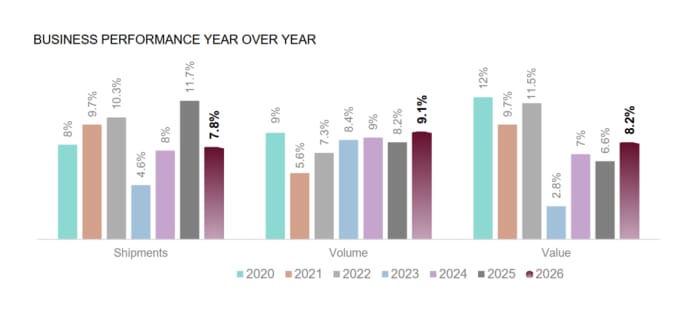
Private fleets are growing steadily, according to NPTC.
NPTC
Growth in Outbound Moves Reflects Supply Chain Control
Private fleets have handled around 70% of respondents’ outbound freight for four consecutive years — 72% in this year’s survey — compared to a historical 66%–67% in previous years.
These outbound moves have become increasingly cost-competitive compared to for-hire alternatives, giving many survey participants a competitive advantage.
If we look at inbound movements, private fleets and vendors operating private fleets together account for 64% of inbound movements of the private fleet respondents. (42% are their own private fleets, 22% are the vendors’ own private fleets.)
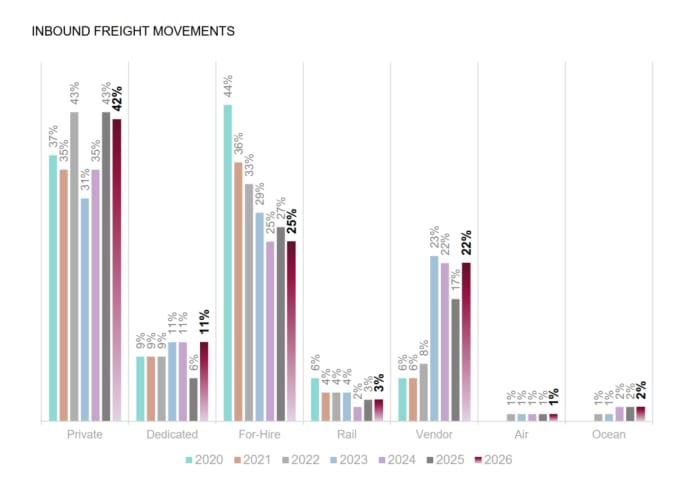
Greater supply-chain control improves service, costs, and efficiency.
NPTC
These numbers reflect how private fleets have strengthened their control over their supply chains. And greater supply-chain control improves service, costs, and efficiency.
“For us, the more we can control our supply chain, the more we can control our service levels, our costs, and overall efficiency,” said Tim Eckhardt, senior director of safety at Dot Foods, in a virtual panel discussion of the NPTC survey results.
“We operate on a lot of short deadlines, so the more control we have of that entire circle, [the more] we’ll be able to provide better, quicker service to our customers.”
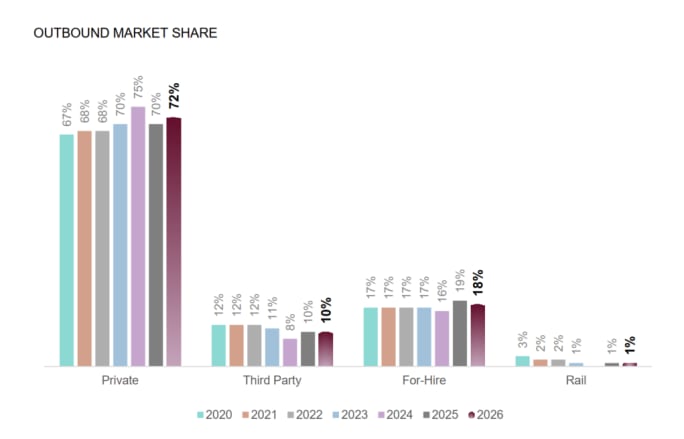
For years private fleet market share of inbound freight didn’t change much. But during the pandemic, private fleets couldn't get service from outside carriers, and if they did, they paid dearly for it. So many decided to grow their fleet and driver pool to serve as a hedge against that outbound capacity. And it seems they haven't returned to the pre-Covid numbers.
NPTC
Growing Private Fleets
Seventy-one percent of NPTC’s survey respondents expect to add equipment or handle more company freight over the next five years.
Private fleets are adding locations and moving closer to customers, reflected in lower annual mileage per truck — 80,750 miles.
The average number of locations for survey respondents was 48, the second-highest in survey history, and 35% of the respondents report an increase in terminal locations.
Moving closer to their customers not only reduces the length of haul for private fleets, but it also helps to get drivers home more frequently. Private fleets also report that drivers are increasingly demanding more regular hours and more home time, which helps drive mileage lower.
Since the pandemic, panelists said, increased visibility and communication between private fleet management and the management of the company they are a part of has been improving.
“We’re enhancing our abilities to connect and provide those resources, the hedge against for-hire capacity, and better visibility,” Moore said. “Sometimes I think our members look at the supply chain first and then optimizing their fleets second.”
Dot’s Eckhardt added, “It’s the connection of operating together and being able to operate more efficiently and optimized and be able to have as much visibility as you can.”
AutoZone’s Marley Bebout, director of outbound transportation, pointed out that the Covid-19 pandemic “shined a spotlight on how important the supply chain is to all retailers, how that is a critical piece of the business, and I think we have been more integrated and working more collaboratively since.”
Private Fleets See a Regional Shift
In addition to lower average miles per unit, a shift to being closer to customers is also reflected in the trucks they buy.
For the first time, NPTC's survey dug deeper into the Class 8 equipment purchased. It found that 69% of the units purchased are day cabs and the remaining 31% are sleepers.
As private fleets add locations to move closer to customers, longer routes that need sleepers are less common.
Kevin Mattimore, senior VP with Penske Truck Leasing (which sponsors the report), said his company has seen a similar trend in terms of the miles its customers are running.
“We’ve seen a shift from sleepers… as fleets try to get close to the customer, day cabs continue to be in demand,” he said.
What Does This Mean for For-Hire Fleets?
As private fleets increase their share, for-hire and dedicated fleets are losing out.
Private fleets in 2025 saw a near-record share of the inbound freight at 42%. Pair that figure with the 22% market share of inbound freight handled by vendors’ own private truck fleets.
The for-hire segment, according to the report, once the dominant force on the inbound side of the equation, continues a steady erosion in market share, this year dropping to 25%, mirroring the all-time low set two years ago.
Asked about the trend of for-hire and dedicated fleets losing market share to private fleets, NPTC Executive VP Tom Moore said the success of private fleets has often been blamed on them “cherry-picking” the freight they want.
Moore said he’s hearing the opposite, “reverse cherry-picking” if you will.
“I’m hearing a lot from our members that we are looking to handle the more challenging customers out there, the ones that need more handholding. I think private fleets are looking at their network to see what they can do from a value-added perspective moving forward.”
Dot’s Eckhardt added, “a lot of that just goes back to service levels, and costs. What are your highest cost lanes? You want to try to run them using your fleet as much as you can.”
The message for for-hire carriers is that capacity alone may not win this freight. They must demonstrate the reliability, visibility and specialized service that shippers increasingly expect from their own fleets.
Why Companies Operate Private Fleets
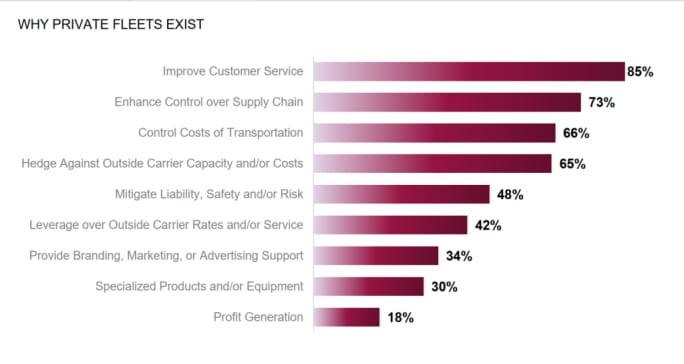
Exceptional customer service has always been a big reason for using private fleets. But other reasons are emerging.
NPTC
- Private fleets enhance control of the supply-chain while delivering exceptional customer service.
- In-house transportation provides stability (and even leverage) against volatile outside carrier capacity.
The biggest reason companies report operating a private fleet is to provide exceptional levels of customer service(cited by 85% of this year’s respondents.) That’s similar to previous years.
But this year’s survey revealed the emergence of other factors: Providing control over the supply chain (up 14 percentage points to 73%) and leverage over outside carrier rates and/or service, at 42%, a dramatic climb from last year.
More Fleet Management

Color Match Smarter: Tools That Restore & Perform
For fleet managers and collision repair professionals keeping heavy-duty trucks on the road, getting the color right the first time isn't just about appearance — it's about efficiency, turnaround time, and bottom-line results. Discover how today's digital color tools are transforming the repair process from guesswork to precision.
Read More →
FMCSA Pauses Biennial-Update Enforcement Amid Motus Transition
Carriers whose updates were due on or after June 1 have more time, while FMCSA works to stabilize its new registration system and warns of phishing sites impersonating its new carrier registration system, Motus.
Read More →
2026 Blueprint for Countering Smarter Supply Chain Theft
Cargo theft is no longer just the cost of doing business. It's a multi-billion-dollar criminal enterprise exploiting vulnerabilities across your fleet, drivers, and supply chain.
Read More →


How Telematics Improves Visibility, Control, and Performance in Refrigerated Fleets
Explore how telematics help refrigerated fleets improve visibility, uptime, efficiency, compliance, and cargo protection across connected cold chain operations.
Read More →
What the U.S.-Canada Trade War Means for Trucking
Escalating U.S.-Canada tariffs could disrupt cross-border freight, reduce truck volumes, raise costs, and create new uncertainty for carriers on both sides of the border.
Read More →
What Are Trucking’s Top Concerns for 2026?
The American Transportation Research Institute wants to know what's worrying trucking fleet managers, drivers, and other stakeholders in its annual Industry Issues survey.
Read More →
American Trucking Associations Looks for a New Leader
ATA President and CEO Chris Spear abruptly left his job at the association on August 21, at a pivotal time for the trucking industry.
Read More →
Public Wi-Fi Cybersecurity Risks: How Truck Drivers and Fleets Can Protect Their Data
Public Wi-Fi can expose truck drivers and fleets to credential theft, malware, and other cyber threats. Here’s how to reduce the risk on the road.
Read More →
For Nicky Cupp, Fleet Innovation Starts With Frustration
HDT Truck Fleet Innovator Nicky Cupp turns everyday pain points at Fraley & Schilling into opportunities for better technology and smarter processes.
Read More →
Adam Buttgenbach’s Approach to Electric Trucks: Start With Where They Fit
HDT Truck Fleet Innovator Adam Buttgenbach helped PepsiCo build one of North America’s largest EV fleets by focusing on where electric trucks make operational sense.
Read More →