




Whiting SmartWashout Cleans Trailer Interiors
A new, internal, wash system from Whiting Systems is designed to clean trailer interiors such as reefers and produce haulers.

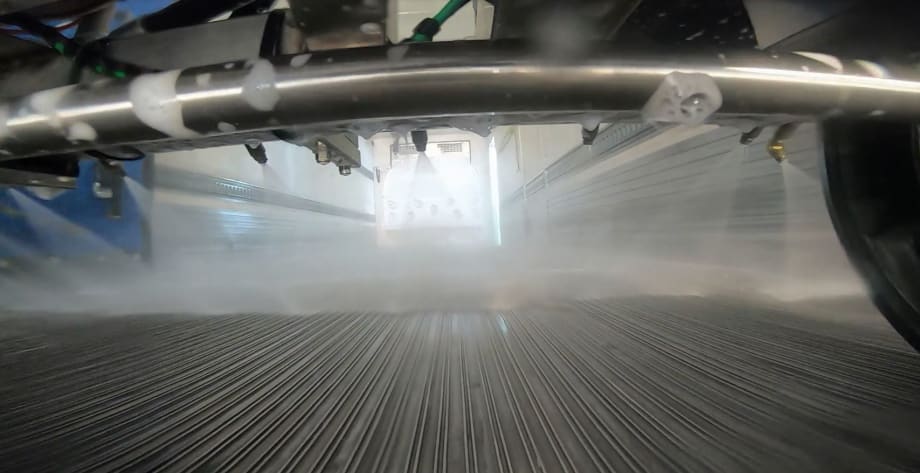
SmartWashout is a new, internal, cleaning system for reefers and produce fleets from Whiting Systems.
Photo: Whiting Systems
Whiting Systems, a manufacturer of automatic truck, bus and train wash systems, designed its new SmartWashout internal trailer washout system with refrigerated transporters and produce haulers in mind.
“The new SmartWashout is made of all stainless framework, offers a highly innovative self-centering software system to perfectly ensure proper cleaning and disinfecting of the refrigerated trailer,” said Dave Speer, senior vice president, Whiting Systems. “The SmartWashout unit has the ability to operate as a 2020 MultiGun. The touchscreen has the options displayed ‘SmartWashout’ or ‘MultiGun.' By making the MultiGun option, the unit will control the appropriate valving and process to have the capacity of running four handheld pressure wash guns at the same time. These can be plumbed and dropped into wash bays and shop areas.”
Russ Whiting, president and CEO, said SmartWashout has been adopted by several food distribution companies, whose staff offered advice during the research and design phase.
Whiting Systems developed the SmartWashout with data logging for carriers that must implement procedures to ensure equipment and vehicles are in appropriate sanitary condition while making sure previous cargo does not make food-grade loads unsafe.
Whiting said the design and Pure Hard Surface disinfectant chemistry meet all Food Safety Modernization Act requirements.
“Everything designed into this unit was to better assist in safe food delivery and reducing downtime," Whiting said.
More Safety & Compliance

FMCSA Pauses Biennial-Update Enforcement Amid Motus Transition
Carriers whose updates were due on or after June 1 have more time, while FMCSA works to stabilize its new registration system and warns of phishing sites impersonating its new carrier registration system, Motus.
Read More →
ZF Expands Commercial Vehicle Push in North America
ZF is expanding its North American commercial-vehicle presence with new transmission applications, electrification, trailer technology and autonomous-driving systems.
Read More →
Truck Drivers Need More Than Another Alert
Fleets have more visibility into truck health, safety events, and driver activity than ever. The next challenge is turning all that information into useful guidance for the person who has to decide what to do next.
Read More →
Tesla Wants a Self-Driving Semi. Are Cameras Enough?
Could Tesla’s camera-only autonomous driving technology work on an 80,000-pound Semi? In this commentary, HDT's Deborah Lockridge takes a look at Tesla, Cybercab, and how autonomous trucks see the road.
Read More →
What DOT’s Automated Vehicle Strategy Means for Trucking
The U.S. Department of Transportation issued a new automated-vehicle strategy that outlines plans for driverless-truck regulations, cross-state freight corridors, and federal safety standards.
Read More →
NYC Expands Speed, Pedestrian Safety Tech Across Fleet
New York City is expanding intelligent speed assistance and pedestrian-alert systems across its municipal fleet, moving the technologies from pilot programs into vehicle procurement and retrofit requirements.
Read More →
FMCSA Removes 110 Truck Driver Training Schools from Certified ELDT List
Federal regulators also are targeting more than 160 additional training providers and launching a nationwide audit of third-party CDL skills testers as part of a broader crackdown on trucking fraud.
Read More →
Beyond DOT Compliance: What Makes a Trucking Fleet Truly Safe?
A trucking fleet can follow every rule and still make unsafe decisions. The real test comes when safety conflicts with freight, productivity, or cost.
Read More →
Hours of Service Pilot Programs: FMCSA Readies for 2027 Rollout
Two pilot programs could eventually reshape hours-of-service rules, giving truck drivers options to pause their 14-hour clock or use longer split sleeper rest periods.
Read More →
New Guide Offers Pet Safety Tips for Truck Drivers
Hundreds of thousands of pets travel in truck cabs. A new safety guide from Volvo Trucks and the Center for Pet Safety offers practical advice for truck drivers who bring dogs and cats along for the ride.
Read More →