




What Will California Governor's Energy Goals Mean for Trucking?
In his inaugural address this week, California Gov. Jerry Brown laid out what he called “bold commitments” to sustain the environment in the nation’s most populous state, by reducing energy consumption.


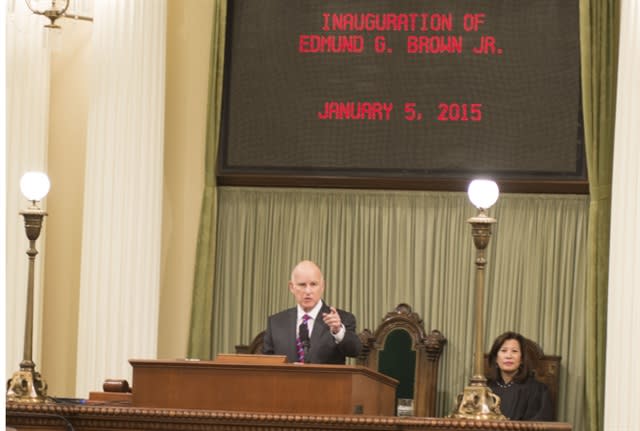
Governor Brown delivers inaugural address. Photo: Brad Alexander, Office of the Governor.
In his inaugural address this week, California Gov. Jerry Brown laid out what he called “bold commitments” to sustain the environment in the nation’s most populous state, by reducing energy consumption.
Among his goals over the next 15 years is to reduce petroleum use in both trucks and passenger vehicles by up to 50%, along with increasing the percentage of the state’s electricity derived from renewable resources to 50% and doubling the energy efficiency of existing buildings, including making heating fuels cleaner.
The news was immediately greeted warmly by environmental groups. Earthjustice Vice President Abigail Dillen said, “We applaud Gov. Brown for working to secure a cleaner, brighter future for California and paving the way for the rest of the country and the world to follow. Weaning the state off dirty fossil fuels and embracing clean energy is the kind of immediate action we need to confront the worst effects of climate change.”
While some in trucking may worry this will mean more regulations and higher costs, Brown’s announcement is not really a major policy change. California’s Air Resources Board has been working on its Sustainable Freight Initiative, due out later this year. It is expected to mean new regulations requiring improved efficiency in freight movements, along with zero or near-zero emissions from equipment used to transport cargo, according to Joe Rajkovacz, director of governmental affairs & communications for the California Construction Trucking Association and its interstate conference, the Western Trucking Alliance.
“One of CARB’s goals is the migration towards electric-powered heavy-duty vehicles and hydrogen powered vehicles. They don’t even view natural gas as a so-called bridge fuel. They want to move beyond fossil fuels, period,” he said in an interview.
For instance, Rajkovacz expects to start seeing mandates in 2017 that would ban the use of diesel-powered equipment for vocational trucking running just in the Los Angeles basin, which would be in place by the middle of the next decade.
Nearly four years ago, CCTA filed suit against CARB challenging the legality of its statewide truck and bus rules that require such equipment to be less polluting. That effort continues, with the next hearing set for February.
“We have been saying for a long time these such mandates were never going to end," Rajkovacz said. "I think a lot of people feel beat down by these constant regulations to reshape the marketplace, and that’s one of the reasons we continue to pursue our litigation against CARB."
For on-highway truck owners, either those running intrastate in California or those running in and out of the state, Rajkovacz believes there is less reason for concern, though he is cautious.
“I think the long-haul segment has less to worry about from this in terms of being potentially forced into purchasing newer trucks that basically right now don’t exist. For example, there isn’t an electric line haul truck that’s available,” he said.
What he is less certain about are possible California mandates that say, for instance, say you can’t use diesel anymore and that you have to use natural gas as a bridge fuel on long-haul trucks. This is where he says lawsuits against CARB by CCTA, as well as separate ones by others, become all the more important.
“If the dust settles on this and CARB feels there is nothing that can be done to stop them from making these mandates, they are going to have lots of stricter rules in the future."
More Fuel Smarts

New California Law Could Shed Light on Electric Truck Prices
Why do battery-electric Class 8 trucks remain so expensive? A California bill signed by Gov. Gavin Newsom would give fleets and state agencies more visibility into what manufacturers charge.
Read More →
How Volvo Updated Its D13 for EPA 2027 [Watch]
Volvo’s updated D13 promises lower emissions without sacrificing performance or fuel economy. Take a closer look at what changed inside the engine in this HDT Spotlight video.
Read More →
Diesel Price Spike Shortens Payback for Natural Gas Trucks, Report Says
Energy Vision estimates fleets could recover the higher purchase price of an RNG-fueled Class 8 tractor in 1.3 to 2.8 years under current fuel-price scenarios.
Read More →

Calstart Becomes Catalyst Mobility, Reflecting Broader Focus
Calstart is now Catalyst Mobility, reflecting the nonprofit’s growing national role in clean transportation, including zero-emission trucks, infrastructure and incentive programs.
Read More →
Record Diesel Prices Squeeze Trucking Fleets
Average U.S. diesel prices have climbed to nearly $6 a gallon, surpassing the 2022 record as tight refinery capacity and Middle East disruptions keep fuel costs elevated.
Read More →
How Fuel Delivery Shapes Engine Performance
Fuel delivery depends on more than what happens at the injector. For fleet, maintenance and technical professionals, looking at the full path from pump to injector can provide useful context for understanding engine performance.
Read More →
East Coast Port Launches $45M Electric Truck Push
The Port Authority of New York and New Jersey announced millions in incentives for zero-emission drayage trucks, yard tractors, and new charging hubs near the port.
Read More →
Detroit Opens Orders for EPA 2027 Engines
Detroit isn’t starting from scratch to meet EPA 2027 diesel emissions standards. Its Gen 6 DD13 and DD15 engines keep much of today’s platform while updating the fuel and aftertreatment systems.
Read More →
Zero-Emission Truck Corridor Planned for West Coast
California, Oregon, Washington, British Columbia and Baja California are coordinating plans for truck charging and hydrogen fueling from Canada to Mexico.
Read More →
A Closer Look at Kenworth’s Electric T880E Vocational Truck [Video]
Learn more about Kenworth's T880E battery-electric vocational truck at the Paccar Technical Center, including its range, applications, upfitting considerations, and PTO options, in this HDT Spotlight video.
Read More →