




Volvo Trucks to Re-Start Production at NRV Plant
Volvo Trucks North America announced that it will re-start production at its New River Valley truck assembly plant under the terms of a six-year contract that was rejected by workers on July 9.

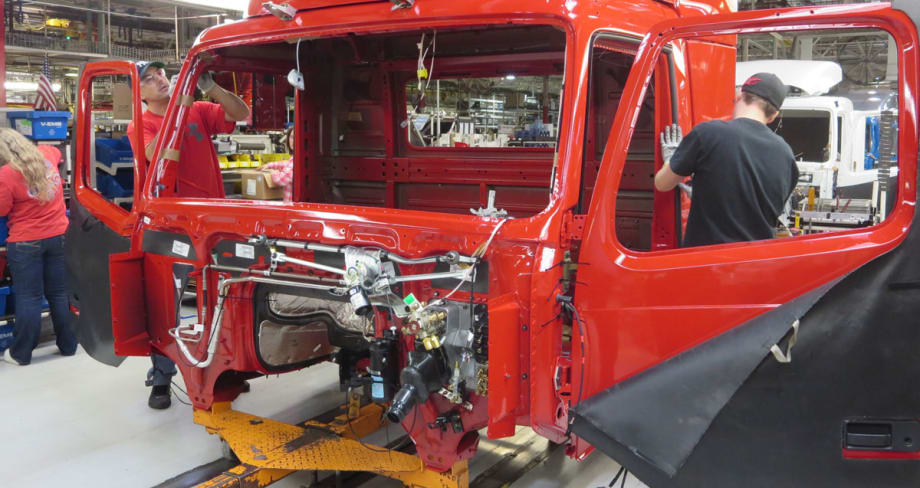
Workers assemble Volvo trucks at the New River Valley plant in this 2015 HDT file photo.
Photo: Deborah Lockridge
Volvo Trucks North America announced that it will re-start production at its New River Valley truck assembly plant under the terms of a six-year contract that was rejected by workers on July 9.
It was the third time union workers rejected a tentative labor agreement between United Auto Workers leadership and Volvo Trucks North America. The NRV plant in Dublin, Virginia employs more than 3,300 people, about 2,900 of whom are UAW members.
In a July 11 press release, Volvo announced, “after reaching an impasse today in discussions with United Auto Workers negotiators regarding a new contract for the company’s New River Valley plant, Volvo Trucks North America will on July 12, 2021, implement the terms and conditions of the tentative agreement endorsed by UAW leaders on July 1, 2021. Any employees who return to work on July 12 or thereafter will immediately receive the wage increases and benefits outlined in the July 1 agreement, except for the ratification bonuses that would be paid on contract ratification.”
The previous five-year contract expired in mid-March, and production stopped April 17 after a 30-day extension expired without an agreement. It was the first such strike for Volvo since 2008. A tentative agreement was reached April 30 and production resumed May 3, but that agreement was soundly rejected by the rank and file on May 16. On June 6, union members rejected a new six-year labor agreement. Workers went on strike again on June 7.
This version of the agreement was not rejected as soundly as the previous two. On hourly and common language, 40% voted to approve the agreement. On salary language it was 33%.
“We need to safeguard our future, and start building trucks for the many customers and dealers whose businesses and livelihoods depend on our products,” said NRV Vice President and General Manager Franky Marchand. “Our last offer delivered significant wage gains and first-class benefits for our employees, and 40% of UAW voters supported it. We look forward to welcoming employees back to the plant, and to getting back to building the industry’s best heavy-duty trucks.”
After the contract was rejected, Marchand said in a statement, “Given the significant wage gains and first-class benefits this agreement delivered, and the strong support it garnered from UAW leadership at every level, this outcome is unexpected and very disappointing. …The ongoing strike – which we continue to believe is unnecessary – is hurting our customers, and has already set back our project to expand and upgrade the facility. No one is gaining from the current situation, and we will consider all options related to the bargaining process.”
Marchand was referring to a $400 million investment for advanced technology upgrades, site expansion and preparation for future products, including the new Volvo VNR Electric truck, which the company is in the midst of.
In its Facebook page, UAW Local 2069 on July 11 said, “there is no more negotiating” and the union will have another ratification vote on Wednesday, July 11. Another letter on the Facebook page asked members not to cross the picket line until that vote has been held.
“We are still on strike until further notice,” said the letter from Matt Blondino, Local 2069 president. “We will have a ratification vote on Wednesday, July 14…. If ratified we could possibly return to work between Thursday, July 15, 2021, to Monday, July 19, 2021.”
In the comments on that post, Missy Edwards, election committee chair for the Local, wrote, “if this fails, we will still go back to work under [tentative agreement 3]. Unfair labor charges will be filed against the company, and we will see what comes of that. Several scenarios are possible and could take months or years to resolve.”
More Equipment

How Volvo Updated Its D13 for EPA 2027 [Watch]
Volvo’s updated D13 promises lower emissions without sacrificing performance or fuel economy. Take a closer look at what changed inside the engine in this HDT Spotlight video.
Read More →
Michelin Tire Improves Efficiency and Durability for Regional Fleets
The Michelin X Multi Energy D2 is a regional haul drive tire engineered to help fleets improve fuel efficiency, durability and traction in demanding stop-and-go operations.
Read More →
ZF Expands Commercial Vehicle Push in North America
ZF is expanding its North American commercial-vehicle presence with new transmission applications, electrification, trailer technology and autonomous-driving systems.
Read More →
Tesla Wants a Self-Driving Semi. Are Cameras Enough?
Could Tesla’s camera-only autonomous driving technology work on an 80,000-pound Semi? In this commentary, HDT's Deborah Lockridge takes a look at Tesla, Cybercab, and how autonomous trucks see the road.
Read More →
Kodiak: Driverless Long-Haul Truck Launch on Track for 2026
Kodiak AI says its driverless long-haul safety case is 93% complete and it remains on track to begin commercial operations by year-end 2026.
Read More →
What DOT’s Automated Vehicle Strategy Means for Trucking
The U.S. Department of Transportation issued a new automated-vehicle strategy that outlines plans for driverless-truck regulations, cross-state freight corridors, and federal safety standards.
Read More →
East Coast Port Launches $45M Electric Truck Push
The Port Authority of New York and New Jersey announced millions in incentives for zero-emission drayage trucks, yard tractors, and new charging hubs near the port.
Read More →
PlusAI Going Public to Fund Autonomous Truck Launch
A SPAC deal could provide PlusAI with up to $300 million as it works toward a 2027 commercial launch of factory-built autonomous trucks.
Read More →
NHTSA Moves to Rewrite Truck Fuel-Economy Rules
The National Highway Traffic Safety Administration says it lacks authority to regulate medium- and heavy-duty truck engines separately from complete vehicles, but the existing standards have not yet been eliminated.
Read More →
Detroit Opens Orders for EPA 2027 Engines
Detroit isn’t starting from scratch to meet EPA 2027 diesel emissions standards. Its Gen 6 DD13 and DD15 engines keep much of today’s platform while updating the fuel and aftertreatment systems.
Read More →