





Related: Volvo Group’s New Boss on the Job
Volvo Trucks Moves Forward With Focus on Brand, Uptime, Technology
The recent reorganization of Volvo Group along brand lines should be pretty seamless to North American customers in the short term, according to executives at a briefing for reporters Wednesday, but expect advances soon in powertrain technology and tests of connected vehicle technology and platooning.
February 24, 2016

Goran Nyberg talks to reporters at a roundable Wednesday morning in Washington, D.C. Photo: Deborah Lockridge
6 min to read

Goran Nyberg talks to reporters at a roundable Wednesday morning in Washington, D.C.Photo: Deborah Lockridge
The recent reorganization of Volvo Group along brand lines should be pretty seamless to North American customers in the short term, according to executives at a briefing for reporters Wednesday, but expect advances soon in powertrain technology and tests of connected vehicle technology and platooning.
Volvo Group’s new President and CEO Martin Lundstedt, described as a charismatic “truck guy,” believes that “customers are buying from brands and he wants us to be laser focused on each brand and maximize the opportunities for each brand,” said Volvo Trucks North America President Göran Nyberg.
Volvo’s truck brands in North America, Volvo and Mack, will still share some shared services that have been created in recent years, such as the joint Uptime Center launched in late 2014.
Nyberg noted that Volvo had a record year in North America last year in market share, hitting 12.4% in the U.S. retail market, 0.4 percentage points higher than in 2014. The company shipped 38,849 trucks out of its New River Valley Plant in Dublin, Va., last year. “But it is just one step. It is good, but it’s not good enough. We have far more to go.”
One of the ways it will do that will be by working to increase its market share in its non-core markets. Last year it did very well in its core business of long-haul and regional, and it has been improving its day cab business as well.
“I truly believe that we have a great opportunity to grow in some of those industrial segments,” Nyberg said. He cited petrochemical, intermodal, vocational, heavy haul, flatbed, and regional distribution as segments “where we can aggressively go after business where we know we can be competitive.” Weight-sensitive applications, he said, is another area where Volvo can shine.
When asked if medium-duty vehicles might be in the picture, Nyberg said the company’s focus is on heavy duty. While admitting medium-duty offerings “would be nice to have,” there’s still a lot of room for the company to expand in the Class 8 market, so that’s the priority.
“I want to earn business by the values we bring to our customers, and the value we bring to our dealers,” Nyberg said. “That earns us the right to do business. A wise man said, ‘You get the business you have earned,’ and I truly believe that.”
For 2016, Volvo is predicting North American sales of Class 8 trucks overall to reach about 260,000. While that’s down from last year, Nyberg pointed out that “it’s still a very good year,” just down from its peak. Volvo dealers have a fair amount of excess inventory that is being worked through now, but officials believe sales will pick up in the second half of the year.
Uptime focus
One change customers may see in some markets is more of a brand focus at their dealers. In recent years, under an organizational structure that was not along brand lines, the industry had seen a growth in dealers offering both Mack and Volvo trucks. Now Volvo is working with dealers to put more of a separate emphasis on each brand.
“We are activily trying in medium and large markets to get the brand focus back,” Nyberg said. “We are single branded in many markets; in some we are still dual branded in the sales function but are pushing our dealers to have dedicated resources for our brand.”
He emphasized that the dealer network is an important part of plans going forward. Over the past several years, Volvo’s dealer network has spent $500 million in new buildings, people, tools and equipment. Since 2010, they have increased bay capacity 42%, had a more than 100% increase in the number of technicians and a 229% increase in the number of master techs, and overall an 88% increase in service capacity. And Nyberg says he could use another 100 locations.
The dealer improvements and Uptime Center are key to Volvo’s focus on uptime, which will continue, Nyberg said.
Expect more dealers this year to roll out Certified Uptime Center locations. There are seven so far; these dealers will have special lanes with a guaranteed two-hour-or-less triage. If the job will take four hours or less, it will get a fast track through these dealerships to get it back on the road.
In addition, Nyberg said he believes that predictive analytics will be a “game changer” — but it will take an attitude shift on the part of truck owners.
“Just because we are on the road, we shouldn’t tolerate unplanned stops,” he said. The ability to predict when parts will fail and proactively replace them before they cause a breakdown already exists and is being used by some fleets.
“Unfortunately, I think that the culture in our business is that we repair trucks when they break down,” he said. “If I tell a customer, 'Your alternator is about to go down so we need to replace it now,’ and he hasn’t seen any problems, he’ll say, ‘Why? It isn’t broken yet.’ We need to educate the industry that we can bring more value to you if we are more proactive in your approach.”
Fuel-efficient powertrains
Integrated powertrains are expected to continue to be a part of that success. Last year, 93% of Volvo trucks in North America were sold with Volvo powertrains, and 83% with Volvo’s I-Shift automated manual transmission.
The AMT was introduced less than 10 years ago in the U.S., in 2007. At the time, many were skeptical that AMTs would ever catch on here.
Those integrated transmissions and powertrains have been key to Volvo’s XE powertrain packages, in which the components are optimized through both mechanical and electronic means to provide better fuel economy through a “downsped” powertrain.
“We are the leader in down-speeding vehicles with our XE package,” Nyberg noted. “The transmission today has become the brain of the truck,” not only keeping up with all the information it needs to shift at the most fuel-efficient points, but also reporting back via telematics when something’s not going the way it should.
The company believes 6x2 powertrains will follow a similar pattern of growing acceptance in the market. These are widely used elsewhere in the world for on-highway applications and are being adopted in the U.S. for fuel economy. The federal government is looking at increased adoption of these as part of its proposed fuel economy/greenhouse gas regulations, but Nyberg also pointed out that beyond regulations, the 6x2 simply offers a better solution in many segments.
Last year, Volvo introduced a 6x2 system with a liftable axle for diminishing-weight applications. Nyberg noted that liftable axles save fuel, not only on the truck but on trailers as well.
“In Europe, as soon as vehicle has a partly loaded or empty trailer, they lift axles. Every time you lift axles, you save fuel.” Widespread adoption in the U.S. “will not happen overnight but we believe in it.”
Meanwhile, officials hinted at a big powertrain-related announcement scheduled for next month.
Looking ahead
Looking further ahead, Volvo continues to be actively involved in developing and testing connected-vehicle technologies that will enable operations such as platooning.
Later this year, researchers at Berkeley will launch a test in conjunction with Volvo trucks to evaluate three VNL 670s on Western highways. The company also is working with platooning company Peloton.
“I think the demand will come faster than we think,” Nyberg said, emphasizing that it is a step-by-step approach that requires both regulation and societal acceptance to move forward. But when you compare the connected technology in personal vehicles today to that of a decade ago, he said, it’s obvious our expectations of vehicle safety and connectivity technology is changing.
“I think the speed will accelerate for products that will help us be safer and more efficient going forward.”
More Fuel Smarts

Record Diesel Prices Squeeze Trucking Fleets
Average U.S. diesel prices have climbed to nearly $6 a gallon, surpassing the 2022 record as tight refinery capacity and Middle East disruptions keep fuel costs elevated.
Read More →
Sponsored•September 9, 2026
How Fuel Delivery Shapes Engine Performance
Fuel delivery depends on more than what happens at the injector. For fleet, maintenance and technical professionals, looking at the full path from pump to injector can provide useful context for understanding engine performance.
Read More →
East Coast Port Launches $45M Electric Truck Push
The Port Authority of New York and New Jersey announced millions in incentives for zero-emission drayage trucks, yard tractors, and new charging hubs near the port.
Read More →

California Bill Could Shed Light on Electric Truck Prices
Why do battery-electric Class 8 trucks remain so expensive? A California bill headed to Gov. Gavin Newsom would give fleets and state agencies more visibility into what manufacturers charge.
Read More →
Detroit Opens Orders for EPA 2027 Engines
Detroit isn’t starting from scratch to meet EPA 2027 diesel emissions standards. Its Gen 6 DD13 and DD15 engines keep much of today’s platform while updating the fuel and aftertreatment systems.
Read More →
Zero-Emission Truck Corridor Planned for West Coast
California, Oregon, Washington, British Columbia and Baja California are coordinating plans for truck charging and hydrogen fueling from Canada to Mexico.
Read More →
A Closer Look at Kenworth’s Electric T880E Vocational Truck [Video]
Learn more about Kenworth's T880E battery-electric vocational truck at the Paccar Technical Center, including its range, applications, upfitting considerations, and PTO options, in this HDT Spotlight video.
Read More →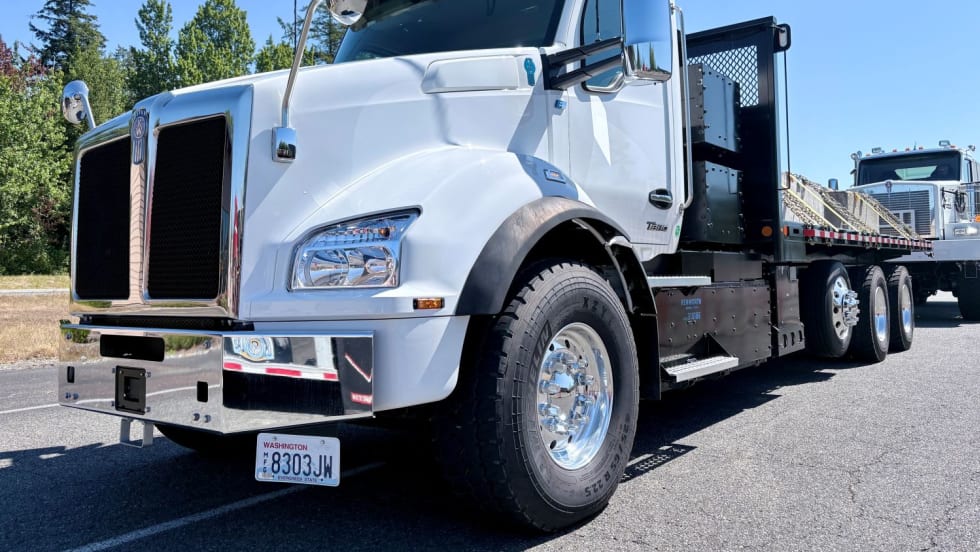
Kenworth T880E Brings EV Power to Vocational Trucks
A closer look at the Kenworth T880E’s range, charging, powertrain and upfit options — and where fleets are showing the most interest.
Read More →
Jennie Abarca Is Proving Electric Trucks Can Do the Job
HDT Truck Fleet Innovator Jennie Abarca is building confidence in fleet electrification one load at a time while openly sharing the challenges she encounters along the way as a small-fleet owner.
Read More →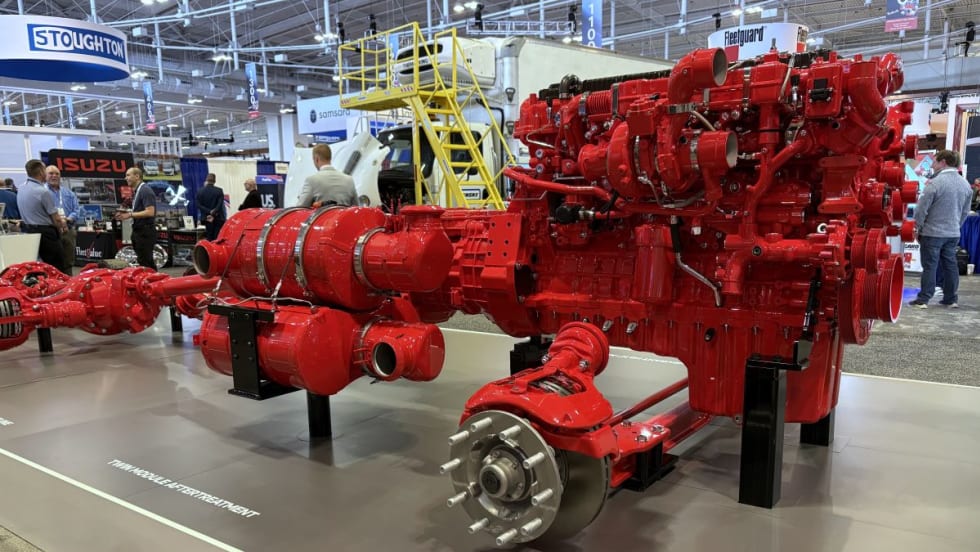
Cummins Adjusts 2027 Engine Rollout After EPA Proposal
The engine maker will gradually introduce its new Model Year 2027 diesel engines while continuing to offer current models during the transition, citing the EPA's proposed emissions rule changes.
Read More →