





How Volvo Designed the New VNL to be its Truck of the Future
Volvo Integrates Waabi Driver into the VNL Autonomous Truck
The integration combines Waabi’s self-driving technology with Volvo’s autonomous truck.
October 29, 2025
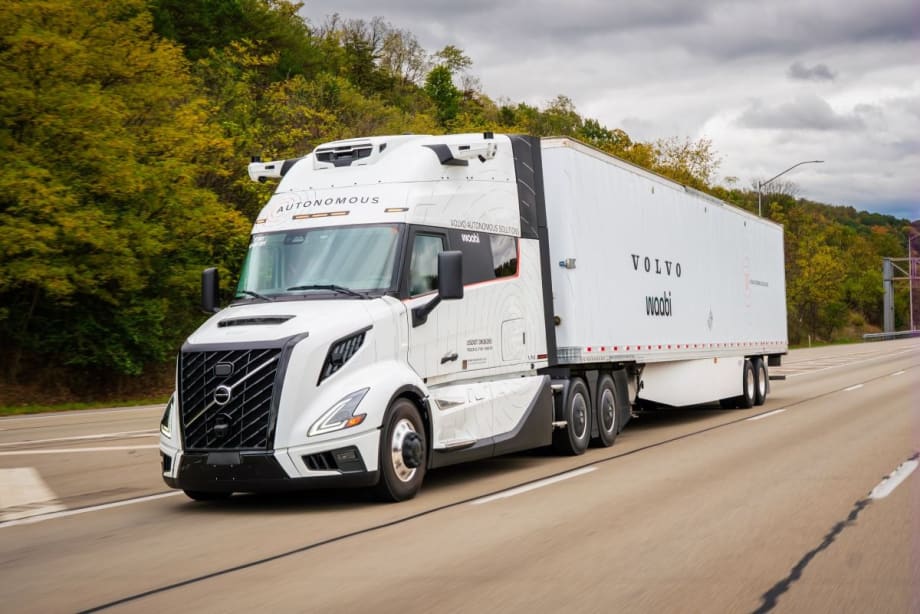
Waabi and Volvo say the joint achievement underscores the significant progress both companies are making together in advancing autonomous freight.
Photo: Wabbi
2 min to read
Waabi and Volvo Autonomous Solutions said they have reached a major milestone in autonomous trucking.
The two companies have successfully integrated the Waabi Driver with the Volvo VNL Autonomous truck.
This joint achievement underscores the significant progress both companies are making together in advancing autonomous freight.
Accelerating Autonomous Technologies
“The future of autonomous trucking hinges on three critical areas: autonomous technology that is safe, scalable, and can deliver on customer needs; hardware that is purpose-built for autonomous operations from the ground up; and a commercial deployment model that solves problems in the supply chain without added friction,” said Raquel Urtasun, founder and CEO of Waabi. “Together with Volvo, we are leading autonomous trucking forward. The Volvo VNL Autonomous, powered by the Waabi Driver, is the next step in ushering in a stronger, safer, and more efficient era in transportation.”
The companies said the successful integration of the Volvo VNL Autonomous and Waabi Driver marks a significant milestone in their longstanding relationship and strategic partnership.
Both companies said they are committed to accelerating the development and adoption of autonomous trucks. With this integration complete, both companies are now focused on delivering an autonomous solution that is safe and supports broad commercial deployment.
The joint solution combines Waabi’s self-driving technology with Volvo’s autonomous truck, designed with redundant systems to enable safe autonomous operations:
According to Waabi, the Waabi Driver is the only interpretable and verifiable end-to-end AI model that is capable of true generalization, enabling it to safely and quickly scale autonomous driving across different geographies, including highways and general surface streets. This enables commercial operations that are scalable, meet the needs of customers, and work within existing logistics operations.
The Volvo VNL Autonomous is a truck purpose-built for autonomy with redundancies or back-up systems for safety-critical functions such as braking, steering, and communication.
By pairing Waabi’s breakthroughs in physical AI with Volvo’s leadership in autonomous trucks, the two companies are developing autonomous solutions primed to meet the freight industry’s needs now and in the future.
“Partnerships like the one between Volvo Autonomous Solutions and Waabi play an important role not only in advancing autonomous technology, but also in building the broader ecosystem required to support commercial deployment,” said Nils Jaeger, president of Volvo Autonomous Solutions. “Autonomy has the potential to address some of the biggest challenges in the transport industry, including safety, efficiency, and capacity. By working together, we are laying the groundwork for a more resilient future for freight.”
More Equipment

How Volvo Updated Its D13 for EPA 2027 [Watch]
Volvo’s updated D13 promises lower emissions without sacrificing performance or fuel economy. Take a closer look at what changed inside the engine in this HDT Spotlight video.
Read More →
Michelin Tire Improves Efficiency and Durability for Regional Fleets
The Michelin X Multi Energy D2 is a regional haul drive tire engineered to help fleets improve fuel efficiency, durability and traction in demanding stop-and-go operations.
Read More →
ZF Expands Commercial Vehicle Push in North America
ZF is expanding its North American commercial-vehicle presence with new transmission applications, electrification, trailer technology and autonomous-driving systems.
Read More →
Tesla Wants a Self-Driving Semi. Are Cameras Enough?
Could Tesla’s camera-only autonomous driving technology work on an 80,000-pound Semi? In this commentary, HDT's Deborah Lockridge takes a look at Tesla, Cybercab, and how autonomous trucks see the road.
Read More →
Kodiak: Driverless Long-Haul Truck Launch on Track for 2026
Kodiak AI says its driverless long-haul safety case is 93% complete and it remains on track to begin commercial operations by year-end 2026.
Read More →
What DOT’s Automated Vehicle Strategy Means for Trucking
The U.S. Department of Transportation issued a new automated-vehicle strategy that outlines plans for driverless-truck regulations, cross-state freight corridors, and federal safety standards.
Read More →
East Coast Port Launches $45M Electric Truck Push
The Port Authority of New York and New Jersey announced millions in incentives for zero-emission drayage trucks, yard tractors, and new charging hubs near the port.
Read More →
PlusAI Going Public to Fund Autonomous Truck Launch
A SPAC deal could provide PlusAI with up to $300 million as it works toward a 2027 commercial launch of factory-built autonomous trucks.
Read More →
NHTSA Moves to Rewrite Truck Fuel-Economy Rules
The National Highway Traffic Safety Administration says it lacks authority to regulate medium- and heavy-duty truck engines separately from complete vehicles, but the existing standards have not yet been eliminated.
Read More →
Detroit Opens Orders for EPA 2027 Engines
Detroit isn’t starting from scratch to meet EPA 2027 diesel emissions standards. Its Gen 6 DD13 and DD15 engines keep much of today’s platform while updating the fuel and aftertreatment systems.
Read More →