




From the HDT archives (1999) – Volvo: Internet Will Change Industry
Volvo Celebrates 35 Years of Innovative Truck Design in North America
This year marks the 35th anniversary of Volvo’s introduction of the Integral Sleeper, the first North American conventional truck model to offer a modern, streamlined design and a fully integrated sleeper compartment.
by Staff
April 20, 20184 min to read
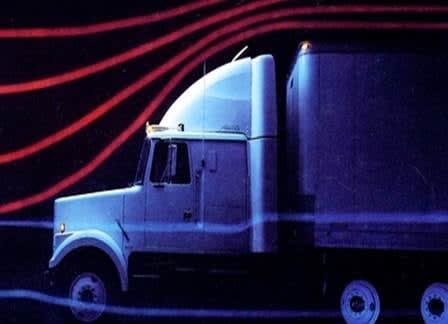
The 1983 introduction of the Integral Sleeper inspired a design revolution for conventional model trucks. It was also colloquially known as the conventional-cabover. Photo: Volvo Trucks
This year marks the 35th anniversary of Volvo’s introduction of the Integral Sleeper, which the company says was the first North American conventional truck model to offer a streamlined design and a fully integrated sleeper compartment.
Caring for the environment has long been a Volvo core value, a position formalized at the 1972 United Nations Conference on the Human Environment, long before it was a trendy mainstream corporate aspiration.
“Pioneering innovations in design, fuel efficiency, driver productivity and safety have defined Volvo Trucks throughout our 90-year history,” said Magnus Koeck, Volvo Trucks North America vice president, marketing and brand management. “We’re proud of our heritage and celebrate 35 years of aerodynamic design. With the Integral Sleeper model we truly introduced a new standard, and all manufacturers quickly followed suit – a trend we continue to see today with automated manual transmissions, greater integration of connectivity services to help maximize uptime, and right-sizing of engines for improved fuel efficiency and weight savings."
The Integral Sleeper united the cab and sleeper compartments for improved aerodynamics with seamless construction that also allowed easy pass-through from the driving environment to the living space. The redefined truck design also introduced a hood that was 6 inches narrower and 6 inches lower at the front than at the cowl, to help reduce wind resistance. Integral Sleeper aerodynamics were further boosted through a full-height roof fairing, cab side extenders, chassis fairings, and trim tabs that helped air flow smoothly from the tractor to the trailer.
“Over the past year we’ve introduced the new Volvo VNR regional haul, Volvo VNL long-haul, and Volvo VNL heavy-haul tractors under the theme 'The Shape of Trucks to Come,' which also would have been very appropriate during the 1983 introduction of the Integral Sleeper, a model that inspired a design revolution for conventional model trucks,” said Koeck.
Setting the Safety Standard
Safety's another one of Volvo's core values, and Volvo became the first Class 8 truck brand in North America to designate a steering wheel-mounted driver’s side airbag as standard equipment. More recently, Volvo Enhanced Stability Technology (VEST), an enhanced stability system, was added as standard equipment for its on-highway lineup in 2007.
“Volvo aspires to zero crashes and zero injuries, helping protect drivers and all road users,” said Johan Agebrand, director of product marketing for Volvo Trucks North America. “Our global Zero Accident Vision is about helping improve safety, and mitigating these events also presents a tremendous cost savings to truck owners.”
Volvo’s July 2017 introduction of the new VNL model also brought Volvo Active Driver Assist, featuring Bendix Wingman Fusion as a standard offering. Volvo said this made it the first heavy-duty truck OEM to offer the active safety system as standard equipment, a designation also applied to the new Volvo VNR series. The system is also integrated with VEST to help drivers avoid rollover, jackknife, and loss-of-control situations on dry, wet, snow- and ice-covered roadways.
The Shift to Automated Manual Transmissions
Volvo also ushered in a shift in transmission preference in North America, as the first to market with a proprietary automated manual transmission. In just over a decade since its North American introduction, the Volvo I-Shift is now spec’d in more than 90% of all Volvo trucks built for the market. It is standard across the Volvo VNR, VNL, VNX, VHD and VAH product range.
“While we still offer manual transmissions, it’s increasingly difficult to justify their use, even for the most demanding jobs,” said John Moore, Volvo Trucks North America product marketing manager – powertrain. “We truly have an I-Shift for every application, whether it’s regional, long-haul, or even heavy loads with our 14-speed I-Shift with Crawler Gears supporting gross weights up to 225,000 pounds. Regardless of the application, the I-Shift consistently performs at its best, whether it is two hours or 10 hours into a job.”
Factory-Installed Connectivity and Beyond
Volvo Trucks today includes its connectivity hardware as standard equipment across its entire North American product range. The connectivity hardware provides access to Remote Diagnostics, which provides proactive diagnostics and monitoring of critical engine, transmission and aftertreatment trouble codes. Volvo also uses the standard onboard connectivity hardware in partnership with fleet management system providers.
Volvo’s standard, factory-installed hardware allows customers to perform software and parameter updates over-the-air with Remote Programming, which helps improve uptime and vehicle efficiency while reducing downtime costs.
“We’re in an exciting period when it comes to truck technology, and the speed of change is only accelerating,” said Agebrand. “It’s easy to get caught up in the technology revolution, but we must keep in mind the industry’s journey and the transformative designs and innovations that will continue to sculpt the shape of trucks to come.”
More Fuel Smarts

How Volvo Updated Its D13 for EPA 2027 [Watch]
Volvo’s updated D13 promises lower emissions without sacrificing performance or fuel economy. Take a closer look at what changed inside the engine in this HDT Spotlight video.
Read More →
Diesel Price Spike Shortens Payback for Natural Gas Trucks, Report Says
Energy Vision estimates fleets could recover the higher purchase price of an RNG-fueled Class 8 tractor in 1.3 to 2.8 years under current fuel-price scenarios.
Read More →
Calstart Becomes Catalyst Mobility, Reflecting Broader Focus
Calstart is now Catalyst Mobility, reflecting the nonprofit’s growing national role in clean transportation, including zero-emission trucks, infrastructure and incentive programs.
Read More →

Record Diesel Prices Squeeze Trucking Fleets
Average U.S. diesel prices have climbed to nearly $6 a gallon, surpassing the 2022 record as tight refinery capacity and Middle East disruptions keep fuel costs elevated.
Read More →
Sponsored•September 9, 2026
How Fuel Delivery Shapes Engine Performance
Fuel delivery depends on more than what happens at the injector. For fleet, maintenance and technical professionals, looking at the full path from pump to injector can provide useful context for understanding engine performance.
Read More →
East Coast Port Launches $45M Electric Truck Push
The Port Authority of New York and New Jersey announced millions in incentives for zero-emission drayage trucks, yard tractors, and new charging hubs near the port.
Read More →
California Bill Could Shed Light on Electric Truck Prices
Why do battery-electric Class 8 trucks remain so expensive? A California bill headed to Gov. Gavin Newsom would give fleets and state agencies more visibility into what manufacturers charge.
Read More →
Detroit Opens Orders for EPA 2027 Engines
Detroit isn’t starting from scratch to meet EPA 2027 diesel emissions standards. Its Gen 6 DD13 and DD15 engines keep much of today’s platform while updating the fuel and aftertreatment systems.
Read More →
Zero-Emission Truck Corridor Planned for West Coast
California, Oregon, Washington, British Columbia and Baja California are coordinating plans for truck charging and hydrogen fueling from Canada to Mexico.
Read More →
A Closer Look at Kenworth’s Electric T880E Vocational Truck [Video]
Learn more about Kenworth's T880E battery-electric vocational truck at the Paccar Technical Center, including its range, applications, upfitting considerations, and PTO options, in this HDT Spotlight video.
Read More →