




Volvo Begins Autonomous Pilot in Sweden Port
Volvo Autonomous Solutions is moving towards commercialization of autonomous transport solutions on both public roads and confined port areas.

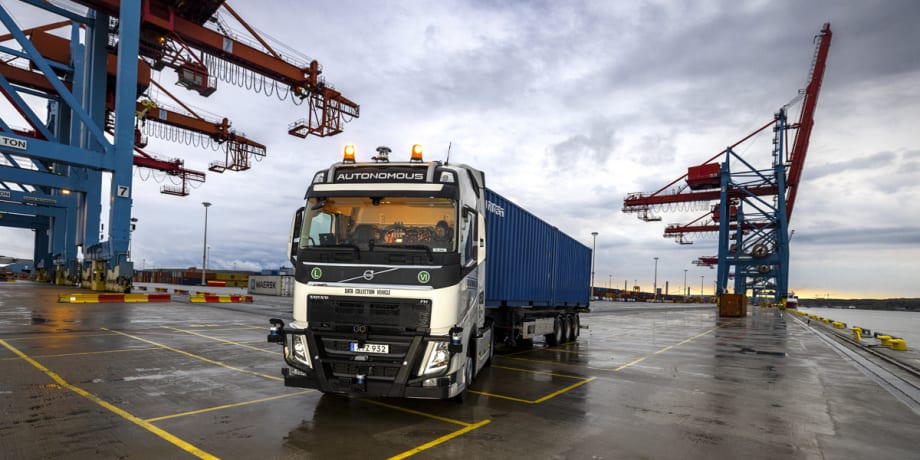
Volvo is collecting data with a sensor-equipped truck in the port area of Gothenburg, Sweden. The data collection is the company’s first phase towards creating an automated and connected system for a continuous flow of goods.
Photo: Volvo
Volvo Autonomous Solutions, together with commercial partners, is now taking the next step towards autonomous transport solutions within the port and logistics center segment.
Through a commercial pilot program, Volvo is collecting data with a sensor-equipped truck in the port area of Gothenburg, Sweden. The data collection is the company’s first phase towards creating an automated and connected system for a continuous flow of goods.
The truck, operated by a human driver, is being driven on both confined port areas and public roads and is collecting data to develop the artificial intelligence to be able to design a safe autonomous solution.
The project is a collaboration between Volvo, the shipping and logistics company DFDS, port operators APM Terminals, the Port of Gothenburg and property company Platzer Fastigheter. The development work is done together with AI and AV computing platforms partner Nvidia.
“It is full speed ahead in the development of on-road as well as off-road transportation solutions,” says Nils Jaeger, President of Volvo Autonomous Solutions, in a press release. “Autonomous transport has an important role to play in the future of logistics and will benefit both business and society in terms of productivity, safety and sustainability.”
The data collection vehicle will be used to learn about complex everyday traffic situations, using sensors logging the surroundings of the vehicles as well as the driver’s interaction with the vehicle. The truck is equipped with 21 sensors in the shape of radars, lidars and cameras, making it possible for the system to detect small things far away on the road surface, as well as objects that are close to the vehicle.
“Volvo is already used to working in confined areas when it comes to operating autonomous vehicles, but the complexity of public roads is something entirely different,” says Luca Delgrossi, VP Vehicle Automation, Volvo Autonomous Solutions.
The project is co-financed by the Connecting Europe Facility of the European Union, and Swedish innovation financier Vinnova.
More Equipment

How Volvo Updated Its D13 for EPA 2027 [Watch]
Volvo’s updated D13 promises lower emissions without sacrificing performance or fuel economy. Take a closer look at what changed inside the engine in this HDT Spotlight video.
Read More →
Michelin Tire Improves Efficiency and Durability for Regional Fleets
The Michelin X Multi Energy D2 is a regional haul drive tire engineered to help fleets improve fuel efficiency, durability and traction in demanding stop-and-go operations.
Read More →
ZF Expands Commercial Vehicle Push in North America
ZF is expanding its North American commercial-vehicle presence with new transmission applications, electrification, trailer technology and autonomous-driving systems.
Read More →
Tesla Wants a Self-Driving Semi. Are Cameras Enough?
Could Tesla’s camera-only autonomous driving technology work on an 80,000-pound Semi? In this commentary, HDT's Deborah Lockridge takes a look at Tesla, Cybercab, and how autonomous trucks see the road.
Read More →
Kodiak: Driverless Long-Haul Truck Launch on Track for 2026
Kodiak AI says its driverless long-haul safety case is 93% complete and it remains on track to begin commercial operations by year-end 2026.
Read More →
What DOT’s Automated Vehicle Strategy Means for Trucking
The U.S. Department of Transportation issued a new automated-vehicle strategy that outlines plans for driverless-truck regulations, cross-state freight corridors, and federal safety standards.
Read More →
East Coast Port Launches $45M Electric Truck Push
The Port Authority of New York and New Jersey announced millions in incentives for zero-emission drayage trucks, yard tractors, and new charging hubs near the port.
Read More →
PlusAI Going Public to Fund Autonomous Truck Launch
A SPAC deal could provide PlusAI with up to $300 million as it works toward a 2027 commercial launch of factory-built autonomous trucks.
Read More →
NHTSA Moves to Rewrite Truck Fuel-Economy Rules
The National Highway Traffic Safety Administration says it lacks authority to regulate medium- and heavy-duty truck engines separately from complete vehicles, but the existing standards have not yet been eliminated.
Read More →
Detroit Opens Orders for EPA 2027 Engines
Detroit isn’t starting from scratch to meet EPA 2027 diesel emissions standards. Its Gen 6 DD13 and DD15 engines keep much of today’s platform while updating the fuel and aftertreatment systems.
Read More →