





Why Medium-Duty Trucks are Leading the Way in Fleet Electrification
Vehicle-to-Grid Charging Key for Evergreen Waste Mack LR Order
Evergreen Waste Services plans to use bi-directional charging to charge its five new Mack LR refuse trucks during off-peak hours.
May 9, 2024
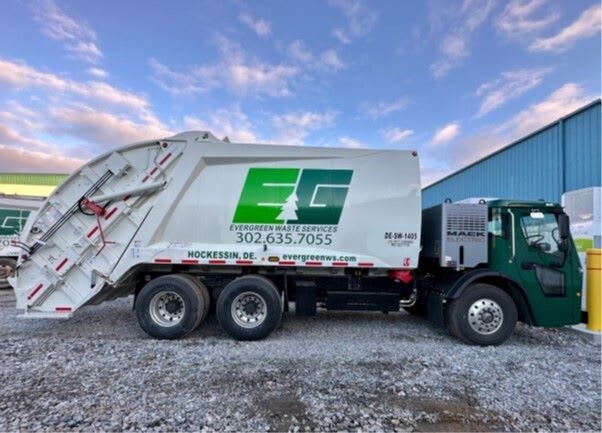
The Mack LR Electric freatures a standard 376 kWh total battery capacity for 42 percent more energy and increased range between vehicle charges.
Photo: Mack Trucks
3 min to read
Evergreen Waste Services recently took delivery of the first of five ordered Mack LR Electric models, the OEM reported. With this delivery, the waste management company is deploying the first fully electric Class 8 refuse vehicle in the State of Delaware.
Evergreen Waste Services also plans to use bi-directional charging when available to charge the LR Electric battery during off-peak hours and push power back to the power grid during peak hours.
Mack made the announcement during WasteExpo 2024, May 6-9, at the Las Vegas Convention Center, Las Vegas, Nevada.
600 Trash Pickups a Day
Evergreen Waste is based out of Hockessin, Delaware. The company will put the LR Electric in service on May 4. Daily service will begin on May 13.
The LR Electric, equipped with a rear loader McNeilus 25-yard body, will operate in a residential area of New Castle County, Delaware.
The truck is planned to make 600 pick-ups and travel about 40 miles each day.
Marcus Stevens, CEO of Evergreen Waste Services, said Evergreen was awarded grant money through the Delaware Mitigation Plan. Stevens said the company planned to add electric vehicles to its fleet whether or not they received funding, but the grant allowed them to purchase four more LR Electric vehicles to add to its fleet of 50 vehicles.
All Class 8 refuse vehicles in the Evergreen Waste fleet are Mack trucks.
Evergreen Waste has two charging station at its site, with three additional charging units to be installed later. Evergreen ordered five charging stations to accommodate the five LR Electric vehicles so all can be charged at the same time.
“It’s exciting for Mack to be part of Evergreen Waste’s peak shaving effort to help reduce the amount of purchased energy from its local utility company during peak demand hours,” said Jonathan Randall, president of Mack Trucks North America. “This is just one example of the benefits of BEVs, and we are happy to be able to supply five Mack LR Electric reuse vehicles to Evergreen Waste to help support them in their journey to adopt electric technology.”
Mack Assistance with Infrastructure
Stevens worked with the team from Mack to help with infrastructure needs. Stevens said he is proud to be a company on the forefront of electric vehicle adoption.
“We are one of the first to do vehicle-to-grid,” Stevens said. “We will bring the LR Electric back to our site with about 40 percent less battery life than when it left. We will then send power back to the grid during peak hours, and then we will charge the vehicle during the off-peak hours of 11 p.m.t o 4 a.m. The vehicle will be fully charged and ready to go by 5 a.m.”
Stevens said the Mack Ultra Service Agreement was instrumental in his purchase decision. Standard on all Mack LR Electric models, the Ultra Service Agreement includes scheduled maintenance, preventative maintenance, towing and repair, a battery monitoring service and Mack’s connected uptime services in one package. It can be included with monthly truck payments for customers in the U.S. and Canada through Mack Financial Services (MFS).
The next generation Mack LR Electric offers a standard 376 kWh total battery capacity for 42 percent more energy and increased range between vehicle charges. Twin electric motors produce 448 continuous horsepower and 4,051 lb.-ft. of peak torque output from zero RPM.
Four NMC (Nickel Manganese Cobalt Oxide) lithium-ion batteries, charged through a 150 kW, SAE J1772-compliant charging system, power the vehicle and all onboard accessories through 12V, 24V and 600V circuits. The two-stage regenerative braking system helps recapture energy from the hundreds of stops the vehicle makes each day with an increasing load.
“The LR Electric purchase will be a homerun if the vehicle can handle 600 stops and go back to the yard because it significantly allows us to save money on diesel and maintenance needs,” Stevens said. “It will be a grand slam if we discharge energy back to the grid and receive a credit back. That makes this really attractive.”
More Fuel Smarts

New California Law Could Shed Light on Electric Truck Prices
Why do battery-electric Class 8 trucks remain so expensive? A California bill signed by Gov. Gavin Newsom would give fleets and state agencies more visibility into what manufacturers charge.
Read More →
How Volvo Updated Its D13 for EPA 2027 [Watch]
Volvo’s updated D13 promises lower emissions without sacrificing performance or fuel economy. Take a closer look at what changed inside the engine in this HDT Spotlight video.
Read More →
Diesel Price Spike Shortens Payback for Natural Gas Trucks, Report Says
Energy Vision estimates fleets could recover the higher purchase price of an RNG-fueled Class 8 tractor in 1.3 to 2.8 years under current fuel-price scenarios.
Read More →

Calstart Becomes Catalyst Mobility, Reflecting Broader Focus
Calstart is now Catalyst Mobility, reflecting the nonprofit’s growing national role in clean transportation, including zero-emission trucks, infrastructure and incentive programs.
Read More →
Record Diesel Prices Squeeze Trucking Fleets
Average U.S. diesel prices have climbed to nearly $6 a gallon, surpassing the 2022 record as tight refinery capacity and Middle East disruptions keep fuel costs elevated.
Read More →
Sponsored•September 9, 2026
How Fuel Delivery Shapes Engine Performance
Fuel delivery depends on more than what happens at the injector. For fleet, maintenance and technical professionals, looking at the full path from pump to injector can provide useful context for understanding engine performance.
Read More →
East Coast Port Launches $45M Electric Truck Push
The Port Authority of New York and New Jersey announced millions in incentives for zero-emission drayage trucks, yard tractors, and new charging hubs near the port.
Read More →
Detroit Opens Orders for EPA 2027 Engines
Detroit isn’t starting from scratch to meet EPA 2027 diesel emissions standards. Its Gen 6 DD13 and DD15 engines keep much of today’s platform while updating the fuel and aftertreatment systems.
Read More →
Zero-Emission Truck Corridor Planned for West Coast
California, Oregon, Washington, British Columbia and Baja California are coordinating plans for truck charging and hydrogen fueling from Canada to Mexico.
Read More →
A Closer Look at Kenworth’s Electric T880E Vocational Truck [Video]
Learn more about Kenworth's T880E battery-electric vocational truck at the Paccar Technical Center, including its range, applications, upfitting considerations, and PTO options, in this HDT Spotlight video.
Read More →