





This article is part of an HDT series,“NACFE’s Electric Fleet Leaders.”
UPS Battles to Overcome EV Infrastructure Issues in California
The UPS distribution center in Compton, California, has highlighted the unforeseen infrastructure issues that can occur when transitioning a facility to battery-electric trucks.
November 1, 2023
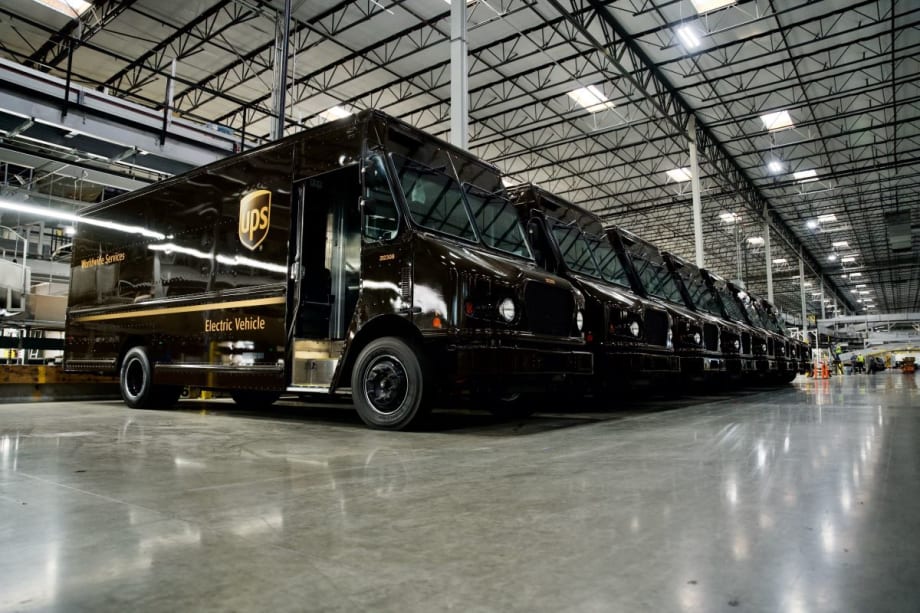
Package cars await cargo while charging off the Metro Line at the UPS distribution center in Compton, California.
Photo: NACFE
5 min to read
The UPS distribution center in Compton, California, ought to be a showcase for how this trucking technology juggernaut is forging ahead on its commitment to a zero-emissions future. But, instead, Compton’s story is one of flexibility and determination — as well as a cautionary tale: A reminder that when it comes to electric vehicle infrastructure, resistance can arise in the most unlikely places.
UPS is a global transportation technology leader and one of 10 fleets participating in the North American Council for Freight Efficiency’s Run on Less Electric - Depot trials. These electric fleet showcases give NACFE analysts an opportunity to see the shift to battery-electric trucks on the front lines. This, in turn, allows NAFCE to report on operational and infrastructure issues fleets are having with this transition process.
An Uphill Battle All the Way
In a video on the NAFCE Run on Less Fleet Profiles page, Dennis Elford, UPS director of maintenance and engineering, said that the Compton facility’s story began five years ago when UPS started talking to truck OEMs and dealers to begin the transition to electric trucks. “It's been a long journey,” Elford said. “And the biggest hill we've had to climb, and we're still climbing it today, is the hill for infrastructure to get us up and running.”
According to David Schaller, director of industy engagment for NACFE, that's because by a zoning quirk, the UPS Compton facility actually falls within two different municipalities, with differing regulations and requirements for installing electric infrastructure. The result has been a series of bureaucratic logjams that have been maddening at times.
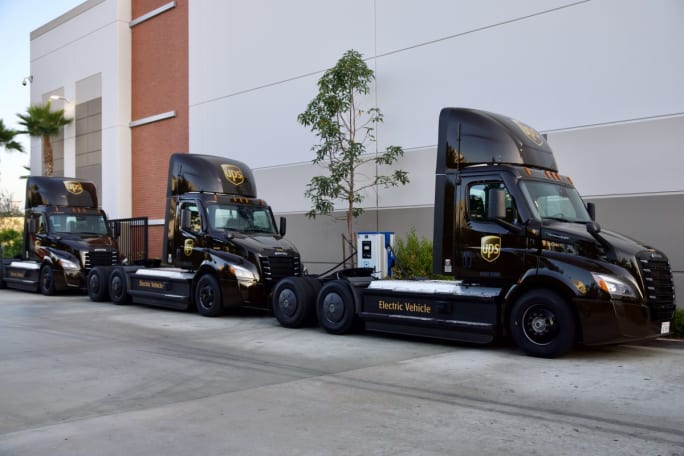
Because of ongoing permitting problems, UPS has set up temporary Class 8 electric truck chargers outside of the Compton facility.
Photo: NACFE
InCharge Energy is the provider of the charging hardware on the site. The company has been a partner to UPS for more than three years, said Terry O’Day, COO and Co-Founder of InCharge.
“Our role in particular is to help with the fleet planning, the facilities planning, design, and engineer sites,” he said. “We do the installation, provide the equipment, supply the software, and the ongoing operations and maintenance.”
Fundamentally, O’Day noted, UPS Compton is a site that has the potential in the long-term to go 100% electric.
“It's an urban location delivering packages into our neighborhoods, picking them up from the airports and from the ports,” he said. "This is a facility that I think UPS could envision one day being all electric.”
With that goal in mind, O’Day pointed out the three ABB chargers outside the facility to serve 10 Freightliner eCascadias. They complement 15 additional chargers inside the facility that serve the medium-duty “package cars,” as UPS has long referred to its delivery vans.
As it turns out, the external heavy-duty chargers are a temporary fix, put in place to overcome an unforeseen infrastructure impasse UPS encountered when it began to transition the facility.
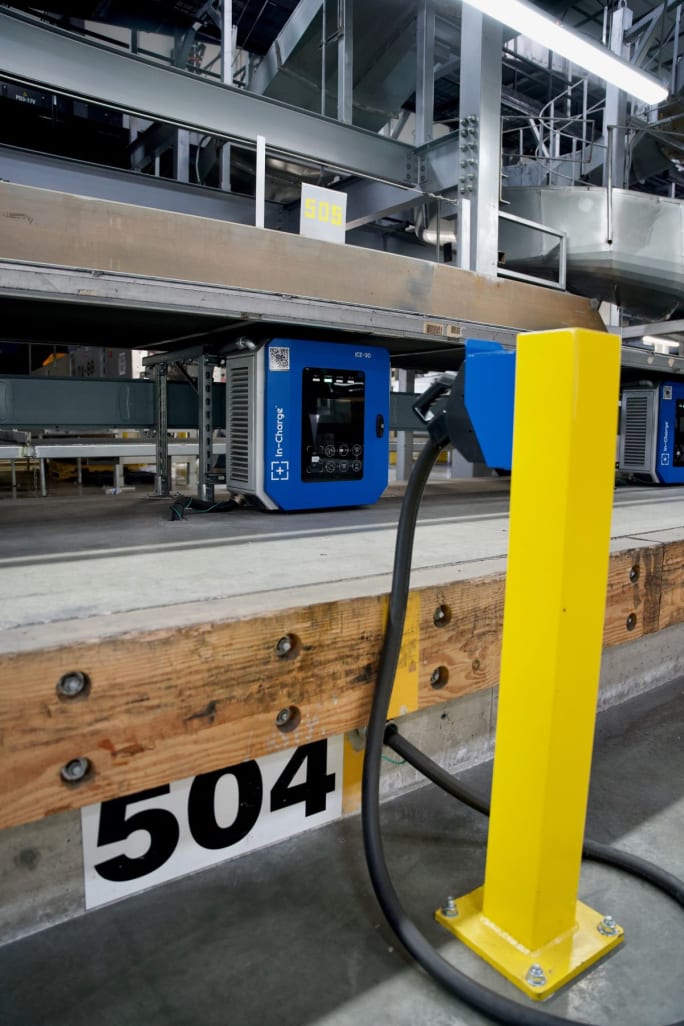
The InCharge installed 30 charging stations inside the UPS Compton facility that can fast-charge up to 30 kW.
Photo: NACFE
“At this UPS site, there were two projects, and both projects had very different circumstances,” explained Chanel Parson, director of electrification for Southern California Edison.
“One of the projects was for the last-mile delivery vehicles inside of the loading dock, and that project proceeded without too many challenges.
"The other project is a project for Class 8 vehicles, and the charging infrastructure was placed outside of the building. And with this project, we did run into a hurdle with getting permits and easements. There was a little bit of an easement challenge between two of the authorities having jurisdiction, and we're waiting for that to be resolved so that we can complete the construction.”
According to Elford, the decision to temporarily charge the Class 8 electric trucks outside the main building is due to the fact after an energy assessment was completed, his team discovered the facility had additional power capacity that could be dedicated to that task.
“Now, we have one temporary charger, a 120-kilowatt charger to charge 10 electric vehicles here in Compton,” he said. “They're able to pull up two eCascadias and charge at the same time. The challenge is for us right now to rotating these vehicles through the charge cycles to keep them on the road.”
Inside the Distribution Center
It's a totally different ballgame inside the distribution center, according to Marcus Kilgo, project manager, InCharge Energy.
“The project that they have inside is definitely cutting edge for the simple fact that it's under their metro line,” he explained. “And if you've been inside of a UPS before, your inside of the metro line is one of the busiest parts of a UPS.”
UPS is using InCharge’s InControl Load Management platform, Kilgo said. InControl is an EV charging software system designed for fleets from the ground up specifically to serve fleet managers by limiting the amount of power drawn from the charging stations to the vehicles so at any given moment, facility total load is never exceeded.
UPS opted for InCharge’s ICE 30 charging stations, Kilgo added. In total, 15 chargers are set up on one 800-AMP 480 panel.
“These are DC fast chargers that charge up to about 30 kw,” he said. “And in this application, we see we have it under metro line here, and you'll have packages running all along here. What'll happen is once the driver gets done with their delivery, they'll back up and they'll plug in."
The package van charges overnight, so in the morning, the driver can come in, load up his vehicle, disconnect from the charger and go drive his route for the day.
"With that InControl network, it allows you to charge simultaneously, charge one at a time. It allows you to do load management.”
The charging situation is still evolving as lessons are learned, said Isaiah Larson, program manager, Electric Walk-in Vans, Freightliner Custom Chassis Corp.
“I'd say the biggest things we're adding are AC charging,” he said in the NACFE video, scheduled for early 2024.
"That's something that was resounding from the market to have AC charging, as one of the features on the vehicle to allow for longer dwell time charging and not as much infrastructure investment for these types of applications.”
“It's a journey, it's a challenge,” Elford said. “But when you see the vehicles driving up and down the road and realizing the impact that you can have on the people that are living in these towns that we deploy these vehicles in, it's just an extremely rewarding feeling to know that you're helping better the planet and the lives of others.”
Updated 11/6/2023 to correct vehicle details in the fleet profile box.
More Fleet Management

Sponsored•September 16, 2026
Color Match Smarter: Tools That Restore & Perform
For fleet managers and collision repair professionals keeping heavy-duty trucks on the road, getting the color right the first time isn't just about appearance — it's about efficiency, turnaround time, and bottom-line results. Discover how today's digital color tools are transforming the repair process from guesswork to precision.
Read More →
FMCSA Pauses Biennial-Update Enforcement Amid Motus Transition
Carriers whose updates were due on or after June 1 have more time, while FMCSA works to stabilize its new registration system and warns of phishing sites impersonating its new carrier registration system, Motus.
Read More →
Sponsored•September 14, 2026
2026 Blueprint for Countering Smarter Supply Chain Theft
Cargo theft is no longer just the cost of doing business. It's a multi-billion-dollar criminal enterprise exploiting vulnerabilities across your fleet, drivers, and supply chain.
Read More →


Sponsored•September 1, 2026
How Telematics Improves Visibility, Control, and Performance in Refrigerated Fleets
Explore how telematics help refrigerated fleets improve visibility, uptime, efficiency, compliance, and cargo protection across connected cold chain operations.
Read More →
What the U.S.-Canada Trade War Means for Trucking
Escalating U.S.-Canada tariffs could disrupt cross-border freight, reduce truck volumes, raise costs, and create new uncertainty for carriers on both sides of the border.
Read More →
What Are Trucking’s Top Concerns for 2026?
The American Transportation Research Institute wants to know what's worrying trucking fleet managers, drivers, and other stakeholders in its annual Industry Issues survey.
Read More →
American Trucking Associations Looks for a New Leader
ATA President and CEO Chris Spear abruptly left his job at the association on August 21, at a pivotal time for the trucking industry.
Read More →
Public Wi-Fi Cybersecurity Risks: How Truck Drivers and Fleets Can Protect Their Data
Public Wi-Fi can expose truck drivers and fleets to credential theft, malware, and other cyber threats. Here’s how to reduce the risk on the road.
Read More →
For Nicky Cupp, Fleet Innovation Starts With Frustration
HDT Truck Fleet Innovator Nicky Cupp turns everyday pain points at Fraley & Schilling into opportunities for better technology and smarter processes.
Read More →
Adam Buttgenbach’s Approach to Electric Trucks: Start With Where They Fit
HDT Truck Fleet Innovator Adam Buttgenbach helped PepsiCo build one of North America’s largest EV fleets by focusing on where electric trucks make operational sense.
Read More →