




Trailer Orders Remained Strong in December
U.S. trailer orders maintained a healthy, four-month long order trend as 2020 closed out.

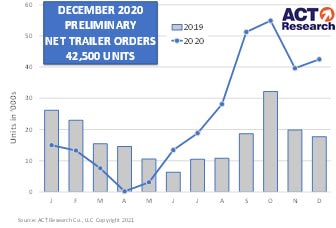
ACT Research reported that the U.S. trailer industry booked 42,500 net orders for the final month of 2020.
Graph: ACT Research
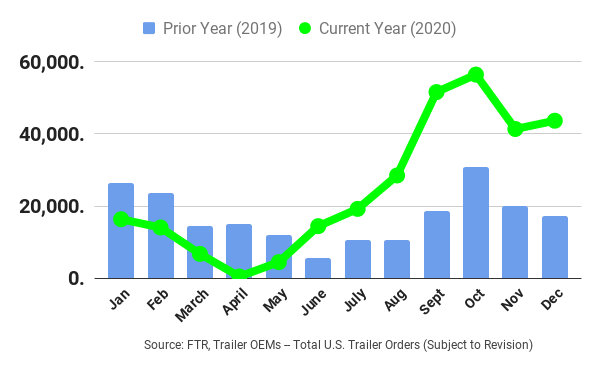
FTR said trailer orders in December remained vibrant for the fourth consecutive month.
Graph: FTR
More than 40,000 new trailers were ordered in December of 2020, continuing a four-month trend of vibrant sales for the trucking industry market segment.
Both FTR and ACT Research, transportation industry research firms, report similar preliminary trailer order numbers for the final month of 2020.
FTR reported that preliminary U.S. net trailer orders remained vibrant for the fourth consecutive month, totaling 41,700 units in December. Order activity was up 6% month-to-month and 155% year-to-year.
Total trailer orders for 2020 totaled 297,000, according to FTR.
Analyzing the December results, FTR concluded that the order volume for October through December was the highest ever for a fourth quarter. Fleets continue to order dry and refrigerated vans in hefty quantities for delivery throughout 2021. Consumer-oriented freight growth continues to rise and should continue, pushed by the second government stimulus. Vocational trailer orders are still recovering but should improve as manufacturing grows.
“This is another great month for trailer orders," said Don Ake, FTR vice president of commercial vehicles, in a news release. "The last four months are very similar to the order surge in August-November 2018. These orders have boosted the backlogs, [which hit] a low point in July during the throes of the pandemic."
Ake predicted that orders will begin falling in January if the 2019 trend repeats – but there are already enough orders in the backlog for a healthy production year.
"Fleet optimism continues to gain momentum. Freight volumes are healthy and growing while the industry is still scrambling to handle the economic restart," Ake said. "The growth should continue as people get vaccinated and employment rises. I also expect manufacturing activity to intensify soon. This will lift industrial-oriented freight.”
Similarly, ACT Research reported that the industry booked 42,500 net orders for the final month of 2020. According to ACT Research analysts, that was 7% better than November and 140% above year-ago levels. For the full year, ACT Research said estimated net order volume of more than 288,000 trailers was 40% better than 2019.
“December activity closes a tumultuous year on a very solid up note," said Frank Maly, ACT director of commercial vehicle transportation analysis and research. “As has been the story throughout recent months, dry van demand continued to drive the market. While October and November were the best two dry van order months in history, final stats will likely show December not far behind, ranking fifth best.
"After rushing to the sidelines in the spring, fleets surged back into the market as the year proceeded, reacting to capacity challenges as well as higher freight rates. Those factors drove a dramatic shift in the short- to medium-term outlook for fleets, driving them to make aggressive investment commitments in the latter part of the year.”
He also noted that industry backlog likely ended the year at more than 200,000 trailers, the best orderboard level since April 2019. At current production levels, many OEMs could well be fully committed for 2021 production slots, he said, but predicted OEMs will work to increase production levels as we move through the year.
More Equipment

ZF Expands Commercial Vehicle Push in North America
ZF is expanding its North American commercial-vehicle presence with new transmission applications, electrification, trailer technology and autonomous-driving systems.
Read More →
Tesla Wants a Self-Driving Semi. Are Cameras Enough?
Could Tesla’s camera-only autonomous driving technology work on an 80,000-pound Semi? In this commentary, HDT's Deborah Lockridge takes a look at Tesla, Cybercab, and how autonomous trucks see the road.
Read More →
Kodiak: Driverless Long-Haul Truck Launch on Track for 2026
Kodiak AI says its driverless long-haul safety case is 93% complete and it remains on track to begin commercial operations by year-end 2026.
Read More →
What DOT’s Automated Vehicle Strategy Means for Trucking
The U.S. Department of Transportation issued a new automated-vehicle strategy that outlines plans for driverless-truck regulations, cross-state freight corridors, and federal safety standards.
Read More →
East Coast Port Launches $45M Electric Truck Push
The Port Authority of New York and New Jersey announced millions in incentives for zero-emission drayage trucks, yard tractors, and new charging hubs near the port.
Read More →
PlusAI Going Public to Fund Autonomous Truck Launch
A SPAC deal could provide PlusAI with up to $300 million as it works toward a 2027 commercial launch of factory-built autonomous trucks.
Read More →
NHTSA Moves to Rewrite Truck Fuel-Economy Rules
The National Highway Traffic Safety Administration says it lacks authority to regulate medium- and heavy-duty truck engines separately from complete vehicles, but the existing standards have not yet been eliminated.
Read More →
Detroit Opens Orders for EPA 2027 Engines
Detroit isn’t starting from scratch to meet EPA 2027 diesel emissions standards. Its Gen 6 DD13 and DD15 engines keep much of today’s platform while updating the fuel and aftertreatment systems.
Read More →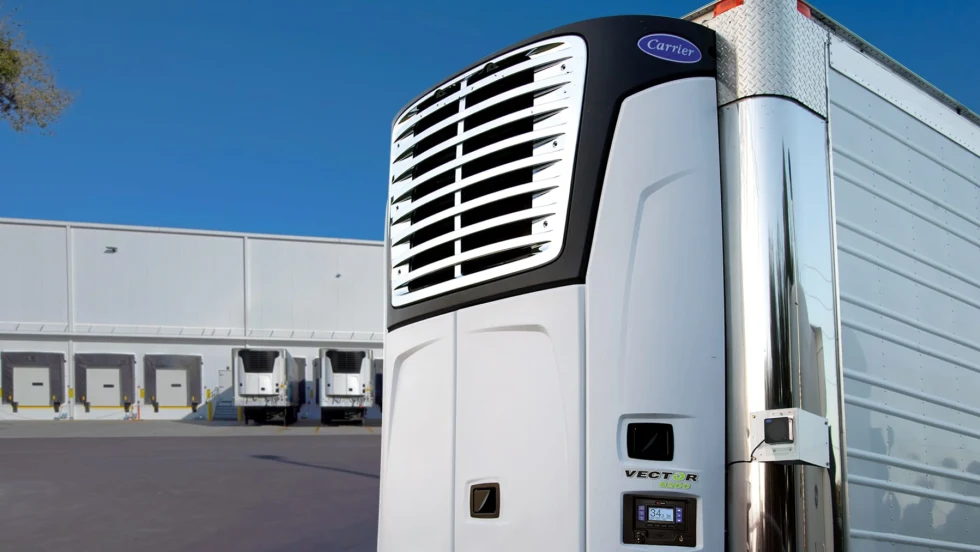
Carrier Transicold Adds All-Electric TRU for Stationary Cold Storage
Carrier Transicold’s new Vector 8200 all-electric transport refrigeration unit gives fleets a diesel-free option for temporary refrigerated and frozen trailer storage.
Read More →
A Closer Look at Kenworth’s Electric T880E Vocational Truck [Video]
Learn more about Kenworth's T880E battery-electric vocational truck at the Paccar Technical Center, including its range, applications, upfitting considerations, and PTO options, in this HDT Spotlight video.
Read More →