




TuSimple Completes First Autonomous Road Test in China
TuSimple said it has successfully completed the first-ever test of an autonomous truck without a driver on public roads in China.

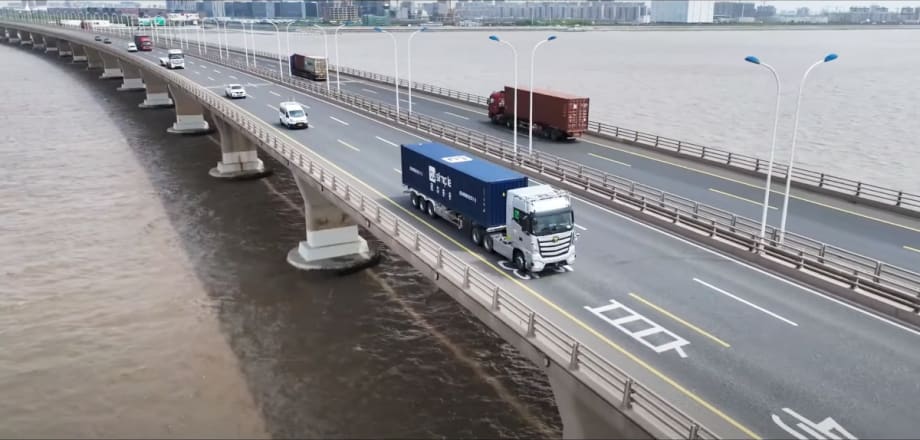
A Chinese truck equipped with TuSimple's autonomous control system crosses the Donghai Bridge during a recent test run in Shanghai.
Photo: TuSimple
Autonomous technology developer TuSimple announced it has successfully completed China’s first fully autonomous semi-truck runs on open public roads without a human in the vehicle and without human intervention.
TuSimple said the "driver-out" run was conducted on designated public roads approved by the Shanghai government. The course included the Yangshan Deep-water Port Logistics Park and Donghai Bridge.
The Driver Out run was operated by TuSimple China’s Autonomous Driving System without a human on-board, without remote human control of the vehicle, and without traffic intervention. In order to ensure public safety, the TuSimple China team worked closely with government regulators and law enforcement and implemented a safety vehicle to ensure safety during the run.
'Driver-Out' Autonomous Operations
Over the course of approximately 62 kilometers, TuSimple China's autonomous truck demonstrated its capability to navigate complex road and weather conditions in both urban and highway environments within the port area. This included traffic signals, on-ramps, off-ramps, lane changes, emergency lane vehicles, partial lane closures, fog, and crosswinds.
The driver-out program in China represents more than two years of intense development. TuSimple said the demonstration shows its commitment to developing an autonomous driving system that fulfills the SAE Level 4 requirements, with a strong emphasis on redundancy, reliability, and stability to enable safe and fully driverless operations on open roads.
"Being the first to conduct a driver-out run in China is a significant milestone," said Cheng Lu, president and CEO of TuSimple. "Following on from our successful driver-out run in the United States in 2021, this accomplishment marks another pivotal breakthrough for TuSimple."
Late last year, TuSimple announced it was cutting staff and focusing on research, development, and “operationalizing” its technology. The restructuring involved a 25% reduction of TuSimple’s total workforce, about 350 people. Of the remaining staff, 80% are in research and development, many of them engineers critical to hardware and software resilience, reliability, safety, and information security. The majority of the restructuring was in TuSimple’s U.S. operations.
The restructuring marked the end of a difficult year for the company, which included investigations into improper technology-sharing, executive shake-ups, and the end of a partnershp with Navistar,
More Fleet Management

Color Match Smarter: Tools That Restore & Perform
For fleet managers and collision repair professionals keeping heavy-duty trucks on the road, getting the color right the first time isn't just about appearance — it's about efficiency, turnaround time, and bottom-line results. Discover how today's digital color tools are transforming the repair process from guesswork to precision.
Read More →
FMCSA Pauses Biennial-Update Enforcement Amid Motus Transition
Carriers whose updates were due on or after June 1 have more time, while FMCSA works to stabilize its new registration system and warns of phishing sites impersonating its new carrier registration system, Motus.
Read More →
2026 Blueprint for Countering Smarter Supply Chain Theft
Cargo theft is no longer just the cost of doing business. It's a multi-billion-dollar criminal enterprise exploiting vulnerabilities across your fleet, drivers, and supply chain.
Read More →


How Telematics Improves Visibility, Control, and Performance in Refrigerated Fleets
Explore how telematics help refrigerated fleets improve visibility, uptime, efficiency, compliance, and cargo protection across connected cold chain operations.
Read More →
What the U.S.-Canada Trade War Means for Trucking
Escalating U.S.-Canada tariffs could disrupt cross-border freight, reduce truck volumes, raise costs, and create new uncertainty for carriers on both sides of the border.
Read More →
What Are Trucking’s Top Concerns for 2026?
The American Transportation Research Institute wants to know what's worrying trucking fleet managers, drivers, and other stakeholders in its annual Industry Issues survey.
Read More →
American Trucking Associations Looks for a New Leader
ATA President and CEO Chris Spear abruptly left his job at the association on August 21, at a pivotal time for the trucking industry.
Read More →
Public Wi-Fi Cybersecurity Risks: How Truck Drivers and Fleets Can Protect Their Data
Public Wi-Fi can expose truck drivers and fleets to credential theft, malware, and other cyber threats. Here’s how to reduce the risk on the road.
Read More →
For Nicky Cupp, Fleet Innovation Starts With Frustration
HDT Truck Fleet Innovator Nicky Cupp turns everyday pain points at Fraley & Schilling into opportunities for better technology and smarter processes.
Read More →
Adam Buttgenbach’s Approach to Electric Trucks: Start With Where They Fit
HDT Truck Fleet Innovator Adam Buttgenbach helped PepsiCo build one of North America’s largest EV fleets by focusing on where electric trucks make operational sense.
Read More →