





Related: TuSimple Begins Autonomous Mail Route Trials for USPS
TuSimple Study Finds 10% Fuel Savings for Autonomous Trucks
Autonomous truck developer TuSimple said the results of a recent fuel economy study proved that trucks under autonomous control get up to 10% better fuel economy than similarly equipped trucks operating with human drivers.
December 18, 2019
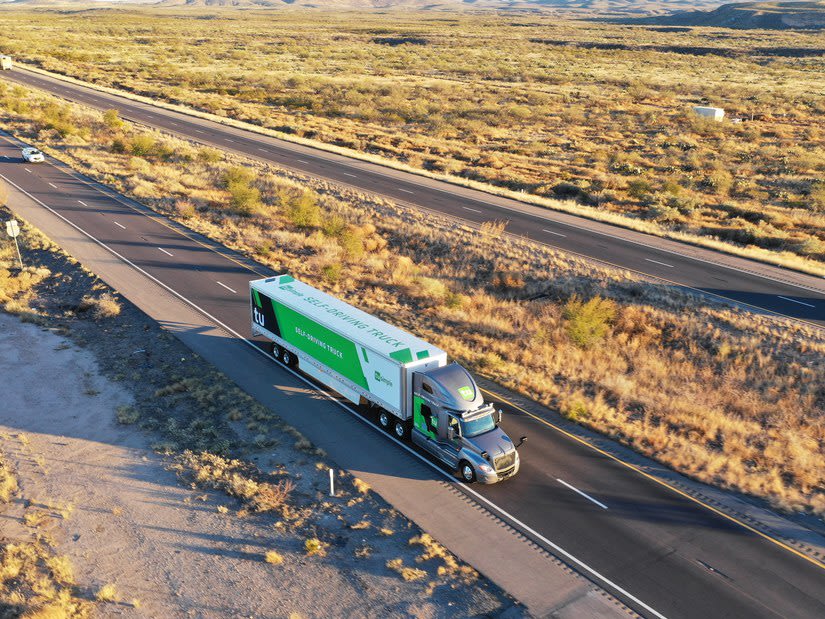
A new study conducted by TuSimple showed the autonomous trucks get better fuel economy when operating in self-driving mode.
Photo: TuSimple
4 min to read
If you’ve followed the advent of autonomous trucks over the past several years, you know that developers have made several business cases for this emerging technology, including safety, efficiency and enhanced asset use. Now, TuSimple is adding fuel economy to that case.
The autonomous truck developer has released the results of a fuel economy study conducted with the University of California San Diego that it said proves TuSimple’s autonomous technology cuts fuel consumption of heavy-duty trucks by at least 10%.
The findings are part of new fuel study from the UC San Diego’s Jacobs School of Engineering and TuSimple.
The study measured similarly equipped Peterbilt Model 579 tractor-trailers on evaluation routes in Arizona, New Mexico and Texas. The trucks operated in a wide range of driving conditions encountered by fleets daily, including long Interstate highway runs and congested urban driving. Special “black box” recorders on the test trucks recorded data during the daily drives, including when the truck was being driven by a human driver – which the company refers to as being under “manual control” – or when it was operating by the onboard autonomous control system. (A human driver is always behind the wheel, regardless of operating mode, to ensure safety.)
The study extracted driving data over a period of six months, which included 122 autonomous missions totaling nearly 6,700 miles, said Arda Kurt, director of planning and control for TuSimple, in an interview. Based on the available data, researchers used the Virginia Tech Comprehensive Power-based Fuel Consumption model to estimate fuel consumption as a function of speed, location, acceleration and braking. Manually driven trucks were also fitted with the same black-box technology, allowing researchers to compare how fuel consumption differed between autonomous and manual heavy-duty trucks.
How Speed Affects Autonomous Fuel Savings
Fuel consumption was then analyzed across different ranges of speed, including 0-30 mph, 30-40 mph, 40-50 mph, 50-60 mph, and over 60 mph. The study found that fuel consumption between autonomous and manually driven vehicles at lower speeds has the most significant fuel savings because of the complex driving that happens at a lower speed.
“The 10% improvement was an average figure across the test trucks,” Kurt told HDT. “At highway speeds – 65 mph – there really isn’t that much of a difference in fuel use between manual and autonomous driving modes. We see that figure rise in lower-speed driving conditions because there are more decisions available to the autonomous control system which allow it to operate more efficiently.”
At this stage of the autonomous development game, Kurt noted, the primary focus for developers like TuSimple has been on safety, and not focused on fuel economy.
“But our software works on making the most efficient driving decisions it can in terms of braking, throttle inputs and other factors. And, in reality, it is us trying to program our software to mimic the best human drivers out there, and then doing those actions repeatedly and reliably every time. But then, when we tie those functions in with other aspects of our vehicle control systems – namely our cameras and sensors which monitor traffic all around the truck, as well as GPS and real-time traffic-flow data – we can expand the ability of the autonomous control system to predict and react to driving conditions in ways humans cannot. For example, you’re in heavy traffic and a lane change looks good to you. But our autonomous control system may know that 500 yards ahead – out of your line of sight – that new lane is at a complete standstill. So it stays in the current lane – and that decision ultimately pays a dividend in better fuel economy.”
Fuel and GHG Savings Possible With Autonomous Trucks
Robert Brown, director of governmental affairs, TuSimple, told HDT that positive response from TuSimple fleet partners, with whom it casually shared the results of the study, encouraged the company to make its findings public.
“We are excited by these results,” Kurt added, “because up to now, our programming focus for our autonomous control system has been on safety. And we already have proof of a 10% fuel economy boost when the truck is under autonomous control. So we feel strongly that as our system matures and we are able to specifically begin programing for improved fuel economy, those numbers will climb even higher.”
Kurt noted that heavy-duty vehicles account for 20% of transportation-sector greenhouse gas emissions in the United States. If all medium-duty and heavy-duty trucks adopted TuSimple’s self-driving technology, TuSimple said, it would result in an estimated savings of 42 million metric tons of CO2 emissions per year, based on calculations using the EPA’s Inventory of U.S. Greenhouse Gas Emissions and Sinks report that outlines transportation emissions. Applying TuSimple’s 10% average to all U.S. diesel trucks would result in an estimated savings of 4 billion gallons of fuel totalling $10 billion per year, according to calculations based on American Trucking Associations fuel consumption reports.
More Fuel Smarts

How Volvo Updated Its D13 for EPA 2027 [Watch]
Volvo’s updated D13 promises lower emissions without sacrificing performance or fuel economy. Take a closer look at what changed inside the engine in this HDT Spotlight video.
Read More →
Diesel Price Spike Shortens Payback for Natural Gas Trucks, Report Says
Energy Vision estimates fleets could recover the higher purchase price of an RNG-fueled Class 8 tractor in 1.3 to 2.8 years under current fuel-price scenarios.
Read More →
Calstart Becomes Catalyst Mobility, Reflecting Broader Focus
Calstart is now Catalyst Mobility, reflecting the nonprofit’s growing national role in clean transportation, including zero-emission trucks, infrastructure and incentive programs.
Read More →

Record Diesel Prices Squeeze Trucking Fleets
Average U.S. diesel prices have climbed to nearly $6 a gallon, surpassing the 2022 record as tight refinery capacity and Middle East disruptions keep fuel costs elevated.
Read More →
Sponsored•September 9, 2026
How Fuel Delivery Shapes Engine Performance
Fuel delivery depends on more than what happens at the injector. For fleet, maintenance and technical professionals, looking at the full path from pump to injector can provide useful context for understanding engine performance.
Read More →
East Coast Port Launches $45M Electric Truck Push
The Port Authority of New York and New Jersey announced millions in incentives for zero-emission drayage trucks, yard tractors, and new charging hubs near the port.
Read More →
California Bill Could Shed Light on Electric Truck Prices
Why do battery-electric Class 8 trucks remain so expensive? A California bill headed to Gov. Gavin Newsom would give fleets and state agencies more visibility into what manufacturers charge.
Read More →
Detroit Opens Orders for EPA 2027 Engines
Detroit isn’t starting from scratch to meet EPA 2027 diesel emissions standards. Its Gen 6 DD13 and DD15 engines keep much of today’s platform while updating the fuel and aftertreatment systems.
Read More →
Zero-Emission Truck Corridor Planned for West Coast
California, Oregon, Washington, British Columbia and Baja California are coordinating plans for truck charging and hydrogen fueling from Canada to Mexico.
Read More →
A Closer Look at Kenworth’s Electric T880E Vocational Truck [Video]
Learn more about Kenworth's T880E battery-electric vocational truck at the Paccar Technical Center, including its range, applications, upfitting considerations, and PTO options, in this HDT Spotlight video.
Read More →