




Trucking Regulations in the Pipeline: Update from NPTC
It took him all of an hour and a half, but Rick Schweitzer, general counsel for the National Private Truck Council, gamely managed to get across the key elements of the sweep of regulatory changes coming down the pike for trucking.

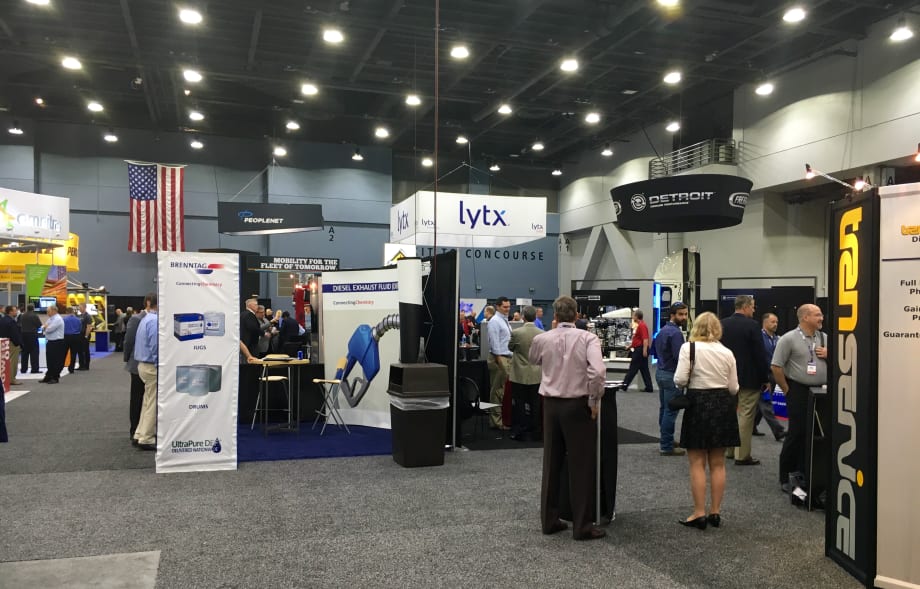
On the NPTC show floor in Cincinnati. Photo: David Cullen
On the NPTC show floor in Cincinnati.Photo: David Cullen
CINCINNATI -- It took him all of an hour and a half, but Rick Schweitzer, general counsel for the National Private Truck Council, gamely managed to get across the key elements of the sweep of regulatory changes coming down the pike for trucking.
Speaking to a standing-room-only audience attending NPTC’s annual meeting at the Duke Energy Center here on April 25, Schweitzer first sorted out the complicated tale of the yet-to-be-determined fate of the 34-hour restart provisions of the Hour of Service rule.
“The previous THUD bill [that includes 2016 fiscal-year appropriations for the Department of Transportation] stated that before DOT could reinstate the [suspended] restart provisions, it had to complete a study to show they improved safety and operator fatigue and driver health and longevity and work schedules, and [the results] had to be certified by the DOT Inspector General.
“But that law removed the statement that the 34-hour restart would remain in place, just without once every 168 hours and the 1 a.m.-5 a.m. [rest-break] requirements,” he continued. “The FMCSA report to Congress is expected in 2Q 2016; once submitted, FMCSA would remove the 34-hour restart entirely – revert back to 2003 HOS rules — and all drivers would need to do a rolling restart every 7 or 8 days to determine available on-duty time.”
Noting that the American Trucking Associations has been leading a coalition to attain a legislative fix so there will be no reversion to the 2003 rule, he said that a political sticking point had been the view held by Sens. Cory Booker (D-NJ) and Richard Blumenthal (D-CT) that drivers could end up being allowed to work too many hours.
“They did not like the hypothetical maximum number of hours [that would exist for drivers],” Schweitzer explained. “But now a deal has been struck [in the Senate] to get that fixed with a cap on on-duty driving after a total of 73 hours weekly in exchange for a 34-hour restart without it being once every 168 hours and without the 1 a.m.-5 a.m. requirements.”
That solution was approved last week by the Senate Appropriations Committee for its 2017 THUD bill. Schweitzer said the legislative repair must also be addressed by the House Appropriations Committee, where he said approval is expected.
Schweitzer advised that, separately, the Commercial Vehicle Safety Alliance petitioned the Federal Motor Carrier Safety Administration in late October to eliminate the 30-minute break provision of the HOS rule. “CVSA said the break rule is difficult to enforce, as an inspector does not know if driver is off duty or performing other tasks. In addition, FMCSA has already granted nine exemptions and there is no evidence that the break rule improves operational safety by reducing fatigue.”
Schweitzer reviewed all the measures within the FAST Act highway bill with an eye to reforming certain existing FMCSA rules, as well as how the agency formulates all future rulemakings:
FAST Act’s CSA Provisions
The National Academies of Science is to conduct an 18-month study of CSA and SMS to analyze the accuracy of BASICs in identifying high-risk carriers and predicting future crash risk and crash severity
The study will review methodology used to calculate BASIC percentiles, weights assigned to violations, ties between crash risk and specific violations, and use of non-fault crashes
A Corrective Action Plan is to be submitted to Congress 120 days after the report. The plan must tell how FMCSA will address deficiencies identified in the study
DOT IG is to assess whether the plan complies with the February 2014 IG Report on CSA.
FAST Act on CSA Data Reform
FMCSA may not make publicly available information on analysis of violations, non-fault crashes, or BASIC percentiles until IG concerns are addressed
Also, the agency may not use CSA data on alerts or relative percentiles for safety fitness determinations until IG concerns are addressed and report to Congress completed. However, FMCSA may still use data to identify carriers for enforcement actions
As of Dec. 4, 2015, BASIC data for property carriers was taken off CSA website; the agency restored absolute scores on March 7, 2016
FAST Act impact on Beyond Compliance initiative
On April 19, FMCSA announced it is seeking input on implementation of the FAST Act requirement that FMCSA must offer a credit or improved SMS score for any carrier that: installs advanced safety equipment, uses enhanced driver fitness measures, adopts fleet safety management tools technologies, and programs, or satisfies other standards determined to be appropriate by the agency
FAST Act and Regulatory Reform
All regulatory impact analyses for proposed and final rules must consider the effect of rule on different segments of the motor carrier industry; use best available science to formulate estimates and findings; use data representative of CMV operators or carriers, and consider effects on various sizes and types of carriers
All major rules (more than $100 million in costs) must begin with an Advance Notice of Proposed rulemaking (ANPRM) or as a negotiated rulemaking (with affected stakeholders) before FMCSA issues a proposed rule
All guidance documents (including regulatory interpretations and statements of enforcement policy) issued by FMCSA must be dated and include the name and contact information of a person who can respond to questions on the guidance. In addition, the guidance must be posted on the FMCSA website for public view
FMCSA must post a summary of all petitions for rulemaking, regulatory interpretation or clarification, on the agency’s website and decide within 180 days of receipt whether to accept, deny or further review the petition. It must also prioritize petitions based on their potential to reduce crashes, improve enforcement, and reduce unnecessary burdens
Exemptions from the motor carrier safety regulations may be granted for up to five years and may be subject to renewal (the current limit is two years).
Also due to the FAST Act, FMCSA must exempt the voluntary mounting on a windshield of vehicle safety technology likely to achieve a level of safety that is equivalent to or greater than the level of safety that would be achieved absent the exemption. This final rule is required by June 2016.
And the FAST Act mandates that FMCSA must allow carriers to conduct pre-employment tests for alcohol and to use hair-testing as an alternative to urine-testing for pre-employment and random testing for controlled substances.
Safety Fitness Determination
Schweitzer also reported on progress on the Safety Fitness Determination rule that was published in January. “It provides for only one rating — ‘Unfit’ — with all others considered to be fit operators. It calls for monthly carrier assessments using absolute standards, rather than percentile ratings against peers.”
Other aspects of the SFD proposal he outlined were:
Uses a revised list of critical and acute regulations; violations would result in failing a BASIC
Will use all investigation results (including roadside), not just compliance reviews, to rate carriers
The proposed rule has different standards for failing a specific BASIC, based on correlation to crash risk
Crash, Drug/Alcohol BASICs will only use investigation data
He added that there will be three ways to be declared unfit: Fail two or more BASICs using roadside data (must have 11 or more inspections with violations over 24 months to fail a BASIC); fail two or more BASICs due to critical or acute violations identified during an investigation; or fail two or more BASICs based on combination of data from roadside and investigations.
Schweitzer noted that the SFD comment deadline has been extended to May 23. In addition, there is an effort under way to include a provision in the House version of the THUD bill to withhold funding for the SFD rulemaking until the CSA study is done and the DOT IG has certified that remedial steps in the mandated Corrective Action Plan have been taken.
ELD Details
He hit the highlights of the Electronic Logging Device final rule:
It mandates adoption of ELDs by all carriers in interstate commerce
Phase-in within two years (December 2017), but carriers already using electronic logs will have another two years to equip trucks with ELDs compliant with this rule
Short-haul drivers (not subject to log books) will be exempt from the ELD rule. They may use paper logs up to 8 days in any 30-day period if they exceed short-haul limits
Supporting documents required to verify on-duty “not driving” time and carriers must retain up to eight documents for each duty period
Drivers must submit supporting documents to carriers within 13 days
Documents must contain driver name or ID number, date, location and time
Prohibition of Coercion
Schweitzer also noted the main points of the final rule on Prohibition of Coercion. Issued last November, it prohibits carriers, brokers, receivers or others from coercing drivers to violate FMCSRs or HMRs. It went into effect Jan. 29. “For coercion to exist, a party must make a threat or take action against a driver’s employment or work opportunities.”
Speed Limiters
As for the proposed rule on truck speed-limiters, Schweitzer said this regulation will affect all Class 7 and 8 trucks — both new and existing vehicles. “In response to petition by ATA and carriers,” Schweitzer said, “it is expected the rule will set limiters no higher than 65 mph.”
Entry-Level Driver Training
The long-awaited — “it’s been around since the 1980s” – entry-level driver training proposal was published in March. Schweitzer said FMCSA issued its NPRM having completed a negotiated rulemaking with stakeholders on driver training curriculum, hours of instruction, and self-certification standards.
More Fleet Management

Nominations Open for HDT Emerging Leaders
Heavy Duty Trucking is looking for accomplished trucking fleet professionals under 40 who are making an impact and helping lead the industry forward.
Read More →
Why Private Fleets Are Taking More Freight
Private fleets are putting their own trucks on demanding customers and high-cost lanes as companies seek greater control over service, costs, and capacity.
Read More →
Color Match Smarter: Tools That Restore & Perform
For fleet managers and collision repair professionals keeping heavy-duty trucks on the road, getting the color right the first time isn't just about appearance — it's about efficiency, turnaround time, and bottom-line results. Discover how today's digital color tools are transforming the repair process from guesswork to precision.
Read More →


FMCSA Pauses Biennial-Update Enforcement Amid Motus Transition
Carriers whose updates were due on or after June 1 have more time, while FMCSA works to stabilize its new registration system and warns of phishing sites impersonating its new carrier registration system, Motus.
Read More →
2026 Blueprint for Countering Smarter Supply Chain Theft
Cargo theft is no longer just the cost of doing business. It's a multi-billion-dollar criminal enterprise exploiting vulnerabilities across your fleet, drivers, and supply chain.
Read More →
How Telematics Improves Visibility, Control, and Performance in Refrigerated Fleets
Explore how telematics help refrigerated fleets improve visibility, uptime, efficiency, compliance, and cargo protection across connected cold chain operations.
Read More →
What the U.S.-Canada Trade War Means for Trucking
Escalating U.S.-Canada tariffs could disrupt cross-border freight, reduce truck volumes, raise costs, and create new uncertainty for carriers on both sides of the border.
Read More →
What Are Trucking’s Top Concerns for 2026?
The American Transportation Research Institute wants to know what's worrying trucking fleet managers, drivers, and other stakeholders in its annual Industry Issues survey.
Read More →
American Trucking Associations Looks for a New Leader
ATA President and CEO Chris Spear abruptly left his job at the association on August 21, at a pivotal time for the trucking industry.
Read More →
Public Wi-Fi Cybersecurity Risks: How Truck Drivers and Fleets Can Protect Their Data
Public Wi-Fi can expose truck drivers and fleets to credential theft, malware, and other cyber threats. Here’s how to reduce the risk on the road.
Read More →