





Related – Commentary: Clean Hydrogen-Powered Vehicles: Are We There Yet?
Hydrogen Fuel Cell Vehicles Could Benefit From Ammonia Breakthrough
In what could be good news for the growth and adoption of hydrogen-fuel-cell-vehicles, an Australian agency says it has developed a way to create hydrogen from ammonia – and ammonia is far easier to store and transport than hydrogen. In fact, Ammonia stores almost twice as much energy as liquid hydrogen.
August 23, 2018
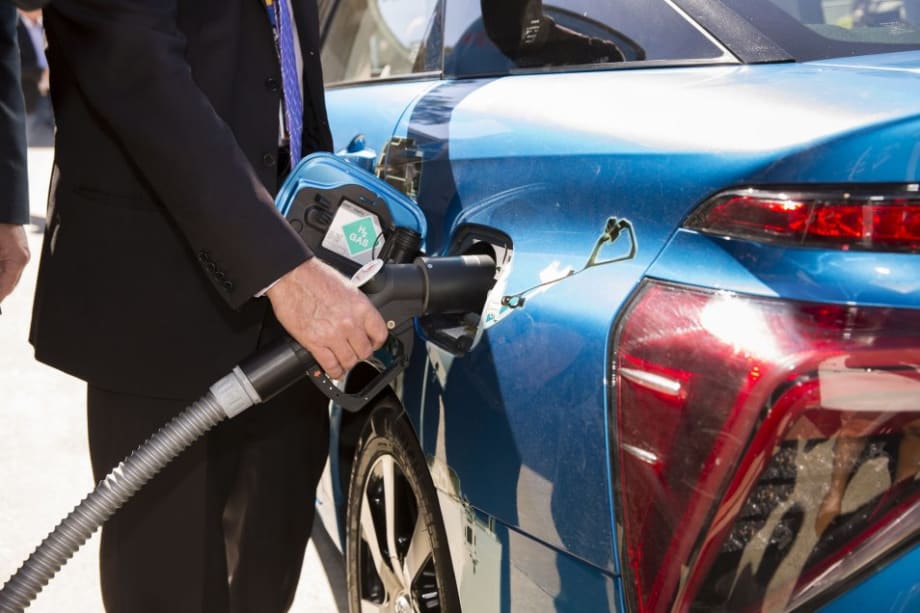
CSIRO says it recently powered Toyota’s Mirai and Hyundai’s Nexo fuel cell electric vehicles using locally produced, ultra-high-purity hydrogen.
Photo courtesy CSIRO
2 min to read
In what could be good news for the growth and adoption of hydrogen-fuel-cell-vehicles, an Australian agency says it has developed a way to create hydrogen from ammonia – and ammonia is far easier to store and transport than hydrogen. In fact, Ammonia stores almost twice as much energy as liquid hydrogen.
Australia’s Commonwealth Scientific and Industrial Research Organization, an independent government agency responsible for scientific research, says it has created a metal membrane that filters out pure hydrogen gas from ammonia. It can then be dispensed into fuel cell cars, buses and even trucks. CSIRO says it recently powered Toyota’s Mirai and Hyundai’s Nexo fuel cell electric vehicles using locally produced, ultra-high-purity hydrogen.
This technology links hydrogen production, distribution, and delivery in the form of a modular unit that can be used at, or near, a refuelling station. It could pave the way for bulk hydrogen to be transported in the form of ammonia, using existing infrastructure, and then reconverted back to hydrogen at the point of use. It has the potential to fill the gap in the technology chain to supply fuel cell vehicles around the world with low-emissions hydrogen.
This means that the transportation and storage of hydrogen – currently a complex and relatively expensive process – is simplified, allowing bulk hydrogen to be transported economically and efficiently in the form of liquid ammonia.
“This is a watershed moment for energy,” said CSIRO chief executive Larry Marshall.
More Fuel Smarts

Wex Adds Cardless Fuel Payments for Over-the-Road Customers
A new fuel card feature for Wex customers offers convenience and security.
Read More →
New California Law Could Shed Light on Electric Truck Prices
Why do battery-electric Class 8 trucks remain so expensive? A California bill signed by Gov. Gavin Newsom would give fleets and state agencies more visibility into what manufacturers charge.
Read More →
How Volvo Updated Its D13 for EPA 2027 [Watch]
Volvo’s updated D13 promises lower emissions without sacrificing performance or fuel economy. Take a closer look at what changed inside the engine in this HDT Spotlight video.
Read More →

Diesel Price Spike Shortens Payback for Natural Gas Trucks, Report Says
Energy Vision estimates fleets could recover the higher purchase price of an RNG-fueled Class 8 tractor in 1.3 to 2.8 years under current fuel-price scenarios.
Read More →
Calstart Becomes Catalyst Mobility, Reflecting Broader Focus
Calstart is now Catalyst Mobility, reflecting the nonprofit’s growing national role in clean transportation, including zero-emission trucks, infrastructure and incentive programs.
Read More →
Record Diesel Prices Squeeze Trucking Fleets
Average U.S. diesel prices have climbed to nearly $6 a gallon, surpassing the 2022 record as tight refinery capacity and Middle East disruptions keep fuel costs elevated.
Read More →
Sponsored•September 9, 2026
How Fuel Delivery Shapes Engine Performance
Fuel delivery depends on more than what happens at the injector. For fleet, maintenance and technical professionals, looking at the full path from pump to injector can provide useful context for understanding engine performance.
Read More →
East Coast Port Launches $45M Electric Truck Push
The Port Authority of New York and New Jersey announced millions in incentives for zero-emission drayage trucks, yard tractors, and new charging hubs near the port.
Read More →
Detroit Opens Orders for EPA 2027 Engines
Detroit isn’t starting from scratch to meet EPA 2027 diesel emissions standards. Its Gen 6 DD13 and DD15 engines keep much of today’s platform while updating the fuel and aftertreatment systems.
Read More →
Zero-Emission Truck Corridor Planned for West Coast
California, Oregon, Washington, British Columbia and Baja California are coordinating plans for truck charging and hydrogen fueling from Canada to Mexico.
Read More →