




Teamsters Testify About Port Congestion Before Congress
Teamsters Port Division Director George Cashman yesterday testified before a House subcommittee on congestion in the nation's ports
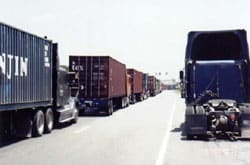
This photo of truckers waiting to get into the Port of Savannah was part of George Cashman's House testimony on port congestion.
Teamsters Port Division Director George Cashman yesterday testified before a House subcommittee on congestion in the nation's ports.
Testifying before the House Subcommittee on Coast Guard and Maritime Transportation, Cashman noted that the number of intermodal containers moving through U.S. ports has doubled in the past decade. Experts also forecast that over the next two decades, the number of containers moving through the larger ports will increase by 175%, he said.
Yet port truckers, who haul the containers in and out of the ports, are not reaping the economic benefits of this boom, he said. On the contrary, because of the increased congestion, these drivers are making even less because they are paid by the load.
"Researchers have estimated that port drivers spend 25% of their workday waiting in line without pay," he said. "After expenses, port drivers earn an average between $7 and $8 per hour. While waiting in these lines, port drivers are burning expensive fuel and needlessly damaging the environment."
Cashman suggested the following solutions:
Extending gate hours
Increasing the number of port gates
Offering incentives to shipping lines to avoid vessel bunching
Usage of off-dock container yards
Hiring sufficient longshore labor
Enforcement of chassis maintenance and repair regulations
Paid waiting time for port drivers.
Cashman included in his testimony photos of trucks lined up waiting to get into the Port of Savannah, Ga. A new high-tech computer system there was supposed to help the situation, but drivers report the system crashes at least once a month, forcing container haulers to sit outside the port gate, lined up along the highway, for up to two hours.
"It's fashionable to advocate high-tech computerization as a solution to port congestion," Cashman said. "We believe, however, the solution lies with proper staffing, availability of roadworthy chassis and off-port container yards. If steamship lines and terminal operators were required to pay truck drivers waiting time, these problems could be solved tomorrow."
The union is trying to organize the more than 40,000 drivers serving two dozen ports throughout the country -- a task complicated by the fact that most port drivers are classified as independent contractors and thus by law cannot engage in collective bargaining.
More Fleet Management

Why Private Fleets Are Taking More Freight
Private fleets are putting their own trucks on demanding customers and high-cost lanes as companies seek greater control over service, costs, and capacity.
Read More →
Color Match Smarter: Tools That Restore & Perform
For fleet managers and collision repair professionals keeping heavy-duty trucks on the road, getting the color right the first time isn't just about appearance — it's about efficiency, turnaround time, and bottom-line results. Discover how today's digital color tools are transforming the repair process from guesswork to precision.
Read More →
FMCSA Pauses Biennial-Update Enforcement Amid Motus Transition
Carriers whose updates were due on or after June 1 have more time, while FMCSA works to stabilize its new registration system and warns of phishing sites impersonating its new carrier registration system, Motus.
Read More →


2026 Blueprint for Countering Smarter Supply Chain Theft
Cargo theft is no longer just the cost of doing business. It's a multi-billion-dollar criminal enterprise exploiting vulnerabilities across your fleet, drivers, and supply chain.
Read More →
How Telematics Improves Visibility, Control, and Performance in Refrigerated Fleets
Explore how telematics help refrigerated fleets improve visibility, uptime, efficiency, compliance, and cargo protection across connected cold chain operations.
Read More →
What the U.S.-Canada Trade War Means for Trucking
Escalating U.S.-Canada tariffs could disrupt cross-border freight, reduce truck volumes, raise costs, and create new uncertainty for carriers on both sides of the border.
Read More →
What Are Trucking’s Top Concerns for 2026?
The American Transportation Research Institute wants to know what's worrying trucking fleet managers, drivers, and other stakeholders in its annual Industry Issues survey.
Read More →
American Trucking Associations Looks for a New Leader
ATA President and CEO Chris Spear abruptly left his job at the association on August 21, at a pivotal time for the trucking industry.
Read More →
Public Wi-Fi Cybersecurity Risks: How Truck Drivers and Fleets Can Protect Their Data
Public Wi-Fi can expose truck drivers and fleets to credential theft, malware, and other cyber threats. Here’s how to reduce the risk on the road.
Read More →
For Nicky Cupp, Fleet Innovation Starts With Frustration
HDT Truck Fleet Innovator Nicky Cupp turns everyday pain points at Fraley & Schilling into opportunities for better technology and smarter processes.
Read More →