




State of Logistics Report Predicts Rapid Change
The authors of the 2018 State of Logistics Report titled “Steep Grade Ahead,” see the logistics industry “rapidly changing to meet growing demand and costs.”


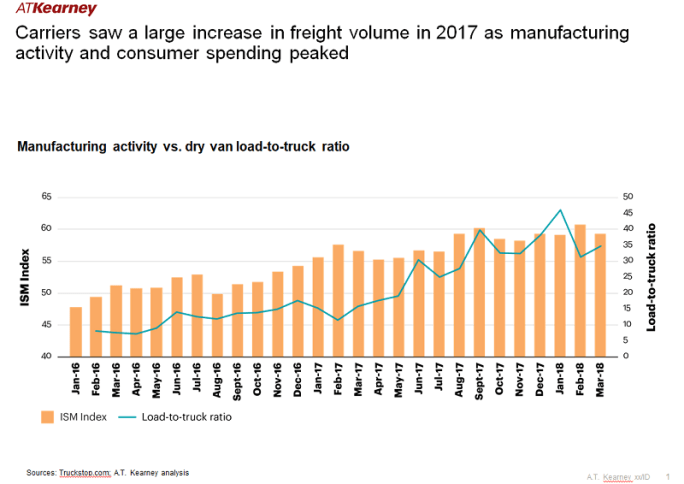
Motor carriers saw a large increase in freight volume in 2017 as manufacturing activity and consumer spending peaked, according to the latest State of Logistics Report.
Photo courtesy Penske Logistics
The authors of the annual bellwether State of Logistics Report have titled the 2018 edition “Steep Grade Ahead,” as they see the logistics industry “rapidly changing to meet growing demand and costs.” Released annually by the Council of Supply Chain Management Professionals, the report is authored by consulting firm A.T. Kearnyand sponsored by Penske Logistics.
“Developments in the second half of 2017 signaled that logistics executives face continuing capacity shortages and price increases, potentially complicated by trade tensions that could disrupt global supply chains,” the authors state. “That’s why we name this year’s report ‘Steep Grade Ahead.’ Shippers looking to control logistics costs need creative thinking and innovation, and that means opportunity for startups and new technologies offering novel solutions to transportation challenges.”
The report states that after declining in 2016 for the first time since 2009, United States Business Logistics Costs (USBLC) “returned to higher levels with a 6.2% increase year over year. The pace of spending increases became pronounced especially in Q4 of 2017, with the main drivers being a robust economic climate with growing demand, strong job market, rising wages, and while nothing new to the industry, significantly intensifying driver shortages.”
“The demand-supply balance shifted much more dramatically this year when compared to last year,” according to Sean Monahan, A.T. Kearney partner and report co-author. “In 2015, it was a dark story if you were a carrier. There was a lot of excess capacity in the marketplace. We saw that starting to turn around in 2016 and continued to accelerate into 2017.”
Source: A.T. Kearney
Noting that e-commerce’s double-digit growth “fueled” everything from parcel delivery to freight forwarding services, the authors point out that toward the end of last year, “over-the-road trucking became so heated that a significant percent of shippers modified their approach to freight bids to reduce exposure, looking to dedicated carriage or curtailing lane bidding to secure capacity.” Nonetheless, reports of 5 to 15% cost increases in 2017 for OTR were characterized as widespread.
“At the midpoint of 2018, we see signs of continued capacity constraints and sustained high prices,” the authors predict. “Unemployment is expected to remain low for the remainder of 2018 and consumer confidence reached its highest level since 2004. Retailers are confident about building higher inventories to meet demand, indicated by increases in both wholesale and retail inventories. In light of these developments we expect pressures on capacity and pricing to intensify.”
Turning to the regulatory front, the authors note that the Joint Committee on Taxation estimates that GDP will be about 0 .7% higher over the next decade as a result of the tax changes, which were passed this year by the Republican-controlled Congress. Stated as among the biggest beneficiaries of tax reform are asset-heavy companies “newly incented to spend money on overdue capital improvements, including projects addressing the logistics industry’s ‘last mile’ challenge”
Remarking that carriers “took the wheel” in 2017, the authors explain that “demand revved up quickly, triggering freight capacity shortages that gave carriers leverage to raise prices after years of downward rate pressure. Fueling the turnaround were healthy economic growth, low unemployment, resurgent consumer spending, and anticipated benefits from tax cuts. These forces show no signs of easing in 2018, although new tariffs and fears of trade wars cloud the outlook.”
Turning to trucking costs, the report finds that there was a 9.5% rise in dedicated trucking costs that “paced an over-the-road sector that saw some of the sharpest spending increases last year. Parcel and express deliveries— a segment closely tied to e-commerce— slipped from last year’s first place finish but still recorded a 7% increase. Even less-than-truckload motor freight, where costs have dropped steadily in recent years, notched a 6.6% rise.”
But bad news for shippers can be good news for truckers. To wit, the authors state that “no sector saw more change last year than motor freight, where severe capacity pressures sparked sharp rate hikes.” Carriers gained “pricing power,” due to rising demand rose as well as the capacity-crunching wrought by the electronic logging mandate that exacerbated the driver shortage. “Trucking shares took off, paving the way for Schneider National’s IPO and mega-mergers including Knight-Swift and Heartland-Interstate. Meanwhile, new technologies such as Tesla’s electric truck concept offered hope for future efficiency gains.”
Looking ahead, the authors see these five trends shaping the future of logistics:
Robust macroeconomic growth rooted in a strong labor market and recent tax cuts will boost demand for logistics
Rising interest rates, a tighter labor market, and higher fuel prices will raise logistics costs
Robust demand patterns and new competitors will challenge old business models
A fully digital, connected, and flexible supply chain optimized for e-commerce and last-mile, same-day delivery will become essential
The next-generation supply chain will improve fulfillment and drive efficiency through technologies such as big data and predictive analytics, artificial intelligence, robotics, crowdsourcing, and electric and autonomous vehicles
This year, the authors conclude, “carriers are in control as demand outstrips supply, while shippers try to ‘create capacity’ by improving efficiency wherever possible. Paradoxically, rising e-commerce volumes will shift attention to the supply chain from digital initiatives. Companies that recognize and capitalize on this trend will succeed, with smart technology investments and astute strategic choices separating winners from losers.”
Related: How E-Commerce Trends Are Affecting Final Mile Logistics
More Fleet Management
Why This Trucking Recovery Is Different
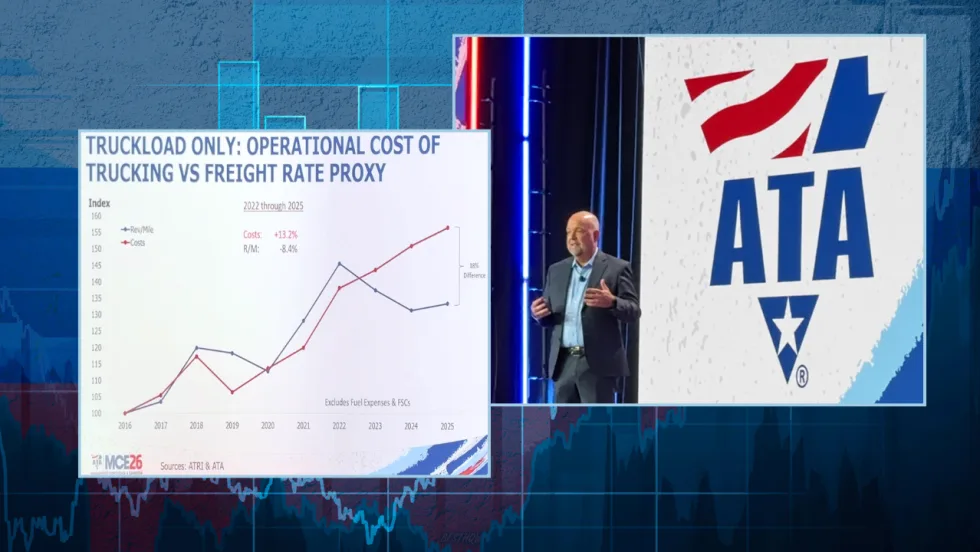
Freight demand remains sluggish, but rising costs and tougher enforcement have taken enough capacity out of the market to change the outlook for motor carriers.
Read More →
Platform Science Adds Dispatch and Safety Tools
Four additions to PS Fleet help fleets monitor loads, manage driver coaching, share truck locations and adjust video system settings.
Read More →
PrePass Intelligence Mines Fleet Bypass, Toll and Safety Data
PrePass Intelligence helps fleets measure bypass savings, flag potential toll overcharges, and spot suspicious transactions by combining data from separate systems.
Read More →
Motive Adds AI Agents for Fleet Operations
New tools automate follow-up on fleet data, from maintenance work orders to driver alerts, with two-way voice conversations planned for later this year.
Read More →
Can You Beat Our Trucking Trivia Challenge?
Test your truck knowledge with 19 trivia questions from Heavy Duty Trucking Exchange. Can you keep up with the fleet pros?
Read More →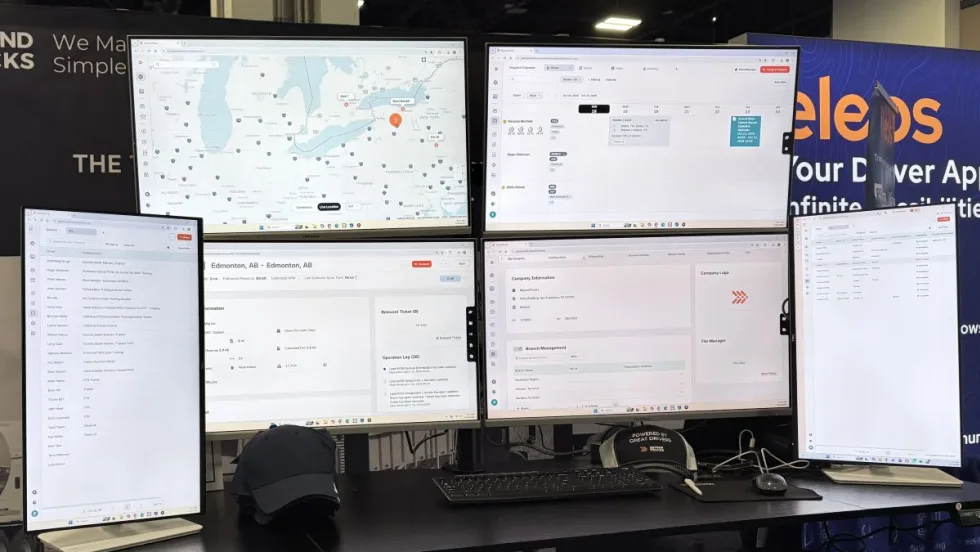
BeyondTrucks Adds Rules Checks to Dispatch
New Compatibility Engine checks driver qualifications, equipment requirements and fleet policies before loads are dispatched.
Read More →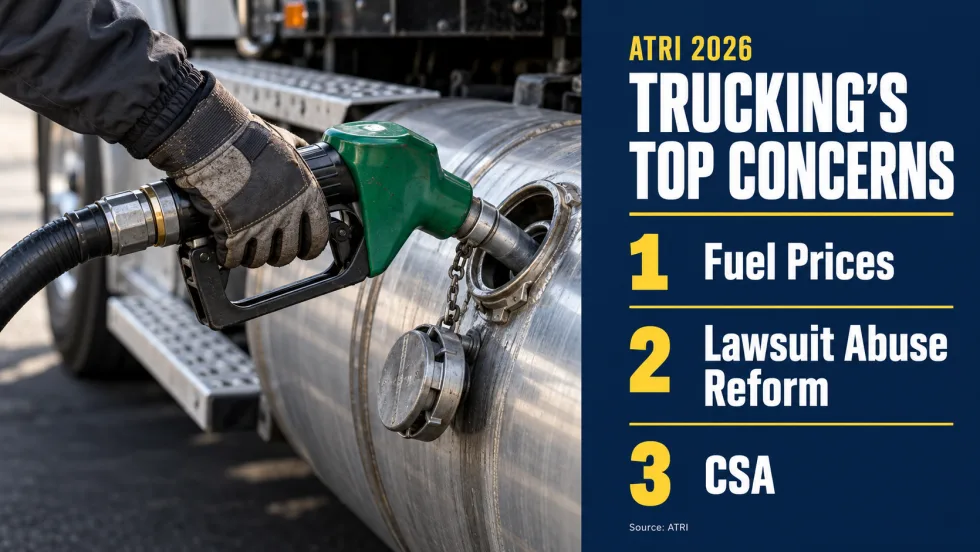
Diesel Prices Hijack Trucking’s Worry List
ATRI’s annual survey finds cautious optimism about freight, but diesel costs, litigation, and insurance continue to squeeze fleets. Drivers have different priorities on several issues.
Read More →
Nomination Deadline Extended for HDT Emerging Leaders
Just a few more days to nominate accomplished trucking fleet professionals under 40 who are making an impact and helping lead the industry forward for the HDT Emerging Leaders award. Deadline extended to October 20!
Read More →
What Will ATA’s New Leader Bring to Trucking's Table?
Incoming President and CEO Mark Colson’s record in Alabama offers clues about his priorities and approach following Chris Spear’s abrupt departure as the head of the American Trucking Associations.
Read More →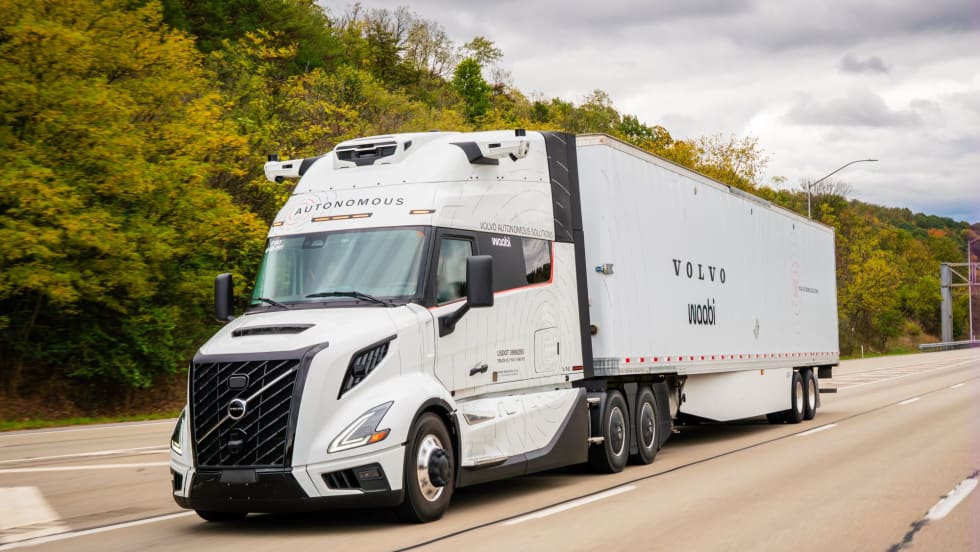
Volvo, Waabi Start Commercial Autonomous Operations in Texas
Volvo VNL Autonomous trucks, powered by the Waabi Driver, are hauling freight directly to third-party facilities for a customer in Texas.
Read More →