




Spot Freight Rates Increased as September Ended
Freight rates are generally up on the spot market while the amount of available freight has declined a little.

Credit: DAT
Freight rates are generally up on the spot market while the amount of available freight has declined a little.
DAT
The freight-matching service provider DAT reports from Sept. 29 through October 5 spot market load availability fell 0.5% from the previous seven days.
This came as load-to-truck ratios improved across the board with it being led by a 6.4% increase for vans, followed by a 3.2% hike for reefers and a 0.4% gain for flatbeds.
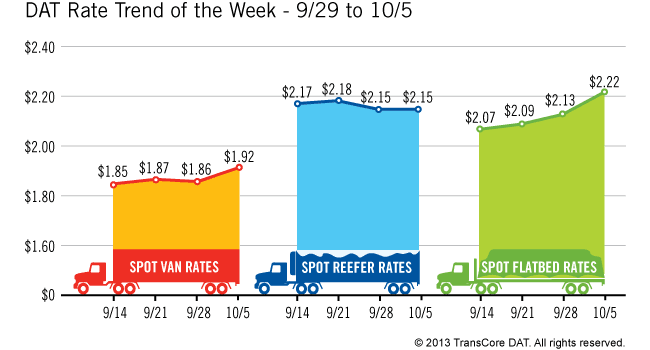
Rates for flatbeds saw the biggest increase, adding 4.2% during the comparable periods, for an average of $2.22 per mile, the best out of the last four weeks. DAT notes load volume dropped, so this may be a temporary, end-of-quarter spike.
Van rates also turned in its best performance out of the last month, increasing 3.2% to $1.92 per mile, but two key hubs in Chicago and L.A. were down, which could signal a slow down in the weeks to come.
In contrast, reefer rates were unchanged at $2.15 per mile, but when September is compared to August, reefer rates rose 2.9% to an average of $2.15 per mile in September.
Writing for the DAT Freight Talk Blog, DAT Analyst Mark Montague noted Monday marked the end of the month and the end of the third quarter, which coincided with the end of the U.S. government's fiscal year. “Some corporations also ended their fiscal year on Monday, and we saw a surge of freight on the spot market last week to close the books on a high note,” he wrote.
He said the word out of California is that a surge of freight is arriving at the Port of L.A. and Long Beach, and logistics companies in the Golden State are seeing a lot of action right now. “That bodes well for Christmas retail orders, despite a recent dip in consumer confidence,” he said.
Montague also pointed out that the recent government shutdown has left trucking without the weeklu USDA Fruit and Vegetable Truckload Rate Report, forcing him to rely on his resources at DAT to produce his own similar report.
You can take a look at it by logging on to the DAT website (
Freight rates are generally up on the spot market while the amount of available freight has declined a little.
The freight-matching service provider DAT reports from Sept. 29 through October 5 spot market load availability fell 0.5% from the previous seven days.
This came as load-to-truck ratios improved across the board with it being led by a 6.4% increase for vans, followed by a 3.2% hike for reefers and a 0.4% gain for flatbeds.
Rates for flatbeds saw the biggest increase, adding 4.2% during the comparable periods, for an average of $2.22 per mile, the best out of the last four weeks. DAT notes load volume dropped, so this may be a temporary, end-of-quarter spike.
Van rates also turned in its best performance out of the last month, increasing 3.2% to $1.92 per mile, but two key hubs in Chicago and L.A. were down, which could signal a slow down in the weeks to come.
In contrast, reefer rates were unchanged at $2.15 per mile, but when September is compared to August, reefer rates rose 2.9% to an average of $2.15 per mile in September.
Writing for the DAT Freight Talk Blog, DAT Analyst Mark Montague noted Monday marked the end of the month and the end of the third quarter, which coincided with the end of the U.S. government's fiscal year. “Some corporations also ended their fiscal year on Monday, and we saw a surge of freight on the spot market last week to close the books on a high note,” he wrote.
He said the word out of California is that a surge of freight is arriving at the Port of L.A. and Long Beach, and logistics companies in the Golden State are seeing a lot of action right now. “That bodes well for Christmas retail orders, despite a recent dip in consumer confidence,” he said.
Montague also pointed out that the recent government shutdown has left trucking without the weeklu USDA Fruit and Vegetable Truckload Rate Report, forcing him to rely on his resources at DAT to produce his own similar report.
You can take a look at it by logging on to the DAT website which Montague says he will publish until the USDA comes back on line with its weekly summary.
More Drivers

FDA Eases Path for Oral-Fluid Testing
Federal actions could advance oral-fluid drug testing for truck drivers, but lab certification delays and marijuana rescheduling questions remain.
Read More →
Why Hiring Truck Drivers Is Getting Harder
Higher recruiting costs, a shrinking driver pool, and renewed pay competition are raising the stakes for fleets heading into 2027.
Read More →
Roehl Offers Truck Drivers $10,000 Retention Incentive
Payments begin after the first load and continue in mileage-based installments for eligible experienced drivers joining the fleet.
Read More →
Platform Science Adds Dispatch and Safety Tools
Four additions to PS Fleet help fleets monitor loads, manage driver coaching, share truck locations and adjust video system settings.
Read More →
When Language Stops the Truck: The Return of ELP Out-of-Service Orders
English language proficiency rules for commercial drivers aren’t new, but renewed out-of-service enforcement has raised the stakes. Here’s what carriers need to know before a driver reaches a roadside inspection.
Read More →
Samsara Launches Custom AI Agent Builder
Agent Studio lets fleets create AI tools for hours-of-service monitoring, reporting and driver support, including agents that communicate by phone.
Read More →
Trucker Path Expands Reserved Parking Network
Trucker Path has added close to 6,000 more truck parking spaces to its Trucker Path Reserved Parking Network with the addition of Safe Truck Parking.
Read More →
EEOC Sues Texas Trucking Company Over Driver Age Limits
The agency says Trancasa USA rejected applicants over 65 and applied tougher driving-record standards to those over 60.
Read More →
Nussbaum, Roehl Announce Second Driver Pay Increase This Year
This year has seen a swath of major truck driver pay increases as freight capacity has tightened.
Read More →
From One Generation to the Next: How Mentorship Builds Safer Truck Drivers
After three decades in trucking, Harold Perry shares what he's learned about driver safety, mentorship, and helping the next generation build confidence behind the wheel.
Read More →