




Related: Southern California Mayors Aim for Zero Emissions at Ports
Southern California Ports Plan for Zero-Emission Trucks
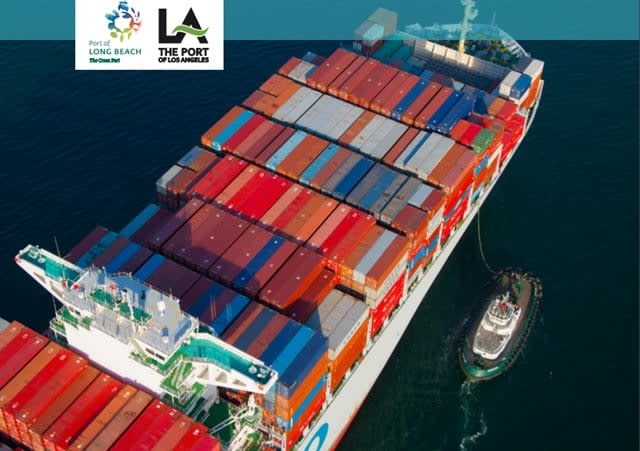
The Ports of Los Angeles and Long Beach have released a draft of a proposed 2017 Clean Air Action Plan Update, outlining a new set of aggressive near-term and long-term strategies to reduce air pollution from the ports.

Steven Martinez・Web Editor

Screenshot via Clean Air Action Plan
4 min to read
Screenshot via Clean Air Action Plan
Updated The Ports of Los Angeles and Long Beach have released a draft of a proposed 2017 Clean Air Action Plan Update, outlining a new set of aggressive near-term and long-term strategies to reduce air pollution from the ports.
The draft plan lays out how the ports plan to reach emissions targets that include the goal of transitioning to a zero-emission drayage fleet by 2035.
The draft 2017 CAAP sets new clean air goals focused on reducing greenhouse gas emissions to 40% below 1990 levels by 2030 and to 80% below 1990 levels by 2050.
The plan carries over previous 2023 targets for cutting other primary pollutants aimed at reducing diesel particulate matter 77%, sulfur oxides 93%, and nitrogen oxides 59% below 2005 levels.
Preliminary analysis on implementing the 2017 CAAP estimate the costs at $7 to $14 billion.
Recent emissions inventories show that the two ports have already surpassed the 2023 diesel particulate matter and sulfur oxide reduction targets and are close to the NOx goal.
“These ports are going where no port has gone before,” said Gene Seroka, Port of Los Angeles executive director. “Based on what we’ve already accomplished to promote healthy, robust trade through our gateway, we’re ready to make history again, looking at a new array of technologies and strategies to further lower port-related emissions in the decades ahead.”
The 2017 draft was drawn up using feedback from two years of dialogue with industry, environmental groups, regulatory agencies, and neighboring communities. The ports conducted small group meetings and large public workshops before detailing its goals, priorities and strategies for public review and comment.
Since then, the ports have held more than 50 stakeholder meetings and another community workshop leading into the release of the draft 2017 CAAP Update. Updates to the plan include local, regional, state and federal standards and regulations. It also aligns with targets of state and local leadership identified in the 2016 CAAP and the joint zero emissions initiatives announced in June by Los Angeles Mayor Eric Garcetti (D) and Long Beach Mayor Robert Garcia (D).
“Working closely with all our partners has been crucial to our success," said Mario Cordero, Port of Long Beach executive director. "That same collaboration went into the development of the 2017 CAAP and will be indispensable going forward.
“Since 2006," he added, "the Clean Air Action Plan has been a model for programs to reduce health risks and air quality impacts from port operations worldwide. We remain committed to being leaders in seaport sustainability.”
Weston LaBar, executive director of the Harbor Trucking Association, an advocacy group for intermodal carriers in California that serve the Ports of Los Angeles and Long Beach, told HDT that HTA would review the new draft plan and work with the ports to "ensure that sustainability is not just implemented in the environmental sense, but also the commercial sense."
"It is important to set goals that are reasonable and attainable, and that we don’t saddle an industry that has invested billions of dollars in clean technology with a mandate that is not viable commercially or operationally," LaBar added.
"There are still many questions regarding zero-emissions truck technology. It is important that the ports ensure the final plan paves a path forward for affordable and efficient movement of cargo through the San Pedro Bay Complex first, and that sustainability is a byproduct of a healthy supply-chain in the region.”
The draft 2017 CAAP is broken down into four major categories that each address major areas to target to reach the emissions goals.
Under the four categories, the near-term and long-term strategies include:
Clean Vehicles, Equipment Technology, and Fuels
Starting in 2018, phase in clean engine standards for new trucks entering the port drayage registries followed by a truck rate structure that encourages the use of near-zero and zero-emission trucks, with the goal of transitioning to a zero-emission drayage fleet by 2035.
Reduce idling and support the state’s efforts to transition terminal equipment to zero emissions by 2030.
Update the Vessel Speed Reduction Program, expand the use of state-approved alternative technologies to reduce at-berth emissions, and encourage clean technology upgrades on ships to attract the cleanest vessels to the San Pedro Bay ports.
Freight Infrastructure Investment and Planning
Expand use of on-dock rail, with the long-term goal of moving 50% of all inbound cargo leaving the ports by rail.
Develop charging standards for electric cargo-handling equipment.
Freight Efficiency
Develop a universal truck appointment system for the entire complex with the goal of minimizing truck turn times.
Create a voluntary Green Terminal Program to recognize terminal operators achieving high levels of freight movement efficiency.
Continue to explore short-haul rail, staging yards, intelligent transportation systems, and other supply chain efficiency improvements.
Energy Resource Planning
Develop infrastructure plans to support terminal equipment electrification, alternative fuels, and other energy resource goals.
Continue to develop and implement viable energy conservation, resiliency, and management strategies.
For more information on the 2017 Clean Air Action Plan as well as the full proposal and fact sheets, click here.
Updated at 1:40 p.m. PDT 7/19/17 to add statement from the HTA
More Fuel Smarts

How Volvo Updated Its D13 for EPA 2027 [Watch]
Volvo’s updated D13 promises lower emissions without sacrificing performance or fuel economy. Take a closer look at what changed inside the engine in this HDT Spotlight video.
Read More →
Diesel Price Spike Shortens Payback for Natural Gas Trucks, Report Says
Energy Vision estimates fleets could recover the higher purchase price of an RNG-fueled Class 8 tractor in 1.3 to 2.8 years under current fuel-price scenarios.
Read More →
Calstart Becomes Catalyst Mobility, Reflecting Broader Focus
Calstart is now Catalyst Mobility, reflecting the nonprofit’s growing national role in clean transportation, including zero-emission trucks, infrastructure and incentive programs.
Read More →

Record Diesel Prices Squeeze Trucking Fleets
Average U.S. diesel prices have climbed to nearly $6 a gallon, surpassing the 2022 record as tight refinery capacity and Middle East disruptions keep fuel costs elevated.
Read More →
Sponsored•September 9, 2026
How Fuel Delivery Shapes Engine Performance
Fuel delivery depends on more than what happens at the injector. For fleet, maintenance and technical professionals, looking at the full path from pump to injector can provide useful context for understanding engine performance.
Read More →
East Coast Port Launches $45M Electric Truck Push
The Port Authority of New York and New Jersey announced millions in incentives for zero-emission drayage trucks, yard tractors, and new charging hubs near the port.
Read More →
California Bill Could Shed Light on Electric Truck Prices
Why do battery-electric Class 8 trucks remain so expensive? A California bill headed to Gov. Gavin Newsom would give fleets and state agencies more visibility into what manufacturers charge.
Read More →
Detroit Opens Orders for EPA 2027 Engines
Detroit isn’t starting from scratch to meet EPA 2027 diesel emissions standards. Its Gen 6 DD13 and DD15 engines keep much of today’s platform while updating the fuel and aftertreatment systems.
Read More →
Zero-Emission Truck Corridor Planned for West Coast
California, Oregon, Washington, British Columbia and Baja California are coordinating plans for truck charging and hydrogen fueling from Canada to Mexico.
Read More →
A Closer Look at Kenworth’s Electric T880E Vocational Truck [Video]
Learn more about Kenworth's T880E battery-electric vocational truck at the Paccar Technical Center, including its range, applications, upfitting considerations, and PTO options, in this HDT Spotlight video.
Read More →