





More from ACT Expo: Will the Last Mile be Electric?
Solar-Powered Truckstop for Electric Truck Charging to Break Ground this Fall
A solar-powered truck stop for heavy-duty electric trucks, believed to be the first of its kind in California, is expected to break ground in late October in Bakersfield.
September 8, 2021

WattEV wants to deploy 12,000 electric heavy-duty trucks on the road by 2030.
Photo: WattEV rendering
3 min to read
A solar-powered truck stop for heavy-duty electric trucks, believed to be the first of its kind in California, is expected to break ground in late October in Bakersfield and to be open by late October 2022.
The truck stop is being built by WattEV Inc. with the help of a $5 million grant from the California Energy Commission. The company called the grant an important milestone in its effort to deploy 12,000 electric heavy-duty trucks on the road by 2030.
The announcement was made at the Advanced Clean Transportation (ACT) Expo 2021 in Long Beach, just ahead of the anticipated approval of the grant. The company first announced plans to build the electric truck stop in May.
“The electric truck stop in Bakersfield is the first step toward our commitment to help build the charging infrastructure network necessary to accelerate the heavy-duty trucking sector’s transition to electric drive, and to get more heavy-duty electric trucks on the road in California as quickly as possible,” said Salim Youssefzadeh, chief executive officer of WattEV.
Partners joining WattEV and the CEC on the Bakersfield electric truck stop project include the San Joaquin Valley Air Pollution Control District, the Central California Asthma Collaborative, Greenlots, Power Electronics and several others.
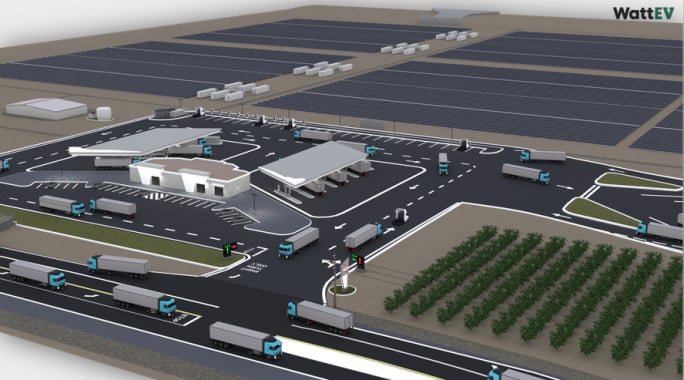
WattEV, which earlier this year revealed plans for a 25-megawatt, solar-powered, electric-only public truck stop, announced that it has secured funding for the site and expects to break ground in late October.
Photo: WattEV rendering
In addition to the Bakersfield project, WattEV is in the planning stages for similar projects in San Bernardino and Gardena in Southern California. Both of these electric truck stops will serve the Port of Los Angeles and Port of Long Beach and the warehouses fed by goods coming through the ports. To enable these projects and support further expansion, WattEV has raised $6 million in private equity seed funding led by Canon Equity.
WattEV also has secured purchase incentive vouchers through the California Air Resources Board’s Hybrid and Zero-Emission Truck and Bus Voucher Incentive Project (HVIP), initially for six Volvo VNR Electric Class 8 trucks, and has applied for 24 more electric truck HVIP vouchers.
Electric Trucks as a Service
All told, WattEV plans to run its own fleet of 30 heavy-duty electric trucks by the end of 2022 to deploy under contract with several Southern California fleet customers, providing transportation as a service.
The first fleet partnership is with Total Transportation Services Inc. (TTSI), one of the leading freight transporters making the transition to EV trucks serving the ports of Los Angeles and Long Beach, which also has a presence in Bakersfield. TTSI will be offering electric transport freight services to shippers in Southern California on routes served by WattEV’s platform.
To help accelerate the transition to electric goods movement, WattEV is developing an advanced software platform to offer trucks as a service, designed specifically for the use of electric trucks within its network of charging stations on designated routes. The TaaS platform will offer an all-inclusive, charge-per-mile formula that will enable a transporter to efficiently and cost-effectively use an electric truck to move goods normally handled with diesel trucks on the routes selected by shippers committed to clean air.
More Fuel Smarts

How Volvo Updated Its D13 for EPA 2027 [Watch]
Volvo’s updated D13 promises lower emissions without sacrificing performance or fuel economy. Take a closer look at what changed inside the engine in this HDT Spotlight video.
Read More →
Diesel Price Spike Shortens Payback for Natural Gas Trucks, Report Says
Energy Vision estimates fleets could recover the higher purchase price of an RNG-fueled Class 8 tractor in 1.3 to 2.8 years under current fuel-price scenarios.
Read More →
Calstart Becomes Catalyst Mobility, Reflecting Broader Focus
Calstart is now Catalyst Mobility, reflecting the nonprofit’s growing national role in clean transportation, including zero-emission trucks, infrastructure and incentive programs.
Read More →

Record Diesel Prices Squeeze Trucking Fleets
Average U.S. diesel prices have climbed to nearly $6 a gallon, surpassing the 2022 record as tight refinery capacity and Middle East disruptions keep fuel costs elevated.
Read More →
Sponsored•September 9, 2026
How Fuel Delivery Shapes Engine Performance
Fuel delivery depends on more than what happens at the injector. For fleet, maintenance and technical professionals, looking at the full path from pump to injector can provide useful context for understanding engine performance.
Read More →
East Coast Port Launches $45M Electric Truck Push
The Port Authority of New York and New Jersey announced millions in incentives for zero-emission drayage trucks, yard tractors, and new charging hubs near the port.
Read More →
California Bill Could Shed Light on Electric Truck Prices
Why do battery-electric Class 8 trucks remain so expensive? A California bill headed to Gov. Gavin Newsom would give fleets and state agencies more visibility into what manufacturers charge.
Read More →
Detroit Opens Orders for EPA 2027 Engines
Detroit isn’t starting from scratch to meet EPA 2027 diesel emissions standards. Its Gen 6 DD13 and DD15 engines keep much of today’s platform while updating the fuel and aftertreatment systems.
Read More →
Zero-Emission Truck Corridor Planned for West Coast
California, Oregon, Washington, British Columbia and Baja California are coordinating plans for truck charging and hydrogen fueling from Canada to Mexico.
Read More →
A Closer Look at Kenworth’s Electric T880E Vocational Truck [Video]
Learn more about Kenworth's T880E battery-electric vocational truck at the Paccar Technical Center, including its range, applications, upfitting considerations, and PTO options, in this HDT Spotlight video.
Read More →