





Shell Explores the Limits of Fuel Efficiency at Eco-Marathon
Shell Starship 2.0 Pushes Fuel Economy Forward
Shell’s Starship 2.0, a Class 8 demonstration truck built with energy-efficient technologies for high fuel efficiency and reduced emissions, exceeded the results of its predecessor in its second cross-country run.
September 2, 2021
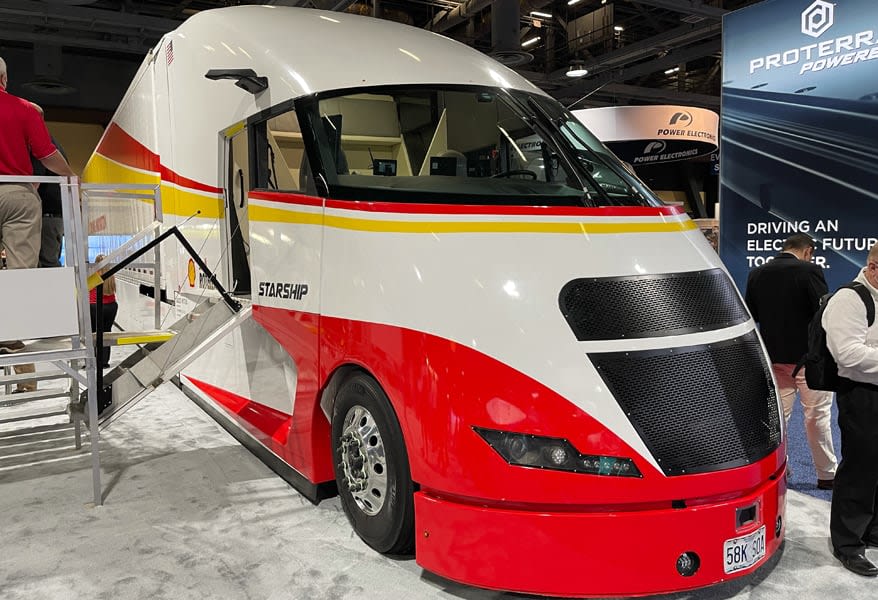
Starship 2.0 achieved a 10.8 mpg on its cross-country run from San Diego to Jacksonville, Florida, compared to the 8.94 mpg achieved by Starship 1.0 and the 6.4 mpg North American fleet average.
Photo: Jack Roberts
4 min to read
Shell’s Starship 2.0, a Class 8 demonstration truck built with energy-efficient technologies for high fuel efficiency and reduced emissions, exceeded the results of its predecessor in its second cross-country run.
Starship 2.0 achieved 10.8 mpg on its cross-country run from San Diego to Jacksonville, Florida, compared to the 8.94 mpg achieved by Starship 1.0 in 2018 and the 6.4 mpg North American fleet average.
These improvements were achieved while carrying 18% more payload — up from 39,900 pounds in 2018 to 47,100 pounds this year.
Jeff Priborsky, global marketing manager for the on-highway fleet sector at Shell Lubricant Solutions, said the truck achieved 254 ton-miles per gallon for freight ton efficiency – 3.5 times higher than the North America average freight ton efficiency for trucks, which is estimated at 72 ton-miles per gallon by NACFE.
Priborsky explained that freight ton efficiency is a relevant statistic for judging the energy intensity associated with moving cargo from point A to point B, because it combines the weight of cargo being moved with the amount of fuel consumed.
A second, shorter 400-mile evaluation run was also conducted to provide additional data on the truck’s freight ton efficiency and fuel economy benefits. Both trips were monitored and verified by the North American Council for Freight Efficiency.
“Understanding that not all fleets run fully loaded from coast-to-coast, we felt it was important to conduct a variety of tests to provide additional data that can show how trucking efficiencies work in different conditions, in order to provide tangible benefits to the freight transport industry,” Priborsky said.
The 400-mile evaluation was completed in North Carolina with a cargo weight of 17.5 tons, which was chosen to reflect more typical payload commonly used by many fleets. The average fuel economy obtained there was an impressive 12 mpg and the freight ton efficiency value was 210 ton-miles per gallon
Priborsky said Shell understands that the path to a low-carbon energy future will require a range of solutions. And that while Starship 2.0 is demonstrating what is possible using currently available efficient technologies and lubricants, it will not be the truck’s last time in the spotlight.
“There are new technologies coming out all the time that we felt can boost the numbers we’ve just logged even higher,” he said. “So, you will be seeing this truck again. We’re not done with it, yet.”
From 1.0 to 2.0
In 2018, with freight and fuel efficiency quickly becoming buzzwords in the trucking industry, Shell engineers decided to build a one-off demonstration truck that would take advantage of every possible fuel-saving technology then available.
Aptly enough, the gleaming, white, futuristic-looking Class 8 truck was dubbed the “Shell Starship,” and was soon on a cross-country drive to demonstrates how the use of energy-efficient technologies could help fleets improve fuel economy and cut CO2 emissions substantially in real-world operating conditions.
That run netted an overall fuel economy average of 8.8 mpg for the cross-country trip.
Not bad.
But the Shell Lubricants Solutions and Shell Technology Teams felt they could do better.
“We felt like the first truck just left too much on the table,” Jeff Priborsky, global marketing manager for the on-highway fleet sector at Shell Lubricant Solutions, said. “And there was so much new fuel-saving technology becoming available, we believed that we could boost the truck’s performance numbers across the board.”
Aerodynamic Updates
From the outside, Starship 2.0 appears identical to the 2018 model. And that’s no coincidence, Priborsky said. The highly aerodynamic tractor and trailer bodies are the only components carried over from the first Starship truck. But under that sleek exterior, Starship 2.0 is an entirely new truck, featuring an all-new chassis and drivetrain, along with new safety and fuel-efficient upgrades.
“That doesn’t mean we didn’t enhance the exterior of the truck, though,” Priborsky explained during a walk-around tour of the truck at the Shell booth on the ACT Expo show floor. “We’ve added a host of new, or improved, aerodynamic devices that gives the truck an unbelievably sleep aerodynamic profile that virtually eliminates drag coefficients around the tractor and trailer.”
These include new fifth wheel gap extensions. These aerodynamic panels deploy automatically at highway speeds and retract at speeds where turning articulation between the tractor and trailer is necessary. Even more impressively, the new fifth wheel gap extenders include an overhead panel that smooths airflow as it passes over the roof of the tractor and starts over the trailer.
Likewise, at the rear of the Starship 2.0 tractor-trailer is an all-new boat tail aerodynamic device, complemented by tightly fitted side skirts. Air dams running down both sides of the tractor-trailer further enhance air flow even at road level — but give the truck a treacherously low amount of ground clearance that drivers have to be conscious of when driving in urban areas.
Truck Interior Features
The interior of the truck is airy and well lit. The most striking feature is the clean, uncluttered, driver’s station, which features a host of display screens, gauges and camera screens, where rearward and side views captured by the aerodynamic StoneRidge MirrorEye rear-view cameras are displayed.
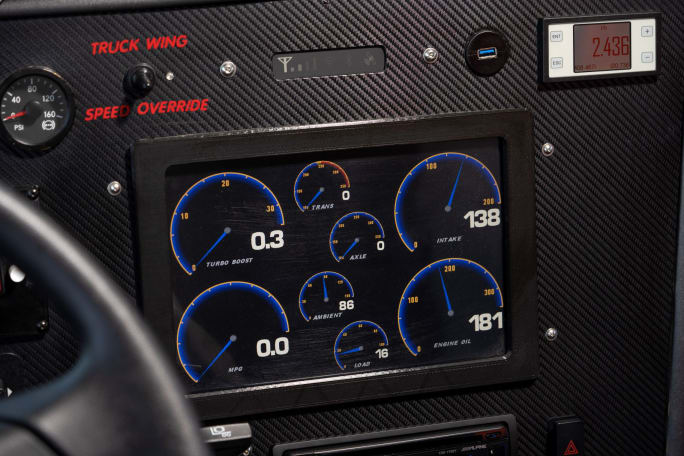
The driver’s station features a host of display screens, gauges and camera screens.
Photo: Shell
The oddest feature is the long, sleek, narrow hood stretching out in front of the driver — a design necessity to give the truck such a sleek aerodynamic profile. But even with that dash real estate in front of the driver, views to the front and downward are quite good.
More Fuel Smarts
Electric Yard Tractors Move Beyond Pilots
Operating-cost savings have overtaken sustainability goals as the leading reason surveyed fleets are adopting battery-electric terminal tractors, according to new NACFE research.
Read More →
Geotab Links Fleet Card to Vehicle Data
The new card combines fuel discounts with telematics-based purchase controls. Geotab’s analysis also points to potential savings from choosing lower-priced fuel stops.
Read More →
Fleet Economics Shape Electric Truck Outlook
ACT Research expects costs, charging infrastructure, and technology improvements to drive zero-emission commercial vehicle adoption as federal regulations and incentives retreat.
Read More →
Wex Adds Cardless Fuel Payments for Over-the-Road Customers
A new fuel card feature for Wex customers offers convenience and security.
Read More →
New California Law Could Shed Light on Electric Truck Prices
Why do battery-electric Class 8 trucks remain so expensive? A California bill signed by Gov. Gavin Newsom would give fleets and state agencies more visibility into what manufacturers charge.
Read More →
How Volvo Updated Its D13 for EPA 2027 [Watch]
Volvo’s updated D13 promises lower emissions without sacrificing performance or fuel economy. Take a closer look at what changed inside the engine in this HDT Spotlight video.
Read More →
Diesel Price Spike Shortens Payback for Natural Gas Trucks, Report Says
Energy Vision estimates fleets could recover the higher purchase price of an RNG-fueled Class 8 tractor in 1.3 to 2.8 years under current fuel-price scenarios.
Read More →
Calstart Becomes Catalyst Mobility, Reflecting Broader Focus
Calstart is now Catalyst Mobility, reflecting the nonprofit’s growing national role in clean transportation, including zero-emission trucks, infrastructure and incentive programs.
Read More →
Record Diesel Prices Squeeze Trucking Fleets
Average U.S. diesel prices have climbed to nearly $6 a gallon, surpassing the 2022 record as tight refinery capacity and Middle East disruptions keep fuel costs elevated.
Read More →
East Coast Port Launches $45M Electric Truck Push
The Port Authority of New York and New Jersey announced millions in incentives for zero-emission drayage trucks, yard tractors, and new charging hubs near the port.
Read More →