





Also of interest: How Can Fleets Turn Around a Sagging Safety Record?
Senators to Hutcheson: What's FMCSA Doing About Driver Shortage?
The new younger-driver pilot program and other steps to address the truck driver shortage were a key topic during Robin Hutcheson’s confirmation hearing on her nomination to be administrator of the Federal Motor Carrier Safety Administration.
June 8, 2022
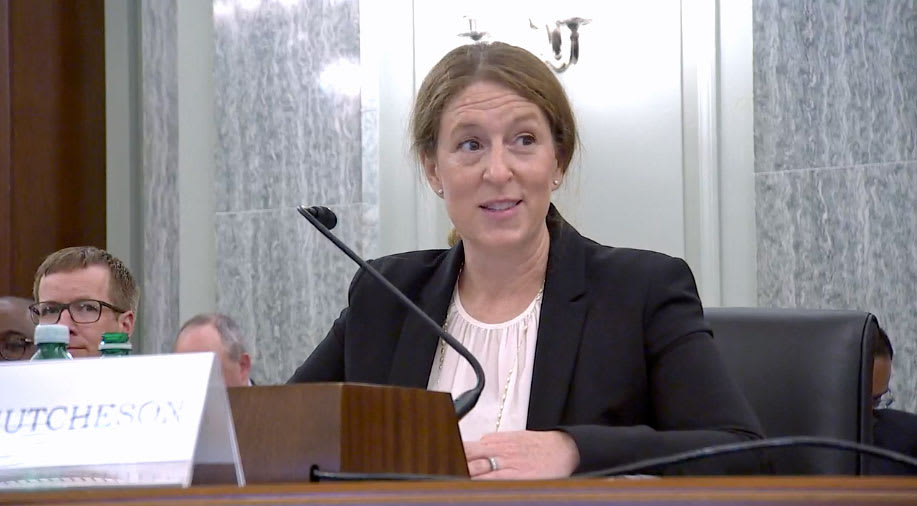
Robin Hutcheson fielded questions about the truck driver shortage, CSA, younger drivers, and more in her confirmation hearing.
Screen capture from confirmation hearing live-stream.
6 min to read
The new younger-driver pilot program and other steps to address the truck driver shortage were a key topic during Robin Hutcheson’s nomination hearing on June 8 to be administrator of the Federal Motor Carrier Safety Administration.
Hutcheson currently serves as deputy administrator and acting administrator. She previously served as deputy assistant secretary for safety policy at the DOT, where she led the development of the National Roadway Safety Strategy.
In her opening remarks to the Senate Committee on Commerce, Science and Transportation, Hutcheson cited her work on the National Roadway Safety Strategy. As it applies to FMCSA, she said, it would include “increasing our investigations in high-risk carriers, and technology investments to close registration loopholes that would prevent unsafe drivers from ever being on the road.”
She also talked about the driver shortage, noting that the Bipartisan Infrastructure Law signed by President Biden late last year “dedicates resources to assisting the truck driving profession by creating a better, safer pipeline of drivers and improving recruitment and retention in the profession. I have and will continue to engage in discussion, ride-alongs, and other forums to deepen my understanding of the needs of drivers, and all of our critical stakeholders.”
18- 20-Year Old Truck Drivers
Republican Sen. Roger Wicker from Mississippi, who pointed out that he was “instrumental in negotiation” on the BIL, took issue with the fact that the new younger driver pilot program that was called for in the law requires participating carriers to register with the Department of Labor as a Registered Apprenticeship program.
“We didn’t put that in the law,” he said, asking where it originated. If that provision had been in the law, he wasn’t sure if it would have garnered enough bipartisan support to pass.
“DOT partnered with DOL to launch this program in the most expeditious manner,” Hutcheson answered. “We had approximately 100 registrants within the first 90 days. We now have over 500 companies.” When Wicker continued to push for an answer on where this requirement came from, she said, “We will continue to implement this program in order to maximize its potential effect on bringing drivers into the industry.”
Wicker “guaranteed” that the issue would be the topic of continued discussion.
Hutcheson repeated the progress numbers when asked by Sen. Sen. Marsha Blackburn, Republican senator from Tennessee, who said the younger-driver pilot program was of critical interest to her constituents because “Tennessee “is a logistics state.”
“We are on track to begin welcoming younger drivers in, along with all the safety provisions that wrap around this program, we are on track for early fall.”
Sen. Todd Young of Indiana pressed Hutcheson further on the question. Now that the Drive Safe Act, as the legislation calling for a younger-driver pilot program was called before it was rolled into the BIL, “is now the law of the land,” he asked her to answer several yes-no questions. She answered in the affirmative when he asked if she believed there is a truck driver shortage, but when he asked for a yes-no answer on whether she believe that allowing an 18 to 20 year old to drive a short distance across a state border is more dangerous than allowing them to travel hundreds of miles back and forth across the same state, she said she would prefer to rely on data rather than speculation – upon which he asked if she had studied the data used in developing the new law.
“We are working expeditiously to launch the safe driver apprenticeship program,” she said.
FMCSA and the Truck Driver Shortage
The younger drivers program was not the only driver-related question posed to Hutcheson. Many of the committee members asked what Hutcheson and the FMCSA are doing to address the trck driver shortage.
Sen. Tammy Baldwin, Democrat from Wisconsin, pointed out that women make up only 24% of the trucking workforce and only 7% of drivers. Her bill setting up a women in trucking advisory board at the DOT was included in the Bipartisan Infrastructure Law, and she asked for a progress report.
Hutcheson said FMCSA called for nominations to the board in May and is currently working through the more than 250 received. A kickoff meeting of the board is expected in late summer or early fall, with the goal is to identify barriers to women entering or staying in the profession.
Amy Klobuchar, a Democrat and senior senator from Minnesota, entered into the record an American Trucking Associations letter in support of the nomination and asked, “How will you work with DOT interagency and industry stakeholders to ensure a steady supply of truckers?”
Hutcheson replied, “FMCSA is working on both short and long term efforts to increase the supply of drivers,” such as working to issue CDLs more expeditiously in the short term, as well as longer-term projects such as recruiting more women into the industry, and understanding why drivers leave the industry, with studies on issues such as driver pay and detention.
She had a similar answer for Sen. Jon Tester, a Democrat from Montana, who also asked what the FMCSA is doing to address the driver shortage.
Trucking Safety: CSA Changes, Hair Testing
Deb Fischer, the Republican senator from Nebraska, was one of the few who questioned Hutcheson about safety issues.
Since the Compliance, Safety, Accountability and Safety Measurement System program was implemented in 2010 with the goal of helping FMCSA identify unsafe motor carriers, Fischer said, “we’ve seen a steady uptick in truck-related crashes and industry fatalities.” In 2017, as called for in the FAST Act, the National Academy of Sciences made recommendations to improve the program, she noted, wanting to know if those recommendations have been implemented.
NAS recommended that FMSCA take about two years to study a more scientific modeling approach known as “Item Response Theory” and then consider implementing it to make the SMS function more accurately.
“I’ve reviewed the study,” Hutcheson answered. “There are a few updates to the framework. There are four conditions that need to be met before this new prioritization system can be put in place. We’ll be seeking input from stakeholders and member offices.”
Fischer also asked why there is no requirement for shippers or brokers to check FMCSA data before hiring motor carriers. She plans to re-introduce legislation to clarify criteria brokers and shippers must make sure carriers meet before hiring them. “If shippers and brokers had a standard due diligence process,” she asked, “would it improve safety and help remove unauthorized carriers?”
Hutcheson’s response did not directly answer that question, but she did say the agency is working to clarify the definition of broker and is “very close to asking for comments” on the proposal. “We believe this will be effective in addressing some of the problems.”
Sen. Jerry Moran, a Republican senator from Kansas, wanted to know why it is taking so long to get hair-testing approved as an official method for drug testing.
“Drug-impaired driving remains a serious issue, [yet] we can’t seem to get hair testing to occur.” Federal regulations must change in order to allow carriers to report positive hair-test results to the FMCSA’s Drug and Alcohol Clearinghouse. Advocates of hair testing say it detects lifestyle users that would be missed with the current urine testing. “Why so this so difficult to achieve?”
Hutcheson answered, “We are working with Health and Human Services. They are completing a study of the hair testing, and when that is complete, we stand ready to implement their recommendations.”
A 2020 hair-testing proposal from HHS was widely criticized in the industry.
More Safety & Compliance

Truck Drivers Need More Than Another Alert
Fleets have more visibility into truck health, safety events, and driver activity than ever. The next challenge is turning all that information into useful guidance for the person who has to decide what to do next.
Read More →
Tesla Wants a Self-Driving Semi. Are Cameras Enough?
Could Tesla’s camera-only autonomous driving technology work on an 80,000-pound Semi? In this commentary, HDT's Deborah Lockridge takes a look at Tesla, Cybercab, and how autonomous trucks see the road.
Read More →
What DOT’s Automated Vehicle Strategy Means for Trucking
The U.S. Department of Transportation issued a new automated-vehicle strategy that outlines plans for driverless-truck regulations, cross-state freight corridors, and federal safety standards.
Read More →
NYC Expands Speed, Pedestrian Safety Tech Across Fleet
New York City is expanding intelligent speed assistance and pedestrian-alert systems across its municipal fleet, moving the technologies from pilot programs into vehicle procurement and retrofit requirements.
Read More →
FMCSA Removes 110 Truck Driver Training Schools from Certified ELDT List
Federal regulators also are targeting more than 160 additional training providers and launching a nationwide audit of third-party CDL skills testers as part of a broader crackdown on trucking fraud.
Read More →
Beyond DOT Compliance: What Makes a Trucking Fleet Truly Safe?
A trucking fleet can follow every rule and still make unsafe decisions. The real test comes when safety conflicts with freight, productivity, or cost.
Read More →
Hours of Service Pilot Programs: FMCSA Readies for 2027 Rollout
Two pilot programs could eventually reshape hours-of-service rules, giving truck drivers options to pause their 14-hour clock or use longer split sleeper rest periods.
Read More →
New Guide Offers Pet Safety Tips for Truck Drivers
Hundreds of thousands of pets travel in truck cabs. A new safety guide from Volvo Trucks and the Center for Pet Safety offers practical advice for truck drivers who bring dogs and cats along for the ride.
Read More →
Medical Cards, English Proficiency Reshape Roadcheck Violations
Medical-card violations jumped to the top of the driver out-of-service list during CVSA’s 2026 International Roadcheck, while English-language proficiency violations appeared among the leading violations for the first time.
Read More →
How Lance Evans Turns Enforcement Experience Into Better Fleet Safety
HDT Truck Fleet Innovator Lance Evans brings lessons from law enforcement to K&B Transportation’s approach to safety technology, data, driver coaching, and compliance.
Read More →