





Commentary: Can We Bridge the Infrastructure Divide?
Senate-Passed Infrastructure Legislation Includes Trucking Provisions
After months of negotiation, the U.S. Senate Aug. 10 passed a bipartisan, $1 trillion infrastructure bill. What's in it for trucking? What happens next?
August 10, 2021
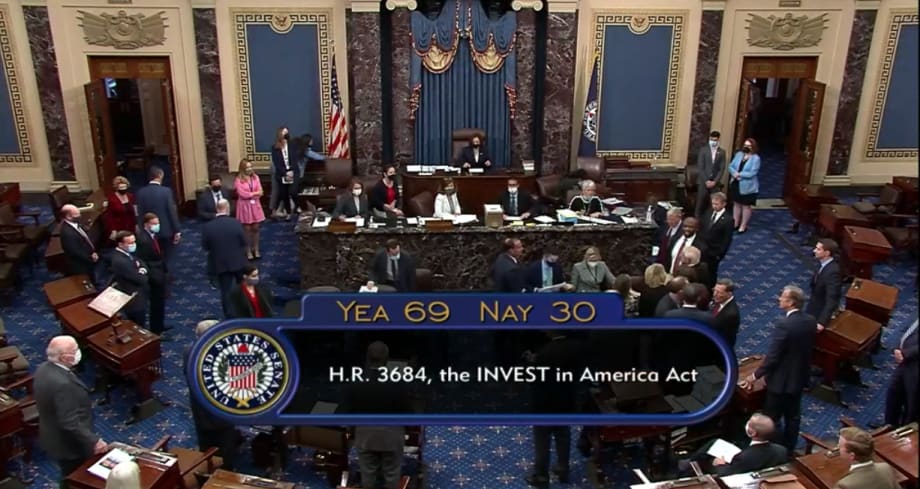
A bipartisan infrastructure bill passed the senate by 69-31.
Photo: C-Span screen capture
7 min to read
After months of negotiation, the U.S. Senate Aug. 10 passed a bipartisan, $1 trillion infrastructure bill, the Infrastructure Investment and Jobs Act of 2021. The legislation contains several measures related to trucking — and leaves out some that were previously considered.
The legislation reauthorizes spending on existing federal public-works programs and provides $550 billion in new spending. Of those new funds, $110 billion would go toward roads and bridges, $66 billion to rail and nearly $40 billion to transit. Some $65 billion is designated for improving the electrical grid and energy production, and nearly $50 billion for making infrastructure more resilient to cyberattacks and natural disasters. Approximately $7.5 billion is dedicated to building charging stations for electric vehicles.
Instead of raising the fuel tax or imposing new types of user fees, or Biden’s plan to raise corporate taxes to cover the cost, the money will come from repurposing Covid-19 funds, delaying a Trump-era rule on Medicare rebates, and auction sales of wireless-spectrum space.
The Congressional Budget Office, however, said it won’t be enough, and that the package would add $256 billion to the federal deficit in the next 10 years.
The legislation would "establish a program to test the feasibility of a road usage fee and other user-based alternative revenue mechanisms" — in other words, a vehicle-miles-traveled pilot program — "to help maintain the long-term solvency of the Highway Trust Fund."
What Happens Next?
Getting a final bill to President Biden’s desk, through the House of Representatives, will be anything but easy.
In the House, the fate of the bill is tied to a $3.5 trillion budget reconciliation package that includes many of the progressive priorities that didn’t make it into the Senate bill, such as climate change and housing. Politico.com notes that House Speaker Nancy Pelosi has said she won't bring the infrastructure bill to a floor vote until the Senate also passes the reconciliation bill.
The current transportation programs expire at the end of September. It’s quite possible lawmakers will have to pass another short-term extension.
Trucking Provisions in the Infrastructure Legislation
As is always the case with highway bills, there are also many non-infrastructure provisions affecting motor carriers. Here’s a look at some of them.
Women in the trucking workforce: The bill notes that while women make up 47% of the workforce in the U.S., they hold only 24% of transportation and warehousing jobs, 6.6% of truck drivers, 12.5% of all workers in truck transportation, and 8% of freight firm owners. It calls for the Federal Motor Carrier Safety Administration to set up a Women of Trucking Advisory Board.
Younger drivers: The legislation would set up an apprenticeship pilot program for commercial driver’s license holders under the age of 21 to operate in interstate commerce. It calls for specific probationary periods, for apprentices to be accompanied in the passenger seat by an experienced driver, and for the trucks driven by these apprentices to be equipped with an active braking collision mitigation system, automated or automatic transmission, forward-facing video event capture system, and a governed speed of 65 mph.
Leased owner-operators: The legislation calls for the DOT and the Labor Department to set up a Truck Leasing Task Force to take a close look at truck leasing arrangements between motor carriers and owner-operators, including lease-purchase agreements, and how those affect things such as vehicle maintenance, emissions from drayage vehicles at ports, driver compensation, etc.
Automatic emergency braking: The legislation directs the DOT to study and potentially mandate automatic emergency braking on new commercial motor vehicles.
Underride protection: The bill calls for strengthening rear trailer underride guard standards and for more research on side underride guards, as well as for the establishment of an Advisory Committee on Underride Protection.
Driver compensation: The Federal Motor Carrier Safety Administration is directed to work with the Transportation Research Board on a driver compensation study, looking at the impacts on various methods of compensation on safety and on driver retention.
Crash causation: It directs the Department of Transportation to carry out a comprehensive study on the causes of, and contributing factors to, crashes involving commercial vehicles.
Smart, Connected, Electric
Commercial motor vehicles are also included in a number of sections related to climate change, emissions, and new technologies.
For instance, the ‘‘Strengthening Mobility and Revolutionizing Transportation Grant Program,” (or SMART Program), which will provide grants for demonstration projects focused on advanced smart city or community technologies and systems, would include projects on connected vehicles, autonomous vehicles, smart grids, intelligent infrastructure, and data and solutions “supporting efficient goods movement.”
The bill sets up an Electric Vehicle Working Group, which would include, among many other stakeholders, representatives of the trucking industry and a manufacturer of medium- and heavy-duty vehicles or the relevant components of medium- and heavy-duty electric vehicles. That group is charged with digging into the barriers and opportunities to scaling up electric vehicle adoption throughout the United States.
There’s a section setting up grants for charging and fueling infrastructure, including electric, hydrogen, propane, and natural gas, along designated alternative fuel corridors. Medium- and heavy-duty vehicles are included, including along the National Highway Freight Network and near intermodal transfer stations.
Industry Reaction
American Trucking Associations: “For nearly three decades, our nation and industry have been held hostage by empty promises—all talk, no action. Today, the Senate put America ahead of itself,” said ATA President and CEO Chris Spear in a statement. “Passage of this bipartisan infrastructure bill is a groundbreaking step toward revitalizing America’s decaying roads and bridges, supporting our supply chain and economy with the foundation they need to grow, compete globally and lead the world. The bill also contains significant measures to grow and strengthen trucking’s essential workforce.”
International Foodservice Distributors Association: Mark S. Allen, IFDA president and CEO of the (IFDA), said in a statement, “Investing in America’s future is critical for the foodservice distribution industry, and modernizing our infrastructure for 21st-century commerce would help the supply chain more efficiently move goods and materials to America’s foodservice operators and restaurants across the country.”
IFDA singled out the pilot program for younger drivers, calling it “a good first step in helping to address our nation’s growing truck driver shortage.” An estimated 15,000+ driver positions are currently open in the foodservice distribution industry, according to an IFDA member survey released this summer.
Owner-Operator Independent Drivers Association: Todd Spencer, president and CEO of OOIDA, expressed frustration with lawmakers who “treat truckers as an afterthought.” OOIDA had pushed for an amendment that would have helped increase truck parking capacity, which did not make it into the final bill.
“Years of inaction on addressing the lack of truck parking has created a nationwide crisis that threatens the safety of millions of professional drivers, and increasingly the motoring public,” Spencer said. “The Senate has missed yet another opportunity to enact meaningful policies that would immediately improve drivers’ lives and highway safety.”
OOIDA was pleased, however, that the legislation did not include previously discussed measures to increase minimum insurance levels.
Women in Trucking: Ellen Voie, president and CEO of the Women In Trucking Association, praised the inclusion of the Women of Trucking Advisory Board, which it has advocated for. “The inclusion of this legislation in the larger infrastructure bill is a significant step toward not only growing the number of women in the industry, but also helping ensure they are able to grow within it.”
“We have long worked with leaders on both sides of the aisle to promote gender diversity in the trucking industry and are thankful to the members of Congress and their staffs who have listened to the needs of women in the industry.”
Transportation Intermediaries Association: TIA applauded the bill and noted that there are three provisions it's especially pleased with. First, a provision that clarifies the role of a dispatch service in the supply chain. Second, language which asks for a full review of the Federal Motor Carrier Safety Administration National Consumer Complaint Database and the subsequent action taken by the federal government. Included in this review is a mandate to include brokers in the process.
And it praised the apprenticeship pilot program for under 21-year-old drivers to help increase the carrier selection pool. "This is a huge issue in the supply chain as the driver shortage continues to hamper transportation," the association said in a statement.
More Fleet Management

Sponsored•September 16, 2026
Color Match Smarter: Tools That Restore & Perform
For fleet managers and collision repair professionals keeping heavy-duty trucks on the road, getting the color right the first time isn't just about appearance — it's about efficiency, turnaround time, and bottom-line results. Discover how today's digital color tools are transforming the repair process from guesswork to precision.
Read More →
FMCSA Pauses Biennial-Update Enforcement Amid Motus Transition
Carriers whose updates were due on or after June 1 have more time, while FMCSA works to stabilize its new registration system and warns of phishing sites impersonating its new carrier registration system, Motus.
Read More →
Sponsored•September 14, 2026
2026 Blueprint for Countering Smarter Supply Chain Theft
Cargo theft is no longer just the cost of doing business. It's a multi-billion-dollar criminal enterprise exploiting vulnerabilities across your fleet, drivers, and supply chain.
Read More →


Sponsored•September 1, 2026
How Telematics Improves Visibility, Control, and Performance in Refrigerated Fleets
Explore how telematics help refrigerated fleets improve visibility, uptime, efficiency, compliance, and cargo protection across connected cold chain operations.
Read More →
What the U.S.-Canada Trade War Means for Trucking
Escalating U.S.-Canada tariffs could disrupt cross-border freight, reduce truck volumes, raise costs, and create new uncertainty for carriers on both sides of the border.
Read More →
What Are Trucking’s Top Concerns for 2026?
The American Transportation Research Institute wants to know what's worrying trucking fleet managers, drivers, and other stakeholders in its annual Industry Issues survey.
Read More →
American Trucking Associations Looks for a New Leader
ATA President and CEO Chris Spear abruptly left his job at the association on August 21, at a pivotal time for the trucking industry.
Read More →
Public Wi-Fi Cybersecurity Risks: How Truck Drivers and Fleets Can Protect Their Data
Public Wi-Fi can expose truck drivers and fleets to credential theft, malware, and other cyber threats. Here’s how to reduce the risk on the road.
Read More →
For Nicky Cupp, Fleet Innovation Starts With Frustration
HDT Truck Fleet Innovator Nicky Cupp turns everyday pain points at Fraley & Schilling into opportunities for better technology and smarter processes.
Read More →
Adam Buttgenbach’s Approach to Electric Trucks: Start With Where They Fit
HDT Truck Fleet Innovator Adam Buttgenbach helped PepsiCo build one of North America’s largest EV fleets by focusing on where electric trucks make operational sense.
Read More →